To deeply study and implement the spirit of the Fourth Plenary Session of the 20th Central Committee of the Party and to continuously promote the in-depth development of campus integrity culture, on November 18, Southern University of Science and Technology (SUSTech) held the special forum “Academicians Talk About Integrity.” This was the twelfth session of the university’s integrity forum. The forum was hosted by the Discipline Inspection Commission, the Office of the Supervisory Commissioner, and the Institute of Integrity at SUSTech, with assistance from the Student Work Department of the Party Committee.
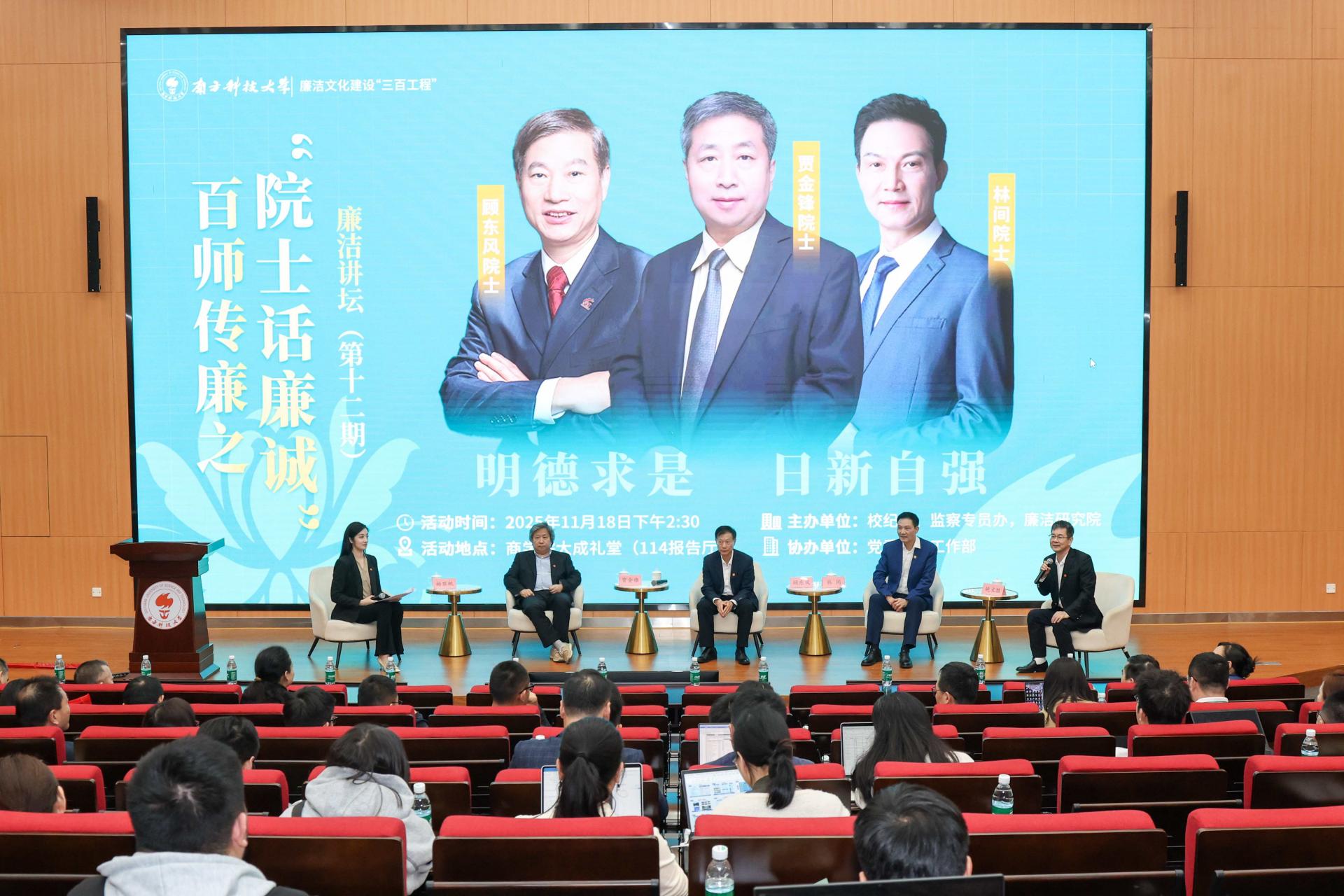
The event featured special guests, including Jinfeng JIA, an academician of the Chinese Academy of Sciences; Dongfeng GU, a chair professor at the School of Medicine of SUSTech; and Jian LIN, an academician of the European Academy of Sciences, dean of the SUSTech Institute for Advanced Ocean Studies, and chair professor of the Department of Ocean Science and Engineering, who shared their insights. Professor Wensheng YAO, director of SUSTech’s Institute for Integrity, served as the discussant. Together, they shared with students and faculty their understanding of integrity and honesty, shared personal experiences, and offered practical advice. The audience included not only representatives from SUSTech’s faculty and students, SUSTech High School, and Bao’an School, but also leaders, officials, and party members from Shenzhen United Assets and Equity Exchange Co., Ltd. The talks combined theoretical depth with real-life stories, bringing the abstract concept of integrity to life for everyone there.
Academician Jinfeng JIA pointed out that the reproducibility of scientific research results is the key measure of quality, while integrity precisely forms the foundation of scientific work. Drawing on his own research experience, he advised young students that integrity determines scientific reputation and also influences the formation of team culture. He also discussed the importance of managing research funds, stating that ‘with integrity in mind, actions will naturally be honest.’ He believes that both a sound system and adherence to values are indispensable. He emphasized that integrity falls within the realm of morality and requires continuous education to guide people, ensuring that those who uphold integrity gain long-term benefits; honesty, on the other hand, is closely related to systems and laws and should be ensured through a robust regulatory framework that eliminates policy gray areas. He stressed that many risks to honesty stem from ambiguous rules, and only by making regulations clearer and enforcement more thorough can legal norms truly take root.
Academician Dongfeng GU pointed out that in the frontlines of medical care and scientific research, the construction of a culture of integrity should prioritize education, while also relying on a sound institutional framework. In response to questions about “requirements for honesty and integrity for laboratory graduate students and research assistants,” Academician GU shared specific practices. He stated that students must first take courses on rules and regulations before entering the laboratory to ensure safety and integrity. Using simple language, he shared his life insights: ‘Only by doing no dishonest deeds can one sleep peacefully; having enough money to meet needs is sufficient, and the value of papers lies in their authenticity.’ At the same time, he emphasized that the family is the first classroom for teaching integrity, and that parents, schools, and the community should work together to create a positive atmosphere, passing down the traditional virtues of honesty and trustworthiness from generation to generation.
Professor Wensheng YAO mentioned that the Fourth Plenary Session of the 20th Central Committee of the Party, driven by the spirit of self-revolution, promotes the comprehensive and strict governance of the Party, providing important guidance for building integrity within schools. Integrity is the cornerstone of school development and the lifeline of education, and it also concerns personal character cultivation and life achievements. Integrity is the basic principle of being human. Currently, SUSTech is taking the implementation of the plenary session’s spirit as an opportunity to fully integrate the construction of an integrity culture into all aspects of running and managing the school, providing support for the construction of “Double First-Class” universities and the implementation of the “3-3-5” strategy. Teachers and students should start by adhering to the bottom line of research integrity, safeguarding their original intention of integrity, consciously internalizing the awareness of honesty and externally manifesting it in actions, living upright lives, and conducting affairs in a straightforward manner. They must resolutely resist erroneous ideologies and unhealthy trends, establish correct values, and make honesty a habit and a way of life. At the same time, it is necessary to continuously strengthen the cultivation of integrity awareness, the forging of self-discipline, and the creation of an integrity culture, achieving long-term effects gradually and steadily, and promoting a campus environment that values integrity, advocates cleanliness, and maintains a positive and upright atmosphere.
Finally, Professor Wensheng YAO presented the speaker certificates to the three academicians. At the same time as the forum, the first floor of the Business School at SUSTech held a calligraphy and painting exhibition themed on integrity culture. Teachers and students who attended the forum expressed that they learned a lot from the experience.
Proofread ByYuwen Zeng
Photo By