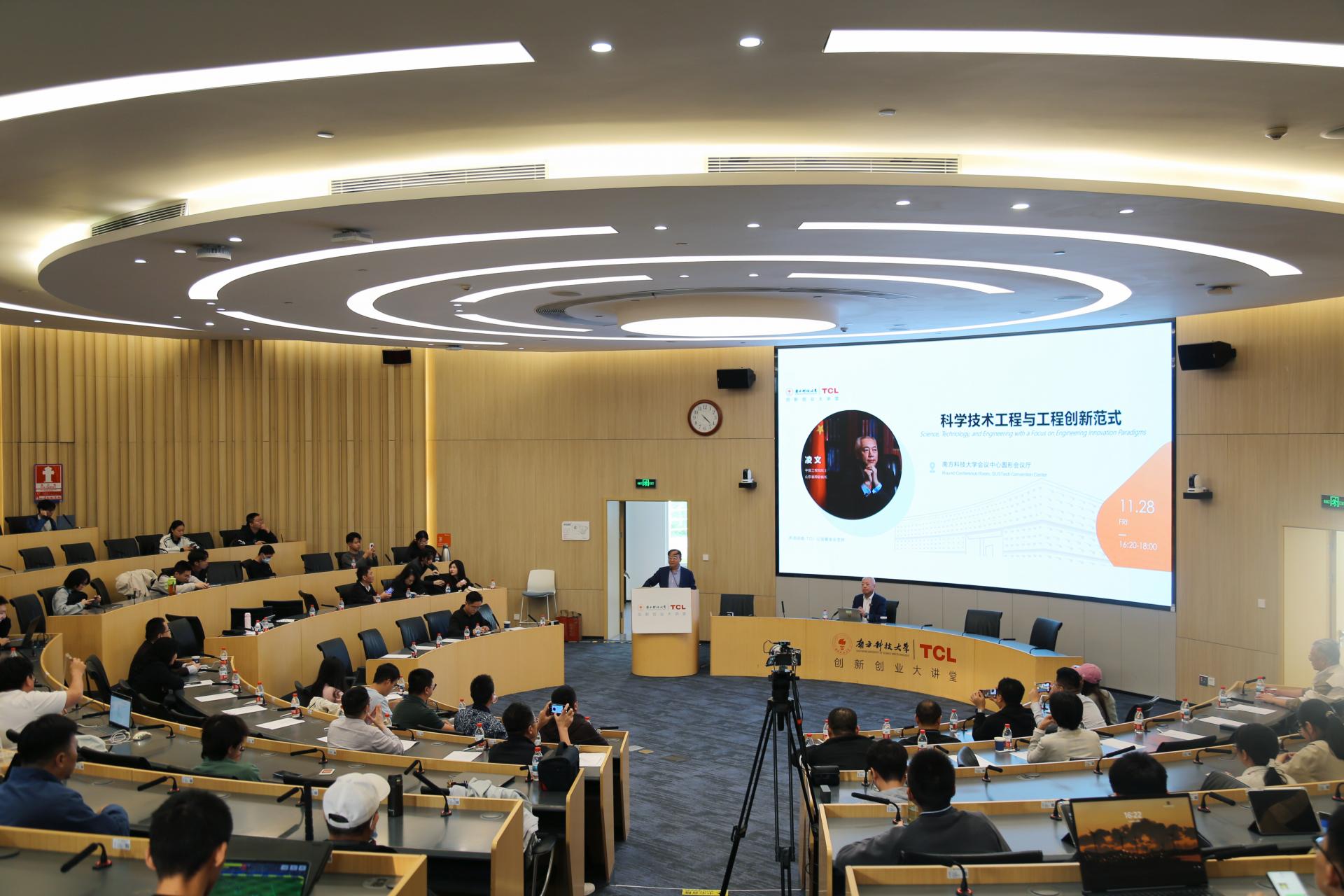
On November 28, 2025, at the invitation of Ke LIU, Dean of the School of Innovation and Entrepreneurship at Southern University of Science and Technology (SUSTech), Wen LING, Academician of the Chinese Academy of Engineering and Chairman of Shandong Association for Science and Technology, delivered a lecture at the SUSTech-TCL Innovation and Entrepreneurship Lectures. He gave a lecture titled “Science, Technology, and Engineering with a Focus on Engineering Innovation Paradigms,” systematically explaining the theoretical foundations and innovation logic of engineering practice in China.
Wen LING is an expert in systems engineering and energy engineering management in China, who has long been dedicated to applying systems engineering theories to solve management challenges in large-scale energy projects. He has led more than ten major research projects on coal-based energy engineering, and his research outcomes have been widely applied in Shenhua Group and the coal industry, comprehensively enhancing the coordinated development of Shenhua’s entire industrial chain, including coal, power, rail, port, shipping, and chemical sectors. He has received multiple awards, including the State Scientific and Technological Progress Award, the Gold Prize of the China Excellent Industrial Design Award, and the National Award for Outstanding Contribution to Industry-Academia-Research Cooperation. He has also been honored as a National Model Worker.
At the beginning of the lecture, Wen LING introduced the basic concepts of science, technology, and engineering. With the development of society, the complexity of engineering has increased sharply, and engineering science has become an independent field of study.
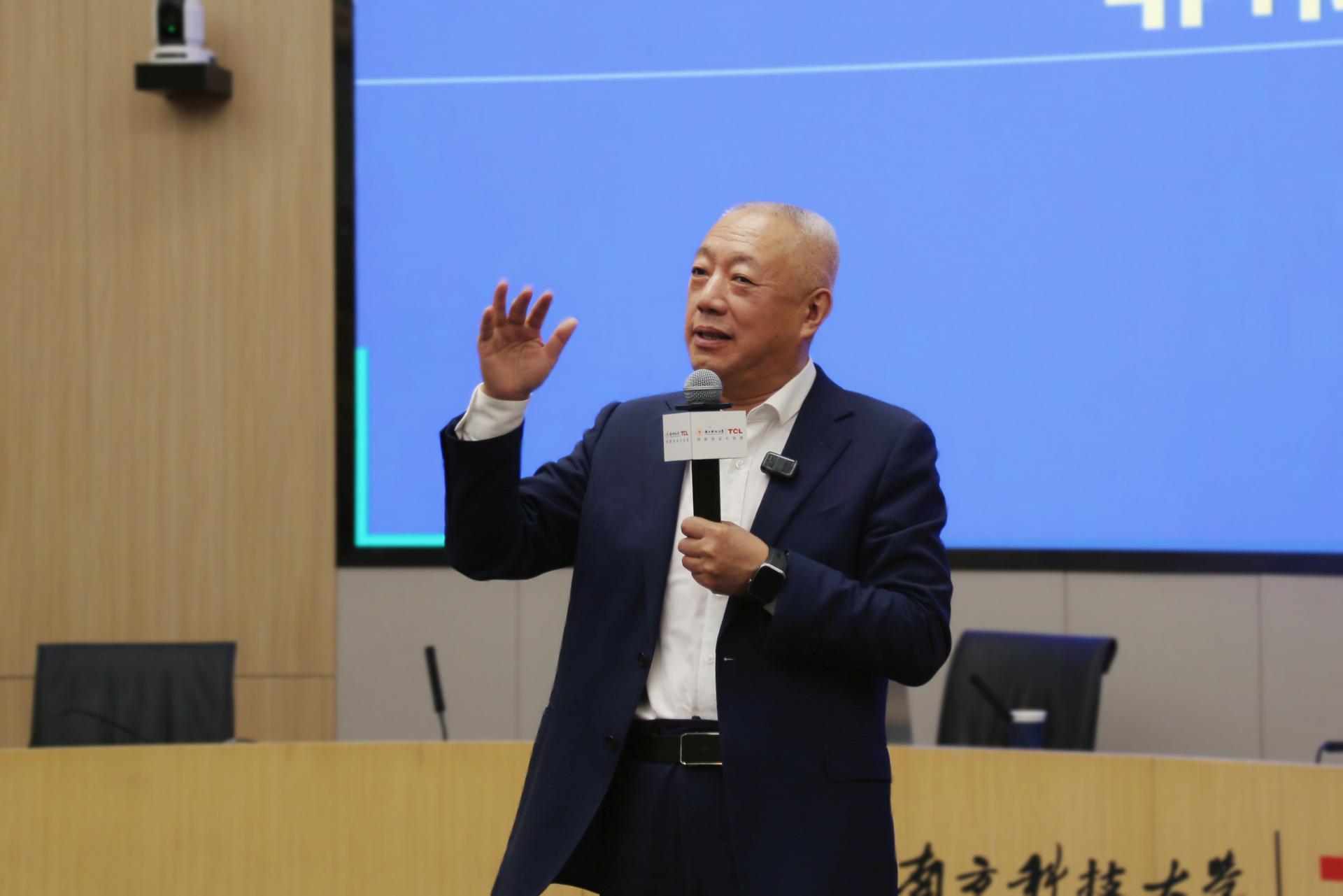
Wen LING emphasized that the three are both mutually independent and closely interconnected: science explores truth, technology creates methods, and engineering implements construction. He reviewed the process by which Xuesen QIAN first systematically proposed the concept of “engineering science,” and cited the famous saying of aerospace engineer Theodore von Kármán, “Scientists discover the world that exists; engineers create the world that does not,” vividly summarizing the core value of engineering. Using artificial intelligence-generated content (AIGC) as an example, Wen LING clearly demonstrated the complete innovation chain from the basic scientific discovery of biological neural networks, to the technological invention of artificial neural network models, and then to the large-scale engineering application of language models, thereby confirming the progressive and mutually reinforcing logical relationship between science, technology, and engineering.
Based on an in-depth analysis of the relationship among the three, Wen LING focuses on elaborating the tremendous achievements of China’s engineering practice and the innovative paradigm shifts behind them. He believes that China’s engineering has already taken the lead in certain fields and is beginning to form an engineering innovation paradigm with Chinese characteristics.
Through specific examples such as the HarmonyOS operating system and high-end communication devices, Wen LING analyzed four insights that China’s engineering innovation paradigm brings us: first, original innovation and engineering innovation should be equally emphasized; second, engineering innovation is key to coping with external technology blockades; third, overall leadership can be achieved through systems engineering; and fourth, a new type of innovation ecosystem and governance system should be established. Ling Wen also mentioned that China, for the first time globally, recognized the ‘National Engineer Award’ as a national honor, which fully reflects the country’s high regard for engineering innovation and the engineering workforce.
When discussing the development of China’s manufacturing industry, Wen LING analyzed the strategic significance of “Made in China 2025.” Leveraging a complete industrial system and the advantages of market scale, China has achieved remarkable accomplishments in the manufacturing sector. He cited international assessment reports indicating that the strategy has yielded significant results in several key areas, such as new energy vehicles and high-speed rail, but efforts are still needed in fields like semiconductors and new materials. Drawing on his own experiences, Wen LING thoroughly examined lessons from the manufacturing decline in some developed countries, noting that excessive financialization and industrial hollowing-out are important reasons. He thus emphasized that we must firmly uphold the real economy as the foundation, and no financial innovation or digital technology should deviate from a solid manufacturing base. He pointed out that having a complete industrial supply chain is a key source of China’s confidence in international competition.
Finally, Wen LING expanded his perspective to global sustainable development. He provided a detailed explanation of the “1-3-3” implementation path centered on emission reductions across the entire economy, including hard targets such as economy-wide carbon reduction, increasing the share of non-fossil energy, and expanding clean energy capacity, as well as softer tasks like promoting new energy vehicles and developing carbon market mechanisms. He pointed out that the concept of Environmental, Social, and Governance (ESG) is moving from voluntary disclosure toward deep governance, and a company’s carbon management capabilities will directly affect its future core competitiveness. Wen LING believes that companies must establish an integrated system of carbon accounting, carbon asset management, and commercialization of green technologies in order to gain a competitive edge in the green and low-carbon transition.
At the end of the lecture, Wen LING encouraged students of SUSTech as well as innovators and entrepreneurs to deeply understand the inherent laws of technological and engineering development, and to boldly explore interdisciplinary and cross-field integrated innovations. He emphasized that in the face of complex international situations and global challenges, one must maintain confidence, apply systems engineering thinking, actively build an open and collaborative innovation ecosystem, and firmly root the practice of innovation and entrepreneurship in national strategic needs and the development of the real economy, contributing wisdom to achieving high-level technological self-reliance and sustainable economic and social development.
Proofread ByRong XIA
Photo ByQixiang WU