Professor Zongxiang XU, from the Department of Chemistry at Southern University of Science and Technology (SUSTech), along with his collaborators, has achieved new progress in the research and development of key materials for perovskite photovoltaics. Related academic papers have been published in the high-impact journals Advanced Energy Materials and Joule, which are leading publications in the fields of materials science and energy.
PTAA (Poly [bis (4-phenyl) (2,4,6-trimethylphenyl)amine]), owing to its excellent thermal stability and significant advantages in achieving high efficiency and long-term device stability, has become one of the most widely used hole transport materials (HTMs) in n-i-p structured perovskite solar cells (PSCs). However, the power conversion efficiency (PCE) of currently reported PTAA-based n-i-p PSCs has yet to surpass the 25% benchmark. Compared to devices using Spiro-OMeTAD, PTAA-based devices exhibit comparable short-circuit current density (JSC) and fill factor (FF), but their open-circuit voltage (VOC) is notably lower.
In PSCs, a high defect density in the bulk or on the surface of the perovskite layer, energy level mismatch, and poor interfacial contact with the charge transport layers (CTLs) can all lead to trap-assisted recombination of minority carriers at the perovskite/CTL interface. This non-radiative recombination process significantly reduces the number of effective photogenerated carriers, thereby causing a decrease in VOC. As a result, interface modification and additive engineering are regarded as effective strategies to address these issues. These approaches can not only align energy levels and reduce defect state density but also substantially improve the interfacial contact between the perovskite and CTLs, ultimately enhancing the overall performance of the device.
To address these challenges, the research team led by Zongxiang XU, built upon their previously developed passivating agent QAPyBF4 (Angew. Chem. Int. Ed., 2022, 134, e202117303; Journal of Energy Chemistry, 2023, 85, 39) and successfully developed a novel conjugated ionic additive of MeQAPyBF4 by modifying the structure of its conjugated cation.
The cationic portion of this additive features a methyl-substituted π-conjugated structure, which not only enhances the π–π interactions among QA-like cations but also promotes their preferential accumulation at the interfaces and grain boundaries of the perovskite film. Through this targeted distribution, MeQAPyBF4 effectively regulates energy level alignment, passivates defects within the film, enhances hole extraction and transport efficiency, and significantly reduces charge accumulation at the interfaces. At the same time, the anionic portion of the additive tends to aggregate at the buried interface between the perovskite and SnO2, a critical region where it plays a vital role in passivating interfacial defects and improving interfacial contact quality. This facilitates the growth of high-quality perovskite films by optimizing the interfacial environment.
Thanks to this optimized interface engineering strategy, n-i-p structured devices using PTAA as the HTM achieved a remarkable PCE of 26.17%, with an impressive VOC of 1.195 V, demonstrating outstanding energy output characteristics. Moreover, a small-area module with an aperture area of 15.17 cm2 attained a peak PCE of 23.57%, indicating that this strategy is also highly applicable to large-area devices. More importantly, these devices exhibited excellent long-term stability: After being stored in a nitrogen atmosphere for 1,944 hours, they retained 85% of their initial efficiency.
Under continuous maximum power point tracking (MPPT) at 1 sun for 940 hours, the efficiency remained at 80%; Even after 140 hours of MPPT testing at 85°C under 1 sun, the devices still maintained 90% of their original efficiency (Figure 1).
These results convincingly demonstrate that the devices exhibit outstanding thermal and operational stability, laying a solid foundation for their practical application. Notably, this newly developed passivating agent has already been industrially supplied by Shenzhen Mole New Energy Technology Co., Ltd., marking an important step toward commercialization.
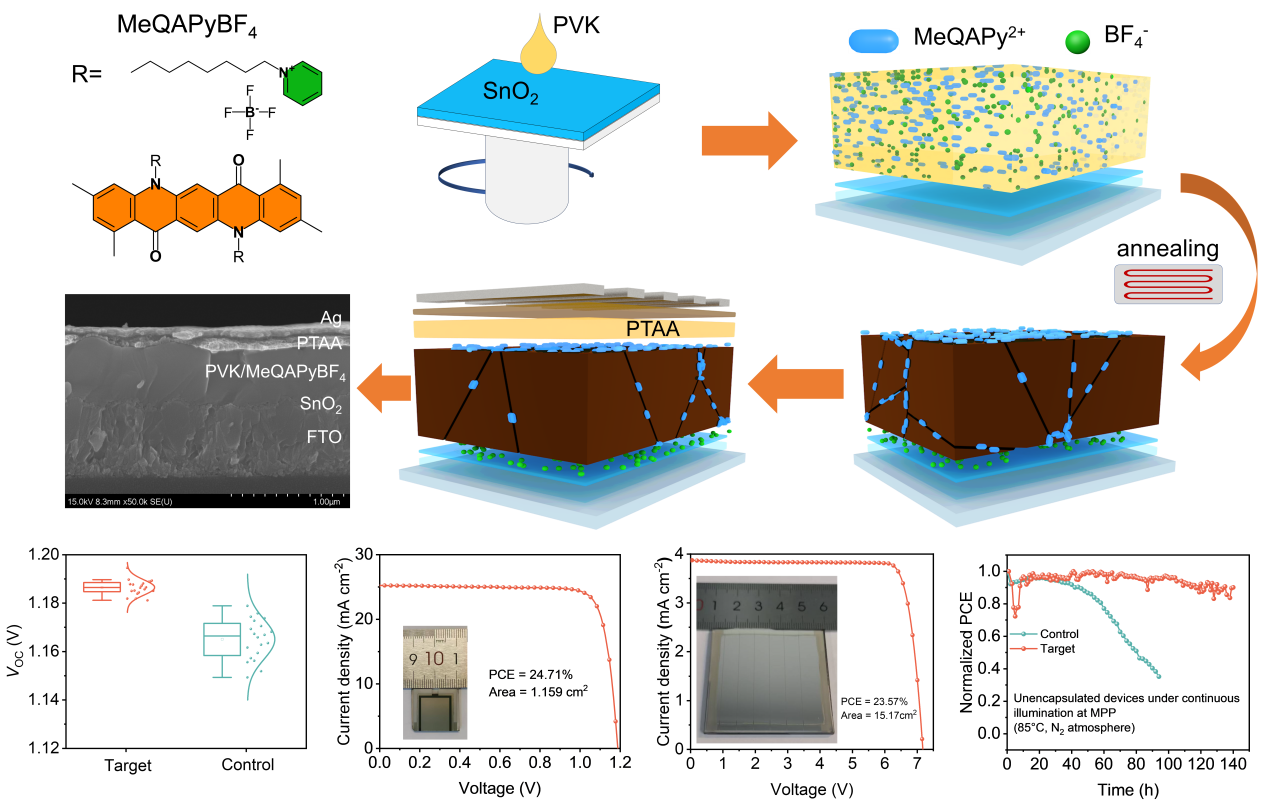
Figure 1. Molecular structure of MeQAPyBF4 and the structure and performance of perovskite photovoltaic devices.
The research findings entitled “Synergistic Bulk and Interface Passivation via Conjugated Ionic Additives Enables 26% Efficient PTAA-Based Perovskite Solar Cells” were published in Advanced Energy Materials. Yuanjia DING, a Ph.D. student at SUSTech, and Letian ZHANG, a master’s student at SUSTech, are co-first authors of the paper. The co-corresponding authors include Geping QU, a visiting scholar at SUSTech, and Professor Zongxiang XU from SUSTech.
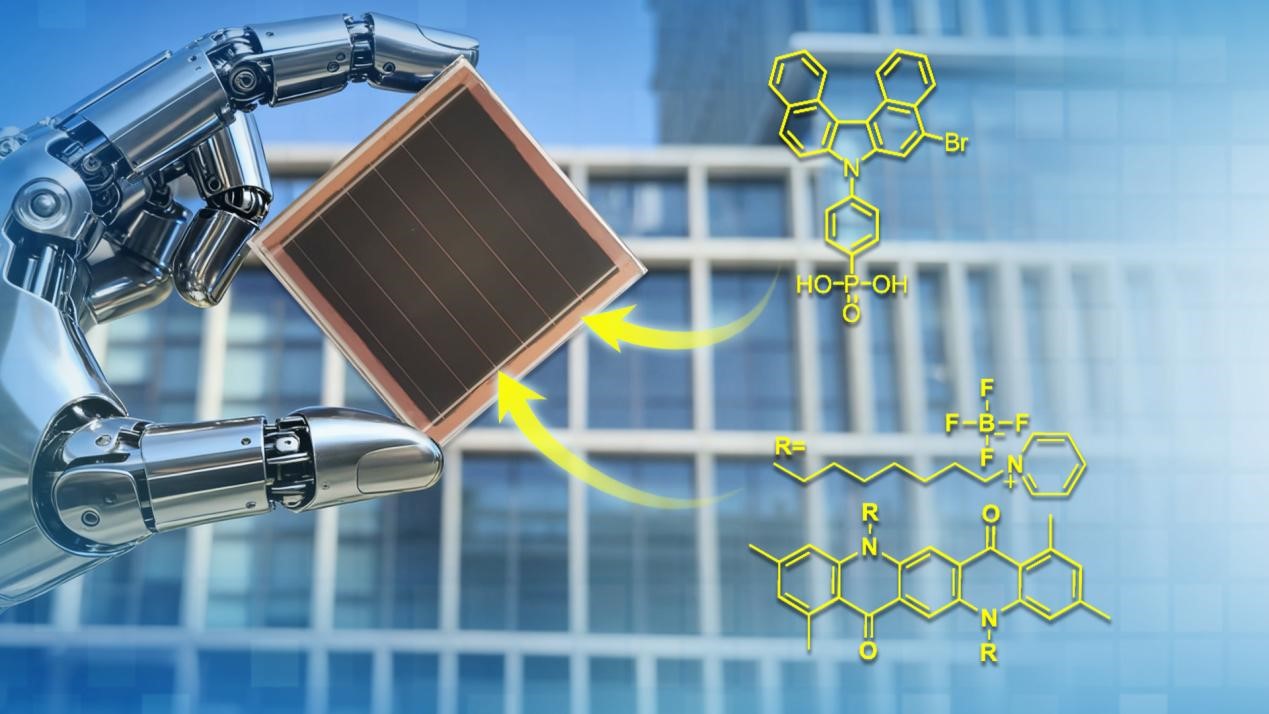
State-of-the-art perovskite/silicon tandem solar cells rely on alkyl-chain-based self-assembled molecules (SAMs) as hole-selective contacts in p-i-n structured perovskite top cells. However, these SAMs tend to aggregate into multilayered stacks on micrometer-scale pyramidal textured silicon interfaces, introducing charge transport losses and degrading device performance. To address this, Professor Zongxiang XU’s research group and collaborators synthesized a conjugated linker-based SAM, (4-(7H-dibenzo[c,g]carbazol-7-yl)phenyl)phosphonic acid (Bz-PhpPACz), and compared it with its alkyl-chain counterpart, (4-(7H-dibenzo[c,g]carbazol-7-yl)butyl)phosphonic acid (4PADCB). Surprisingly, the incorporation of Bz-PhpPACz led to reduced tandem cell performance. Chemical analysis revealed that commercially sourced 4PADCB contains a bromine-substituted impurity, which introduces interfacial passivation and enhances hole transport. By separately synthesizing bromine-substituted Bz-PhpPACz (namely, Bz-PhpPABrCz) and blending it with Bz-PhpPACz in controlled ratios, researchers demonstrate that combining conjugated linkers with bromine substitution synergistically improves tandem cells’ efficiency. The optimized SAMs enable perovskite/silicon tandem cells fabricated on Czochralski (CZ)-grown silicon bottom cells with a power conversion efficiency of 31.4%, marking a significant advancement in molecular interface engineering for commercially viable c-Si-based tandem photovoltaics (Figure 2). This work highlights the critical role of molecular design and impurity engineering in overcoming interfacial challenges in perovskite solar cells. The related novel SAM materials have been filed for a Chinese invention patent and are now industrially supplied by Shenzhen Mole New Energy Technology Co., Ltd.
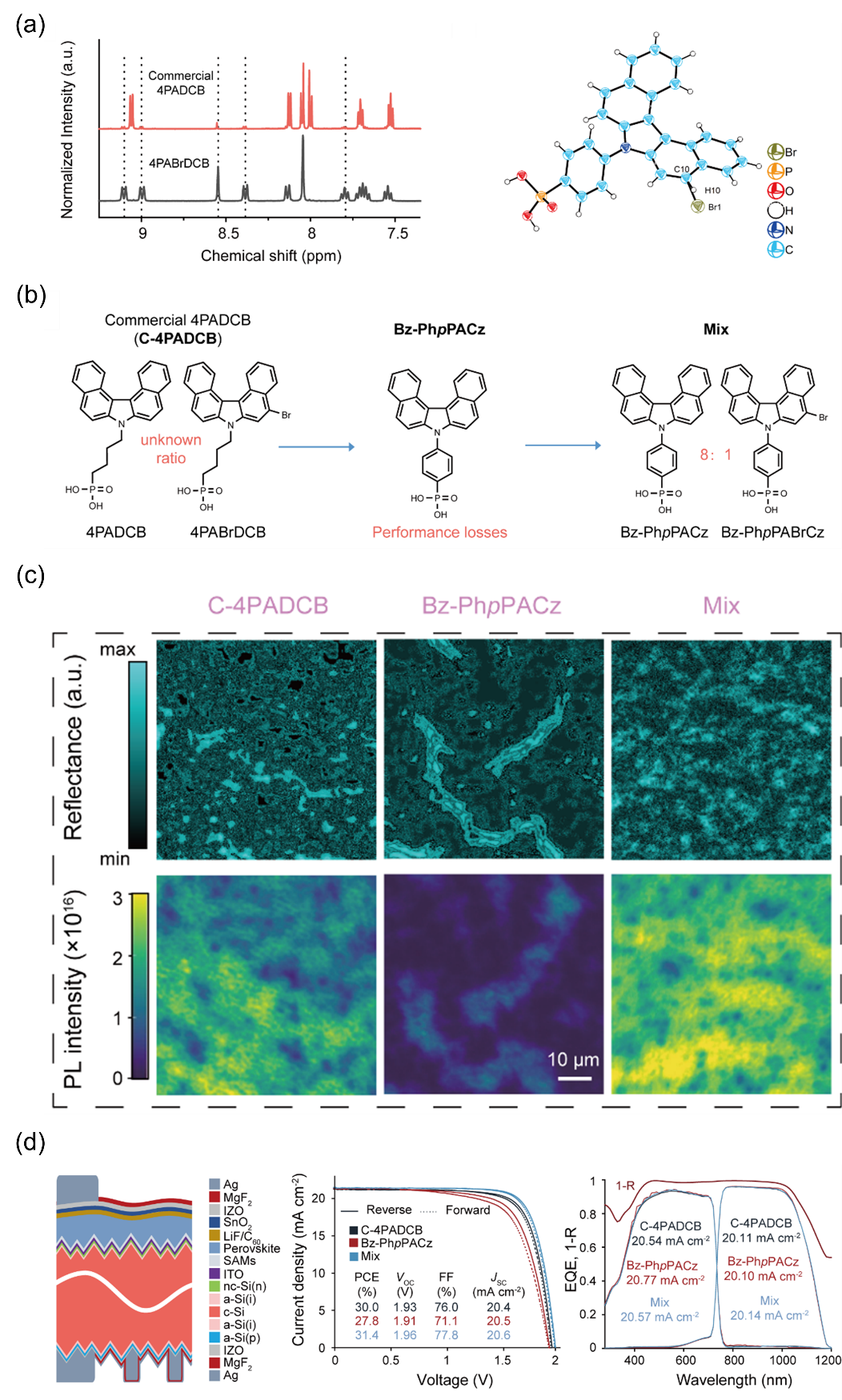 Figure 2. Bromine-substituted SAM molecular design and perovskite/silicon tandem device performance
The related research results, entitled “Enhanced Charge Extraction in Textured Perovskite-Silicon Tandem Solar Cells via Molecular Contact Functionalization,” have been published in Joule.
Jian HUANG, Ph.D. student of Ludwig-Maximilians-Universität München, and Letian ZHANG, MS student of SUSTech, are the co-first authors of this paper. The corresponding authors included Dr. Geping QU from City University of Hong Kong, Dr. Erkan Aydin from Ludwig-Maximilians-Universität München, and Prof. Zongxiang XU from SUSTech.
Advanced Energy Materials: https://doi.org/10.1002/aenm.202504647
Joule:https://doi.org/10.1016/j.joule.2025.102227
Proofread ByNoah Crockett, Yilin ZHOU
Photo By