A collaborative team led by Professor Yang-Gang WANG from the Department of Chemistry at Southern University of Science and Technology (SUSTech), together with Academician Tao ZHAO, Professor Yanqiang HUANG, and Professor Wei LIU from the Dalian Institute of Chemical Physics (DICP), Chinese Academy of Sciences, has, for the first time, revealed the complete pathway of oxygen spillover during catalytic processes at the atomic scale, discovering a novel oxygen migration mechanism governed by the metal-support interface. The related findings have been published in Nature.
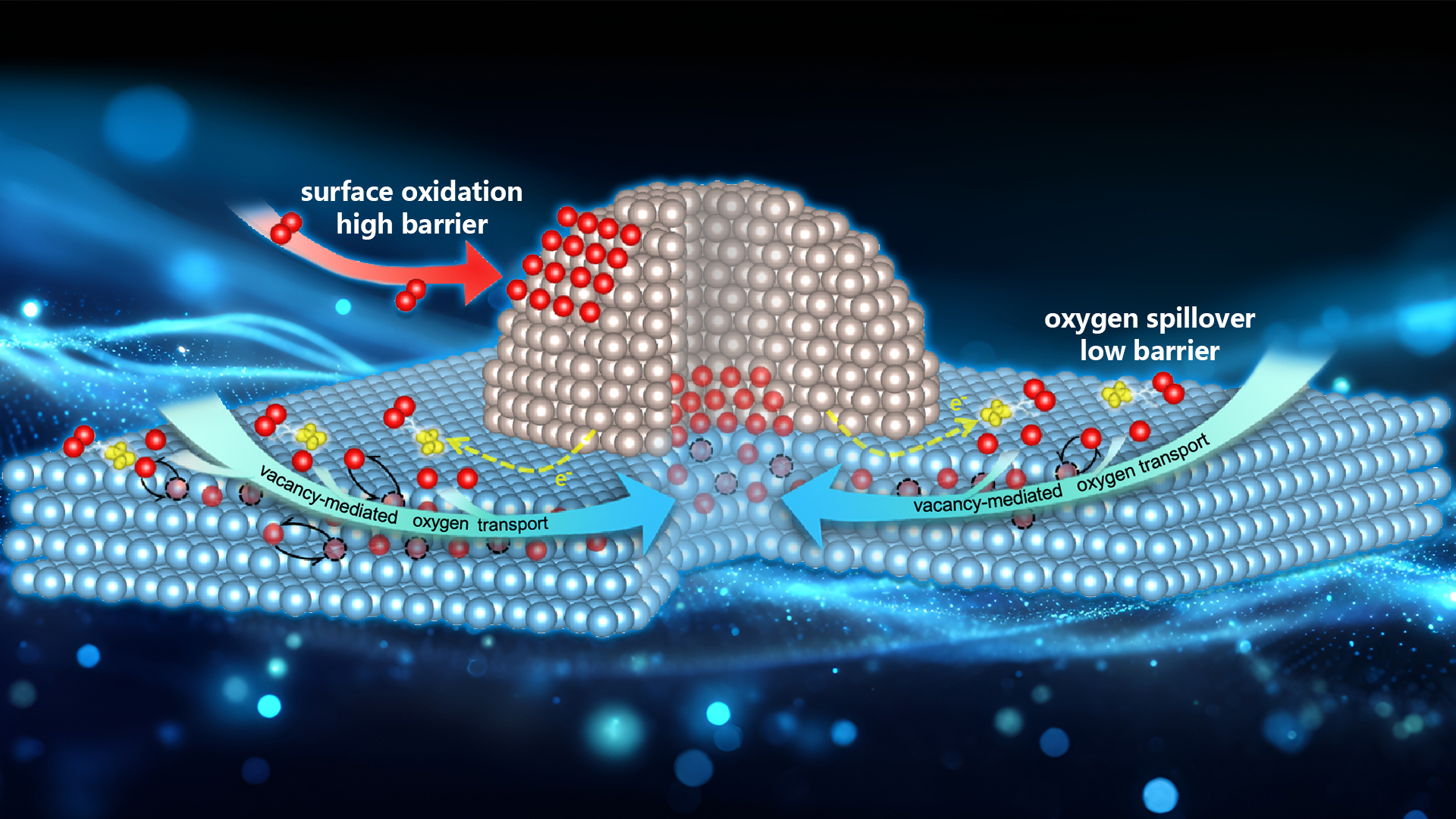
In catalytic reactions, the “spillover” phenomenon refers to the migration of active species between metals and supports, playing a critical role particularly in reactions involving hydrogen and oxygen. For a long time, the scientific community generally believed that spillover primarily occurs on the catalyst surface. However, due to the immense difficulty of directly tracking atomic-scale migration behaviors, the complete spillover pathway has remained a mystery.
In this work, the collaborative team successfully tracked the oxygen spillover process on a Ru/TiO₂ model catalyst using in-situ environmental transmission electron microscopy. Unexpectedly, oxygen did not migrate along the catalyst surface. Instead, it traveled from several atomic layers beneath the surface of the rutile TiO₂ support, passed through the “buried interface” between the metal and the oxide, and directly entered the ruthenium particles. Experiments observed that during the oxidation process, the TiO₂ lattice underwent reversible compression beneath the interface, forming temporary atomic channels. This structural “self-adaptive” capability proved to be essential for oxygen spillover. Further theoretical calculations revealed the driving force of this process: driven by chemical potential, oxygen enters the TiO₂ lattice from the gas phase, subsequently diffuses through the bulk, and transports across the Ru/TiO₂ interface to the Ru particles. The calculations showed that the oxygen chemical potential exhibits relatively low values in oxygen vacancies and at the interfacial region, acting like “low-lying areas” that attract oxygen to preferentially enter these sites. This reveals an “oxygen-vacancy-mediated” oxygen transport mechanism: oxygen vacancies migrate from the interface to the TiO₂ surface, promoting oxygen activation, while new vacancies are continuously generated and replenished, forming a self-sustaining oxygen spillover cycle.
This oxygen spillover mechanism was validated in reactions such as carbon monoxide oxidation and nitrous oxide decomposition. Similar phenomena were also observed in other catalyst systems, including Ru/SnO₂ and Ir/TiO₂, suggesting a degree of universality for this mechanism in supported metal catalysts with well-matched interfaces. This discovery reshapes the conventional understanding of the spillover mechanism, revealing that the metal-support interface in catalysis is not merely a passive anchoring site but can actively participate in the transport of active species, offering new insights for the design of efficient catalysts.
Dr. Weijue WANG from the DICP and Hongbin XU, a 2025 Ph.D. candidate at SUSTech, are the co-first authors of the paper. Professor WANG from SUSTech, along with Academician Tao ZHAO, Professor Yanqiang HUANG, and Professor Wei LIU from DICP, are the co-corresponding authors. SUSTech is the corresponding affiliation of the paper.
Paper Link: https://doi.org/10.1038/s41586-026-10324-x
Proofread ByNoah Crockett, Junxi KE
Photo ByYan QIU