A collaborative research team led by SUSTech has made an advancement in the field of ambient-pressure nickelate high-temperature superconductivity. The team of Qikun XUE and Zhuoyu CHEN from the State Key Laboratory of Quantum Functional Materials and the Department of Physics at Southern University of Science and Technology (SUSTech), the Quantum Science Center of Guangdong-Hong Kong-Macao Greater Bay Area (QSC-GBA), and Tsinghua University, in collaboration with the Dawei SHEN team from the University of Science and Technology of China (USTC) and others, published their latest research results in Nature on April 8, 2026. By artificially designing atomic stacking sequences under extreme oxidative conditions, they created two new ambient-pressure high-temperature nickelate superconductors. Simultaneously, utilizing Angle-Resolved Photoemission Spectroscopy (ARPES), the research team identified the electronic band features corresponding to the superconducting state, providing experimental evidence for understanding the mechanisms of nickelate superconductivity.
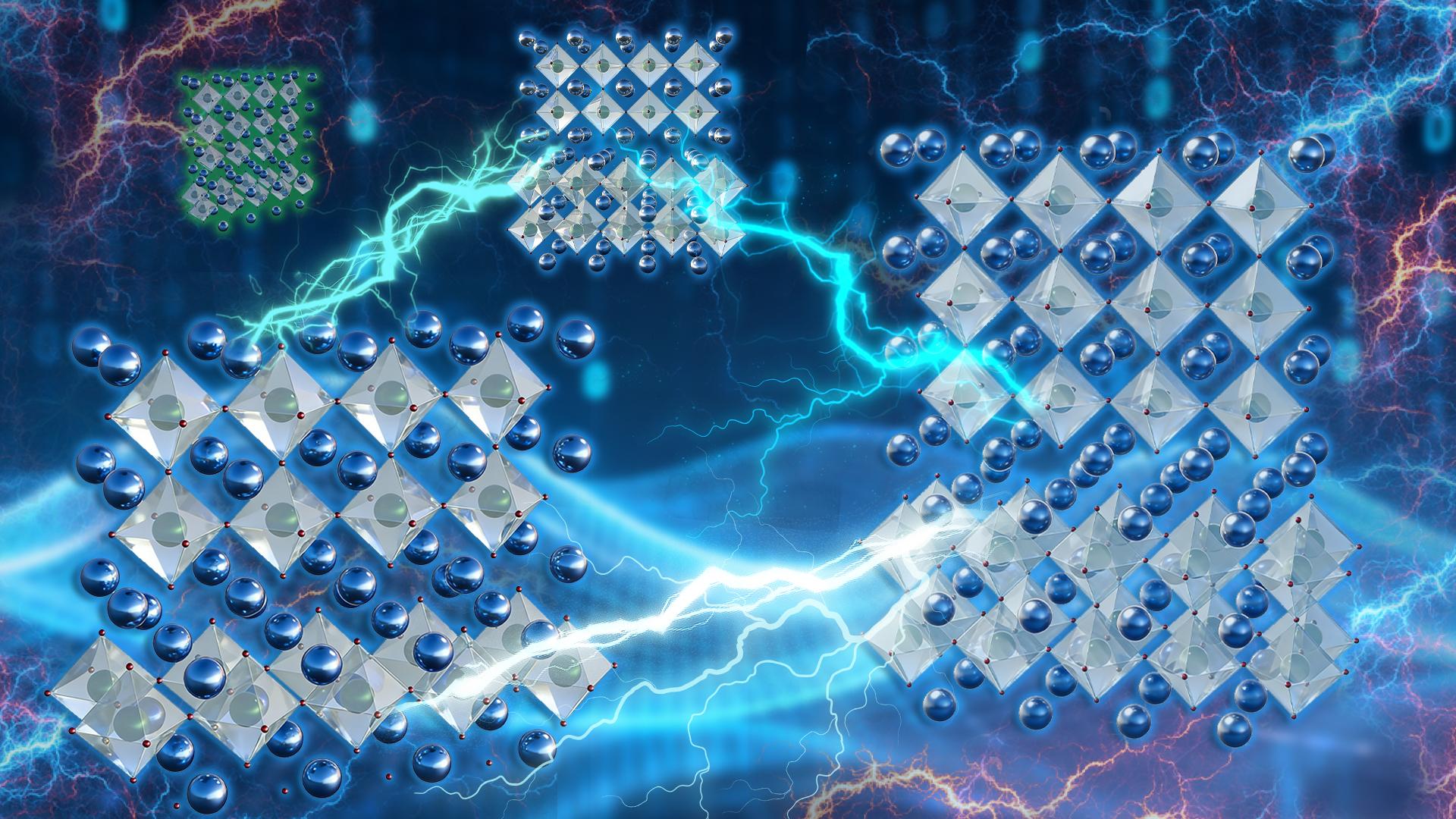
This work builds upon the team’s earlier study on ambient-pressure nickelate high-temperature superconductivity (published in Nature in 2025). Recently, they have enhanced the onset transition temperature to around 60 K (published in National Science Review in 2026). From the realization of ambient-pressure nickelate superconductivity, to the improvement of superconducting performance, and to the artificial creation of new superconducting materials and the revelation of their electronic structure origin, this series of studies demonstrates the unique capacity of “Gigantic-Oxidative Atomic-layer-by-layer Epitaxy” (GAE, published in National Science Review in 2025) thin film growth technique.
Like “Building with LEGO Blocks,” Designing and Constructing Novel Superconductors at the Atomic Level
High-temperature superconductivity remains an important topic in condensed matter physics. Following cuprates and iron-based superconductors, nickelates are considered another candidate system for exploring their underlying mechanisms. However, the synthesis of nickelates faces a key challenge: the high oxidation state required for superconductivity is difficult to reconcile with stable crystal growth. This is analogous to firing both the porcelain body and the glaze simultaneously. While the body requires a mild and stable environment to take shape, the glaze needs intense heat and strong oxidation to develop its color. These two requirements are not easily satisfied at the same time using conventional methods.
The “Gigantic-Oxidative Atomic-layer-by-layer Epitaxy” (GAE) technology developed by the research team provides a way to address this challenge. By creating a powerful oxidizing environment, the technique opens a highly non-equilibrium growth window, allowing the film to achieve both structural formation and oxidation in a single step during film growth. This is like building “atomic blocks” layer by layer in the nano world, while controlling their chemical states in real time. Using this approach, atoms such as lanthanum, praseodymium, and nickel are arranged according to designed sequences, enabling the construction of high-quality superconducting films, ranging from pure bilayers to more complex superstructures. This methodology provides a versatile experimental platform for nickelate superconductivity research and a new approach to the chronic problem of oxygen deficiency in various oxide materials.
Using this technology, the research team increased the superconducting onset temperature of the pure bilayer structure (referred to as 2222 with the chemical formula (La,Pr)3Ni2O7/SrLaAlO4, where SrLaAlO4 is the substrate material) from approximately 45 K to 63 K, with corresponding improvements in zero-resistance temperatures and diamagnetic response. Furthermore, they also synthesized three new nickelate superstructures: the monolayer-bilayer superstructure (referred to as 1212 with the chemical formula (La,Pr)5Ni3O11/SrLaAlO4), the monolayer-trilayer superstructure (1313 with the chemical formula (La,Pr)3Ni2O7, which shares the same chemical formula as 2222 but possesses a different structure), and the bilayer-trilayer superstructure (2323, (La,Pr)7Ni5O17/SrLaAlO4). They discovered that 1212 and 2323 exhibit superconductivity at ambient pressure, with onset temperatures of 50 K and 46 K, respectively. In contrast, 1313 remains metallic. These results illustrate the flexibility of the GAE approach to manipulate materials at the atomic level under extreme oxidation conditions.
“Seeing Clearly” the Energy-Momentum Structure of Superconducting Electrons, Providing a Key to Unlocking the Mystery of High-Temperature Superconductivity
Discovering new superconductors is the first step; understanding the underlying mechanisms is the core objective. By combining precise structural control with Angle-Resolved Photoemission Spectroscopy (ARPES), the team conducted a systematic comparative study of four nickelate films with different stacking structures: 1212, 2222, 1313, and 2323.
ARPES functions like a super camera that can “image” the behavior of electrons inside a material, directly revealing their energy-momentum distribution. The study discovered that in the superconducting 1212, 2222, and 2323 structures, a Fermi pocket associated with the γ band consistently appears near the corner of the Brillouin zone. In contrast, this γ band fails to form a Fermi pocket in the non-superconducting 1313 structure. This finding experimentally indicates a correlation between atomic stacking configuration, electronic band structures, and superconductivity, providing experimental constraints for further studies of nickelate superconductivity.
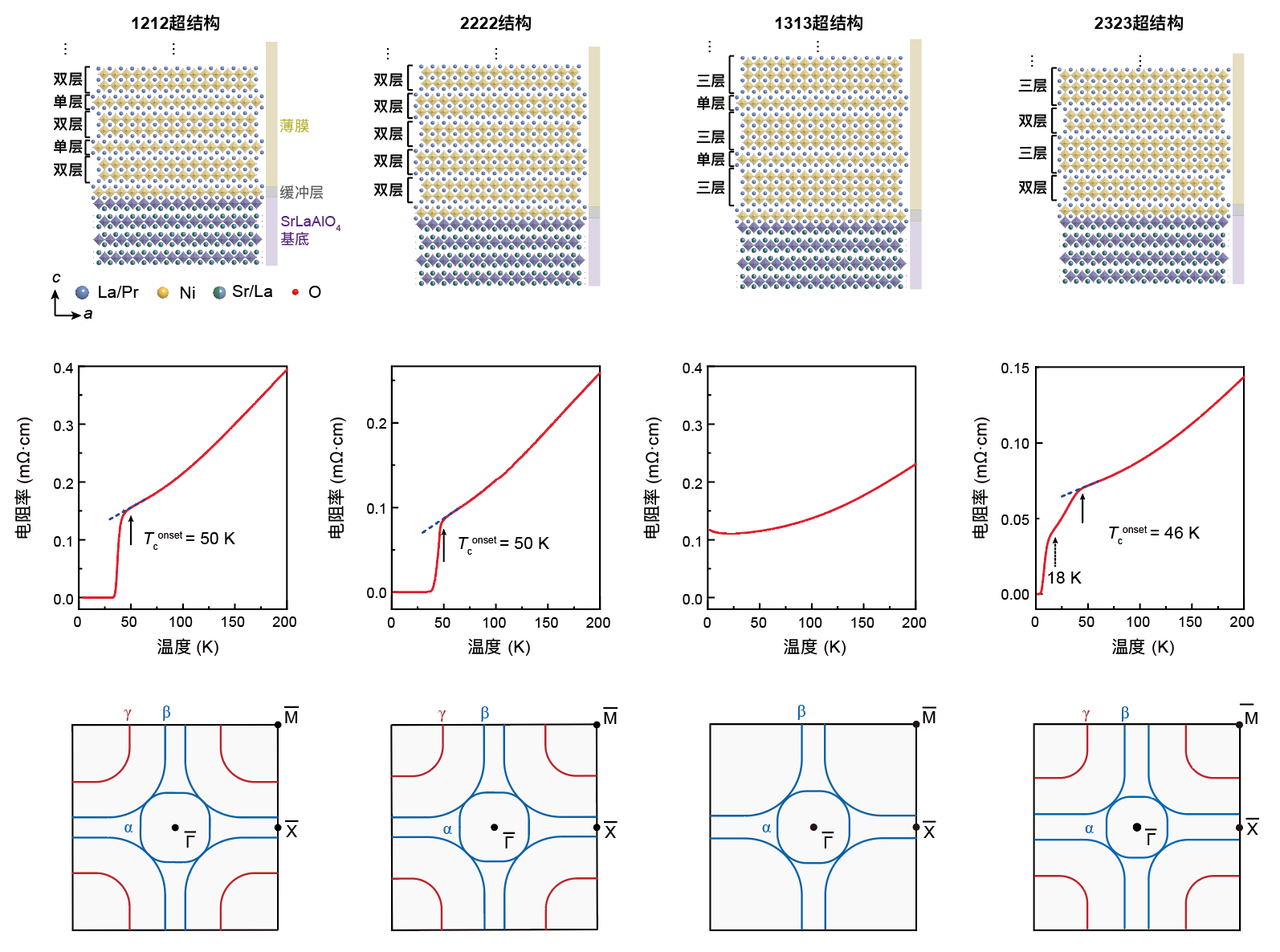
Crystal Structures (top), electrical transport properties (middle), and Fermi surface topologies of four nickelate superstructure films (bottom)
These studies combine thin-film growth, materials synthesis, and spectroscopic characterization to investigate nickelate superconductors, which exhibit electronic features distinct from cuprates and iron-based systems. The comparative studies among these three systems may contribute to a more comprehensive understanding of high-temperature superconductivity and lay the foundation for future research in energy, information, quantum computing, and other related fields.
The primary institute of this research is the State Key Laboratory of Quantum Functional Materials and the Department of Physics at SUSTech. Zihao NIE (Master’s student), Yueying LI (Research Assistant Professor), Wei LV (PhD student) and Lizhi XU (PhD student) at SUSTech, and Zhicheng JIANG (Postdoctoral Fellow) at USTC are the co-first authors of this paper. Professor Dawei SHEN at USTC, Assistant Researcher Peng LI of QSC-GBA, Academician Qikun XUE, and Associate Professor at SUSTech and jointly appointed Researcher of QSC-GBA Zhuoyu CHEN are the co-corresponding authors. The authors also include Academician Jinfeng JIA, and Professor at SUSTech and jointly appointed Researcher of QSC-GBA Junhao LIN.
The State Key Laboratory of Quantum Functional Materials
As the primary institute, the State Key Laboratory of Quantum Functional Materials (hereinafter referred to as the “Laboratory”) focuses on coordinated research efforts addressing key scientific questions. The Laboratory is led by SUSTech and jointly established with Shanghai University of Science and Technology (ShanghaiTech). It was approved for construction by the Ministry of Science and Technology in 2024. It is oriented toward applied basic research, focusing on the quantum functional materials design and synthesis, and advanced characterization based on large-scale scientific facilities. It is committed to advancing the applications of quantum functional materials in the fields of information and energy.
The Laboratory includes more than 170 members, and is directed by Academician Jinfeng JIA, with Professor Junhao LIN serving as Executive Deputy Director. The core members include 2 academicians of the Chinese Academy of Sciences and more than 90 nationally recognized researchers, with over 70% of them under the age of 45.
Since its establishment, the Laboratory has contributed to many studies in quantum materials, including work on ambient-pressure nickelate superconductivity and spin space group theory published in Nature (2025), as well as the present study on nickelate superstructures. In addition, the Laboratory has achieved several notable results. Additional results include the observation of a previously unreported “latent phase transition” in PdSe2; the development of methods to probe and control Néel order in A-type antiferromagnets; the development of a quasi-solid-state ion thermoelectric cycle (t-ITC) system; and the introduction of single-photon counting (SPC) and combined Electroluminescence-Photoluminescence (EL–PL) techniques for studying electron transport in QLED devices. Low-dose electron microscopy has also been used to resolve surface and defect atomic structures in halide perovskites.
At present, the Laboratory covers four main areas: materials design and computation, materials synthesis and regulation, large-scale scientific facilities and advanced characterization, and materials functionalities and devices. By integrating the strengths of SUSTech and ShanghaiTech, and drawing on complementary expertise and infrastructure across Shenzhen and Shanghai, including X-ray free-electron lasers, synchrotron radiation sources, and materials genome platforms, the Laboratory supports ongoing research efforts in quantum materials.
Links:
Nature 2026: https://doi.org/10.1038/s41586-026-10352-7
National Science Review 2026: https://doi.org/10.1093/nsr/nwag151
Nature 2025: https://doi.org/10.1038/s41586-025-08755-z
National Science Review 2025: https://doi.org/10.1093/nsr/nwae429
Proofread ByNoah Crockett, Junxi KE
Photo ByYan QIU