The team led by Professor Zhaobo LANG from the Academy for Advanced Interdisciplinary Studies and the School of Medicine of the Southern University of Science and Technology (SUSTech) published a research paper online in the internationally renowned journal Cell Reports, entitled “The tomato Methyl-CpG-binding domain SlMBD5 Promotes Seed Germination by Repressing the Gibberellin Catabolism Gene SlGA2ox4.” This study is the first to reveal a brand-new molecular mechanism by which the DNA methylation reader protein SlMBD5 regulates tomato seed germination, providing an important theoretical basis for the regulation of crop seed vigor and molecular breeding.

Seed germination is a crucial developmental transition in the life cycle of seed plants, which directly determines the uniformity of crop emergence, seedling growth, and even final yield. This process is precisely and synergistically regulated by endogenous hormones and environmental signals. Among them, gibberellin (GA), as the core hormone promoting germination, and the maintenance of its endogenous homeostasis is the key to the normal initiation of germination. GA2-oxidase (GA2ox) is the core factor regulating GA homeostasis by degrading active gibberellins. However, how epigenetic modifications such as DNA methylation participate in this regulatory process has remained unclear for a long time.
MBD (Methyl-CpG-binding domain) family proteins are key readers of DNA methylation. They can specifically recognize methylated DNA sequences and recruit downstream chromatin regulators, thereby achieving epigenetic regulation of gene expression. In the model plant Arabidopsis thaliana, the loss of function of AtMBD5 and AtMBD6, the homologous proteins of SlMBD5, did not lead to obvious developmental phenotypes, which has long cast doubt on the physiological functions of this class of proteins, and their functions in crops have been rarely reported. This study is the first to reveal the key regulatory role of this protein in the process of seed germination in tomato, filling the gap in this research field.
To explore the physiological function of SlMBD5 in tomato, the research team constructed loss-of-function mutants of the slmbd5 gene using CRISPR-Cas9 gene editing technology. Germination assay results showed that compared with the wild type, the seed germination rate of slmbd5 mutants was significantly reduced, showing an obvious germination delay phenotype, which confirmed for the first time that SlMBD5 is a key positive regulator of tomato seed germination. Subsequently, the research team further dissected the molecular mechanism by which SlMBD5 regulates GA homeostasis. They found that the gibberellin catabolism gene SlGA2ox4 was significantly upregulated in slmbd5 mutants, and the promoter region of this gene contains hypermethylated CpG sites, which are exactly potential binding targets of SlMBD5. Biochemical experiments confirmed that SlMBD5 can directly bind to the promoter of SlGA2ox4 by recognizing these methylation sites and repressing the transcription of this gene.
Further mechanistic studies revealed that SlMBD5 does not function alone. It can interact with the histone methylation reader protein SlEBS to form a functional complex. As a regulator of histone modifications, SlEBS can further enhance the transcriptional repression of SlGA2ox4, thereby jointly inhibiting the expression of this gene, relieving its degradation effect on active gibberellins, and maintaining sufficient active GA levels in seeds.
This study fills the mechanistic gap in the regulation of seed germination by DNA methylation and provides a novel target and theoretical support for the genetic improvement of seed germination traits in horticultural crops.
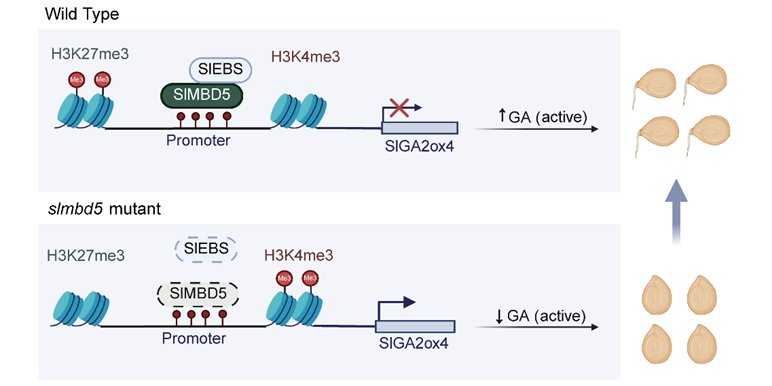
Figure. Mechanistic model of the SlMBD5-SlEBS module regulating tomato seed germination
Shiyang ZHANG, a PhD candidate at SUSTech, Ruie LIU, an assistant researcher at Shanghai Jiao Tong University, and Zhifeng ZENG, a postdoctoral fellow at SUSTech, are the co-first authors of this paper. Professor Zhaobo LANG from SUSTech is the corresponding author of this paper. Professor Caixi ZHANG from Shanghai Jiao Tong University and Academician Jian-Kang ZHU from SUSTech participated in this study. SUSTech is the first affiliation of this paper.
Paper Link: https://www.sciencedirect.com/science/article/pii/S2211124726004201
Proofread ByNoah Crockett, Junxi KE
Photo By