Associate Professor Xin ZHOU’s research group from the School of Microelectronics at the Southern University of Science and Technology (SUSTech), in collaboration with Professor Fei WANG’s group and other partners, made significant progress in the field of high-performance chip-scale gyroscopes.
The research team proposed and experimentally demonstrated a new chip-scale gyroscope scheme based on a cusp-singularity-enhanced Coriolis effect. The related paper, titled “Cusp-singularity-enhanced Coriolis effect for sensitive chip-scale gyroscopes,” has been published in Nature.

Gyroscopes are core inertial sensors that measure rotational motion in free space without the need for external references. They are widely used in consumer electronics, automobiles, aerospace systems, robotics, unmanned systems, and navigation. Among them, Coriolis vibratory gyroscopes are one of the most widely used types, measuring angular velocity through the Coriolis effect.
Compared with traditional macro-scale gyroscopes such as Hemispherical Resonator Gyroscopes, chip-scale Coriolis vibratory gyroscopes offer advantages such as small size, light weight, low cost, and ease of integration. Their performance is constrained by stronger Brownian noise in microscale devices and by the physical limit of the intrinsic Coriolis factor. As a result, their sensitivity, signal-to-noise ratio, and long-term stability have remained difficult to match with those of high-end macro-scale counterparts.
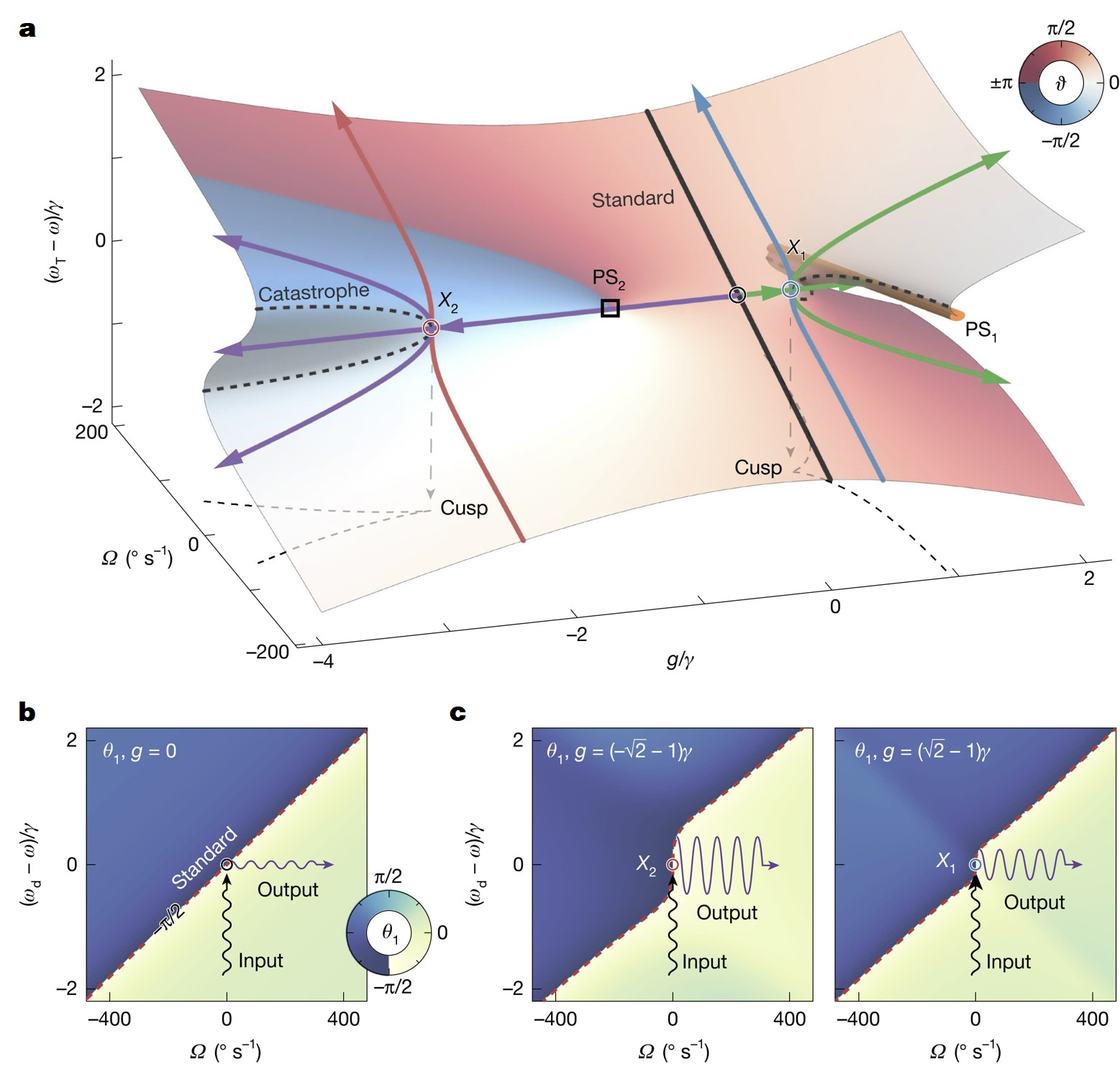
Figure 1. Singularity of cusp catastrophe and its enhancement of gyroscope signals. (a) Cusp catastrophe in the phase-locked loop oscillation of a Coriolis gyroscope. (b) Frequency modulation output of a conventional Coriolis gyroscope. (c) Frequency modulation output of the Coriolis gyroscope near the cusp singularity.
The team introduced singularity physics into chip-scale Coriolis vibratory gyroscopes. In conventional gyroscopes, the Coriolis response is typically linearly proportional to the input angular velocity, making weak rotation signals susceptible to noise. By introducing phase-tracking control and modal stiffness coupling into an on-chip silicon disk resonator, the researchers enabled the system to operate near a third-order cusp catastrophe singularity. This transformed the frequency-modulation response induced by the Coriolis effect from linear scaling to cube-root scaling, producing a significantly amplified output response under small rotational inputs and breaking the sensitivity limitations of conventional chip-scale gyroscopes.
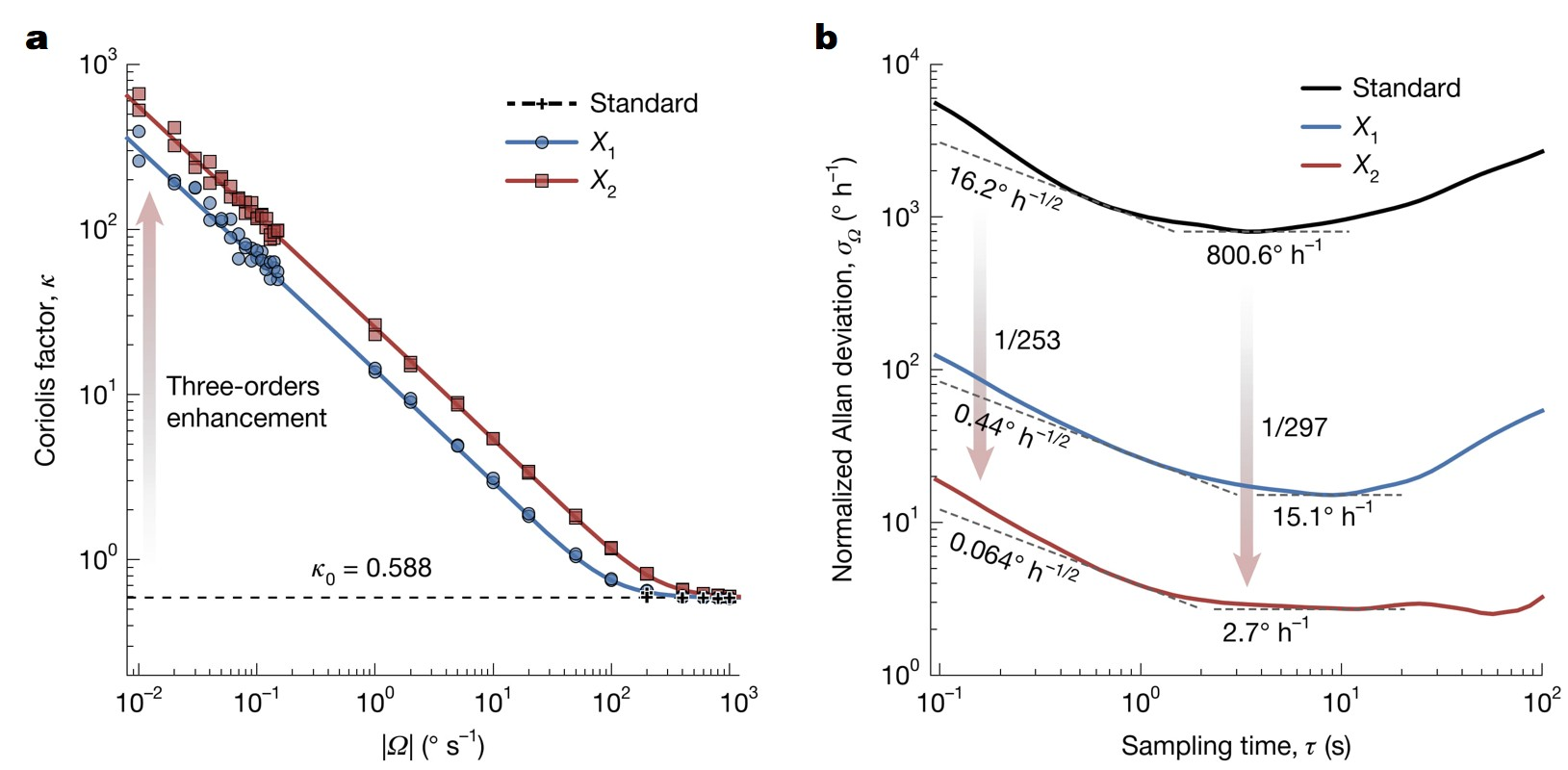
Figure 2. Coriolis effect enhanced by cusp singularities. (a) Coriolis factor with inherent and cusp-singularity-enhancement. (b) Zero-bias Allan variance analysis of conventional and cusp singularity enhanced frequency modulated gyroscopes.
In the experiments, the researchers used an on-chip silicon disk resonator with a diameter of four millimeters as the core device. Electrostatic actuation, detection, and tuning were applied to precisely control a pair of degenerate vibrational modes. The team constructed and observed a cusp catastrophe in the phase-tracked oscillation frequency space, and further verified through closed-loop phase-locking experiments that the system could operate stably near the singularity.
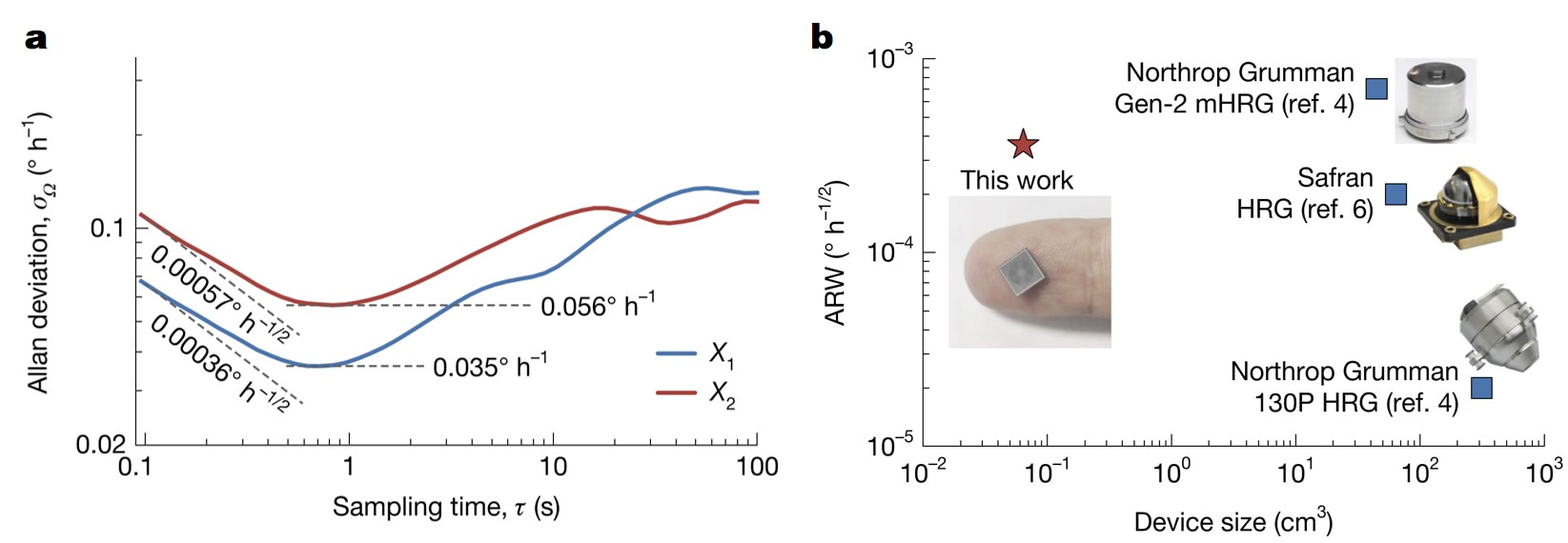
Figure 3. Cusp-singularity-enhanced enhancement achieves record-breaking strategic-level angular random walk. (a) Allan variance analysis of the zero bias of the cusp singularity enhanced phase modulation gyroscope, (b) Comparison of angular random walk with the hemispherical resonator gyroscopes.
The results showed that, under the cusp-singularity-enhanced frequency-modulation mode, the device achieved an approximately three-order-of-magnitude enhancement in the effective Coriolis factor. Its signal-to-noise ratio improved by 253 times, while its measurement precision improved by 297 times.
The team further found that the cusp singularity can also introduce an ultrasensitive phase-modulated readout method that was previously difficult to realize. Compared with frequency-modulated outputs, the relative phase between modes is naturally robust against resonant-frequency drift. Based on this phase-modulated mechanism, the team achieved excellent signal-to-noise performance in a silicon-based chip-scale gyroscope, with an angular random walk of 0.00036°/√h. This performance approaches that of large, high-cost hemispherical resonator gyroscopes and is nearly one order of magnitude better than that of current advanced silicon-chip gyroscopes.
This work is the first to realize and utilize cusp-catastrophe-singularity-enhanced Coriolis effects in a chip-scale Coriolis vibratory gyroscope. It challenges the conventional view that miniaturization inevitably leads to reduced signal-to-noise performance, and provides a new physical mechanism and technical pathway for high-performance, low-cost, and miniaturized inertial sensors.
In the future, this method is expected to support applications including GPS-denied navigation, autonomous driving, advanced robotics, unmanned aerial vehicles, consumer electronics, and microsatellites. It may also be extended to high-sensitivity measurement systems in environmental monitoring, medical sensing, seismic detection, and gravity measurement.
SUSTech is the corresponding affiliation of the paper. Associate Professor Xin ZHOU, Professor Fei WANG, Professor Hui JING from the National University of Defense Technology and Hunan Normal University, and Professor Franco Nori from RIKEN are co-corresponding authors. Sen ZHANG, a Master’s student in ZHOU’s former group, is the first author and conducted the experiments under ZHOU’s supervision. ZHOU led the research conception, experimental guidance, data processing, theoretical analysis, device design, device fabrication, and test-system development. WANG’s group provided important support for the experimental conditions.
Article Link: https://doi.org/10.1038/s41586-026-10565-w
Proofread ByNoah Crockett, Junxi KE
Photo By