Liang LI, a Fellow of the Royal Society of Canada and a tenured professor at the University of Alberta, visited the Southern University of Science and Technology (SUSTech) for the 441st session of the SUSTech Lecture Series to give a special talk titled “Deep Metabolomics: Technology Development and Applications.”
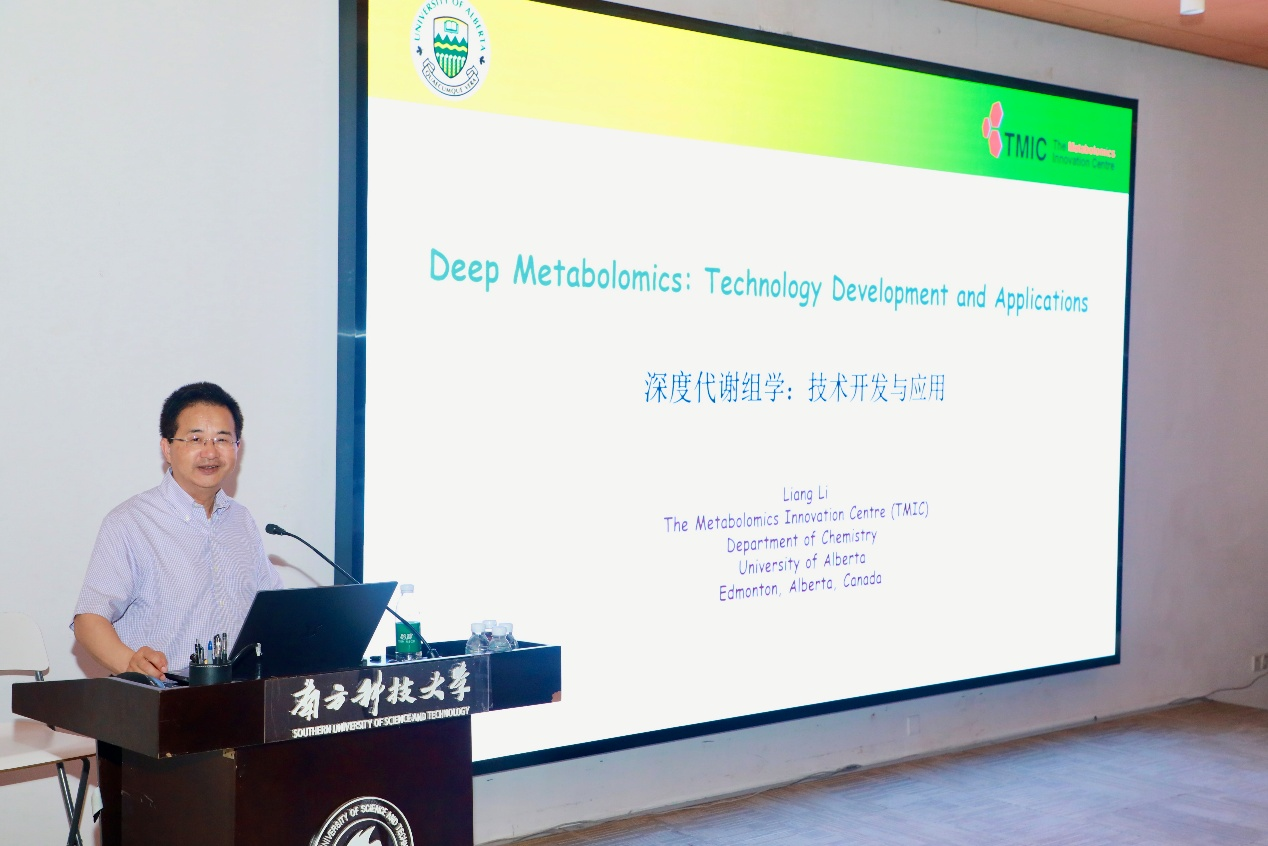
Academician Liang LI talked about the key bottlenecks currently faced in mass spectrometry-based metabolomics analysis. He pointed out that there are many types of metabolites with significantly different physical and chemical properties, and the ionization efficiency of different compounds in mass spectrometry varies greatly, making it hard for signal intensity to directly reflect the actual concentration. At the same time, traditional untargeted metabolomics still faces challenges in absolute quantification, cross-batch comparison, detection of low-abundance metabolites, and stable analysis of large cohort samples. These issues limit the further application of metabolomics in discovering disease markers, clinical cohort studies, and mechanism research.
Academician Liang LI gave a detailed overview of his team’s long-term research on efficient chemical isotope-labeled metabolomics technology. This technique improves the mass spectrometry response and detection sensitivity of metabolites by labeling specific functional groups with isotopes and allows accurate comparison between samples using light and heavy isotope labeling strategies. Compared with traditional mass spectrometry metabolomics methods, this technology combines the quantitative stability of targeted analysis with the high coverage of non-targeted analysis, significantly increasing the number of metabolites detected, the accuracy of quantification, and the reproducibility of data.
Academician Liang LI also focused on introducing key technical designs like the unified reference sample, UMS. By establishing a stable, reusable reference system, this method can effectively correct systematic errors between different batches and samples, providing important support for large-scale clinical sample analysis and cross-cohort data integration. He illustrated its application value in precise disease diagnosis, metabolite marker screening, drug efficacy evaluation, and disease mechanism research by going through several classic case studies. He further explained its significance in building single-disease-specific metabolite databases and promoting in-depth metabolomics research.
In addition, Academician Liang LI, drawing on his team’s long-term experience in building metabolomics technology platforms, introduced the broad application prospects of deep metabolomics in life sciences and clinical medicine research. He said that as sample processing, chemical labeling, mass spectrometry detection, and data analysis processes continue to be optimized, metabolomics is expected to play an even more important role in complex disease classification, early diagnosis, treatment response evaluation, and personalized medicine research.
During the interactive session, faculty and students enthusiastically asked questions about this method’s coverage of different types of compounds, its potential in spatial metabolomics research, its applicability to fecal metabolomics samples, and issues like metabolite quantification and database construction in complex clinical samples. Academician Liang LI answered based on his own research experience and shared his personal insights from the perspectives of technical principles, sample characteristics, application scenarios, and future development directions.
Proofread ByJunxi KE
Photo BySchool of Medicine