John Mekalanos, a Member of the U.S. National Academy of Sciences and professor of the Department of Microbiology at Harvard Medical School, visited the Southern University of Science and Technology (SUSTech) for the 443rd session of the SUSTech Lecture Series to give an academic talk titled “How the interplay between pathogen, host and commensal microbiota determine disease outcomes.”
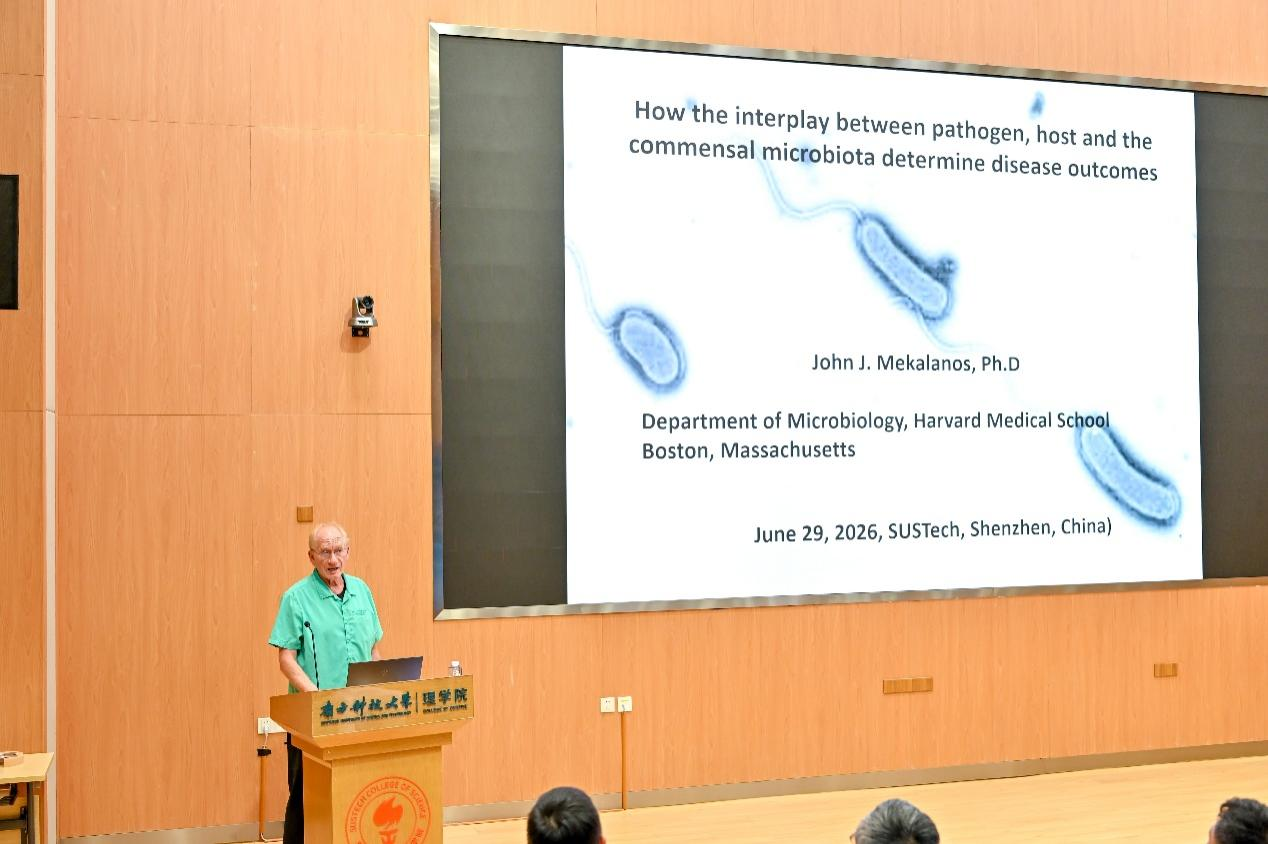
Academician John Mekalanos has served as chair of the Microbiology Department at Harvard Medical School. He is a top scholar in international microbiology and bacterial pathogenesis and has long focused on functional genomics of pathogen-host interactions, bacterial virulence regulation, and antimicrobial drug development. He’s made pioneering contributions in understanding cholera pathogenesis, bacterial toxin functions, bacterial secretion system regulation, and bacterial innate immunity. His research has also helped advance the development of various live attenuated vaccines and antitoxin drugs like Virstatin.
In the report, Academician Mekalanos focused on core topics like pathogen, host, and symbiotic microbe interactions, systematically explaining the T6SS molecular regulation model throughout the cholera pathogenic process. He pointed out that Vibrio cholerae can kill gut symbiotic bacteria through a contact-dependent type VI secretion system (T6SS); the metabolites released from lysed symbiotic bacteria reshape the gut environment and activate the host’s innate intestinal immunity; signals from the gut environment then further induce V. cholerae to produce large amounts of cholera toxin (CT) and toxin-coregulated pilus (TCP), promoting the pathogen’s growth and colonization, which ultimately triggers a host-specific immune response and causes the typical diarrhea symptoms of cholera.
Academician Mekalanos also shared that his team successfully screened a strain of bacteria, Aeromonas dhakensis A603, with strong anti-vibrio activity from the symbiotic bacteria in shrimp from local markets. Genome sequencing and genetic analysis showed that the A603 strain kills Vibrio through a dual mechanism. First, using T6SS for direct contact killing of Vibrio, and second, by secreting a specific phenazine-like molecule, Ad-Phen, which inhibits Vibrio from a distance. Further studies confirmed that Ad-Phen can form a synergistic regulatory loop with the pore-forming T6SS effector protein TseC, significantly increasing Vibrio cholerae’s sensitivity to the inhibitory substance. The synergy between Ad-Phen and TseC enhances Vibrio cholerae’s susceptibility to being killed by Ad-Phen. Infection tests in live shrimp showed that the A603 strain can significantly reduce the mortality rate of shrimp caused by acute hepatopancreatic necrosis disease (AHPND) from Vibrio parahaemolyticus, showing great potential for development as a probiotic specifically for aquaculture. This provides a natural biological solution for environmentally friendly disease control in aquaculture and reducing antibiotic use, highlighting the core value of translating basic research into practical industry applications.
During the interactive session, the faculty and students asked Academician Mekalanos questions about issues like the industrial application of probiotics and bottlenecks in antiviral drug development. Academician Mekalanos answered them one by one, based on his own research experience, and also shared his insights on cutting-edge research directions and scientific innovation in the field of microbiology.
Proofread ByJunxi KE
Photo ByDepartment of Biochemistry