The research team led by Associate Professor Ning JIA from the Department of Biochemistry, the School of Medicine, and the Institute for Homeostatic Medicine at the Southern University of Science and Technology (SUSTech), in collaboration with the research group of Professor Xueyan LIU from Shenzhen People’s Hospital (the First Affiliated Hospital of SUSTech), published a research paper titled “Mechanistic insights into activation of bacterial Retron-Eco8 immunity by phage protein SSB” in Nature Communications.
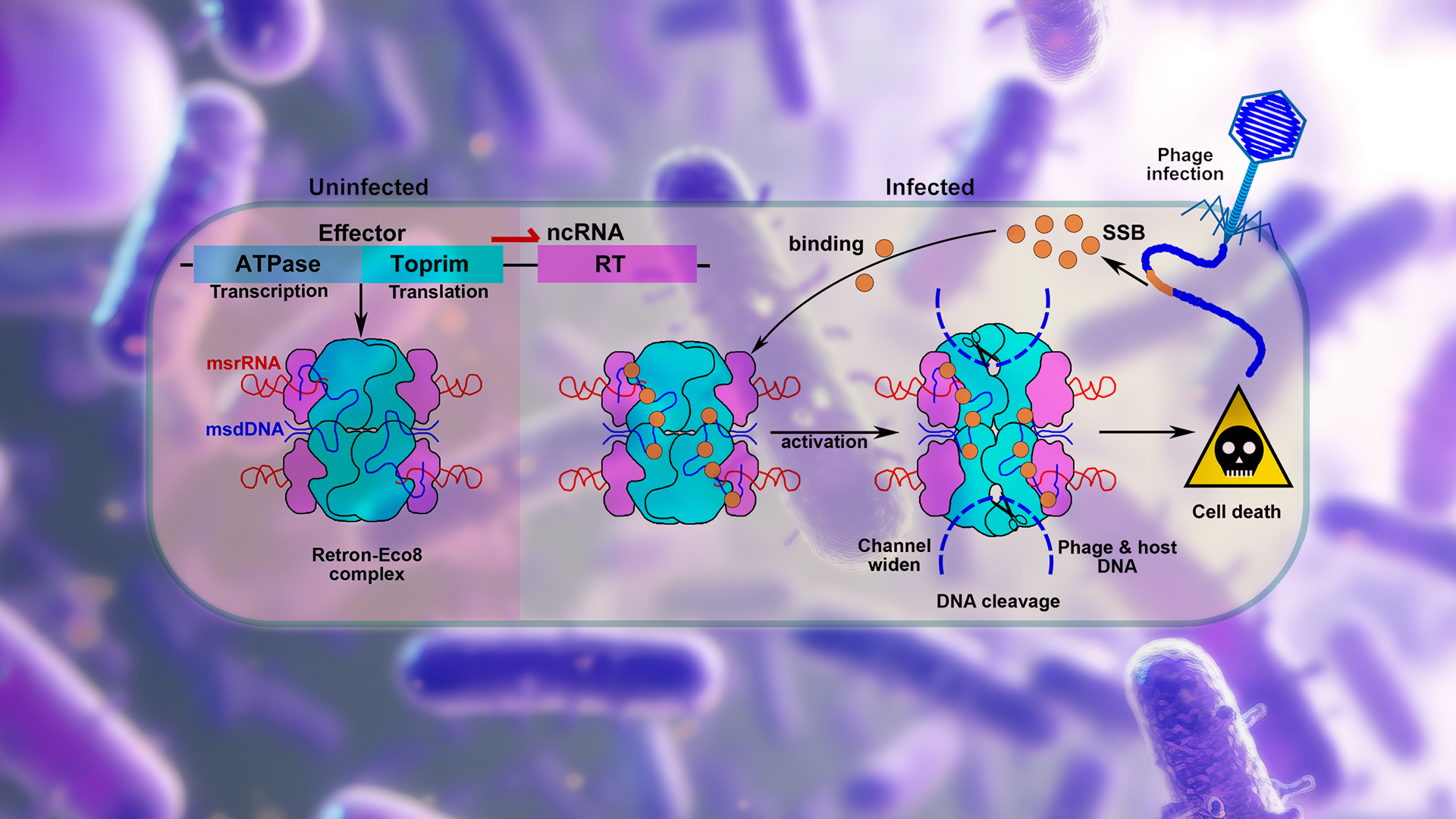
During long-term co-evolution with bacteriophages, bacteria have developed a variety of sophisticated immune defense systems. The study elucidates how the bacterial Retron-Eco8 immune system maintains an autoinhibited state through the formation of a tetrameric complex. Upon sensing phage-derived single-stranded DNA-binding protein (SSB), the system becomes activated, leading to non-specific degradation of both host and phage DNA and triggering cell death, effectively blocking phage propagation. These findings deepen our understanding of prokaryotic retron defense systems and provide a molecular foundation for the development of retron-based biotechnological tools.
The research team confirmed that the Retron-Eco8 system provides effective protection against multiple phage infections in vivo, and further demonstrated that the RT, ncRNA, and effector protein co-assemble into a stable tetrameric complex (Fig 1). Using cryo-electron microscopy (cryo-EM) single-particle analysis, the team resolved high-resolution structures of the inactive Retron-Eco8 tetramer and the activated Retron-Eco8-SSB complex, revealing the assembly mode, autoinhibition mechanism, and SSB-induced activation process of the system.
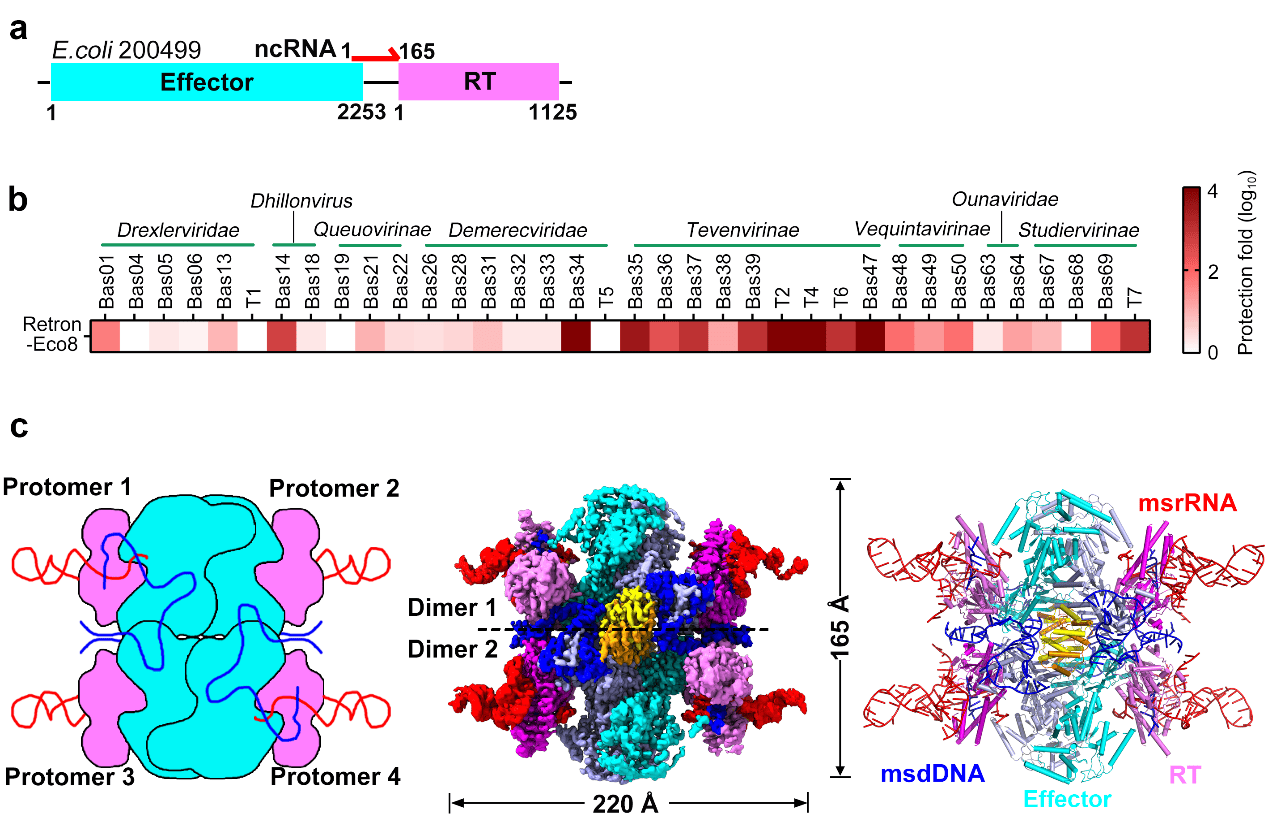
Fig 1. The Retron-Eco8 system mediates defense against multi-phage infection and assembles into a tetramer.
Structural analysis shows that Retron-Eco8 adopts a twisted “I”-shaped tetrameric architecture, in which four effector protein subunits form a central scaffold. Each effector protein binds one RT subunit on its periphery, while the msrRNA-msdDNA hybrid duplex wraps around the RT subunits and locks the entire complex in an autoinhibited state. Two stem-loop structures, SL1 and SL2, play key roles in the msdDNA molecule. SL1 interacts with the ATPase domain of the effector protein, while SL2 serves as the direct binding site for phage SSB. Upon phage infection of bacteria, the phage-derived SSB protein specifically binds to the SL2 region of msdDNA, triggering a conformational rearrangement of msdDNA, relieving autoinhibition, and causing a significant allosteric change in the substrate-binding channel of the effector protein’s TOPRIM nuclease domain, thereby activating its non-specific DNA cleavage activity. The activated Retron-Eco8 efficiently degrades both invading phage DNA and host genomic DNA, ultimately leading to programmed cell death of the infected bacterium, effectively blocking phage replication and propagation (Fig 2).
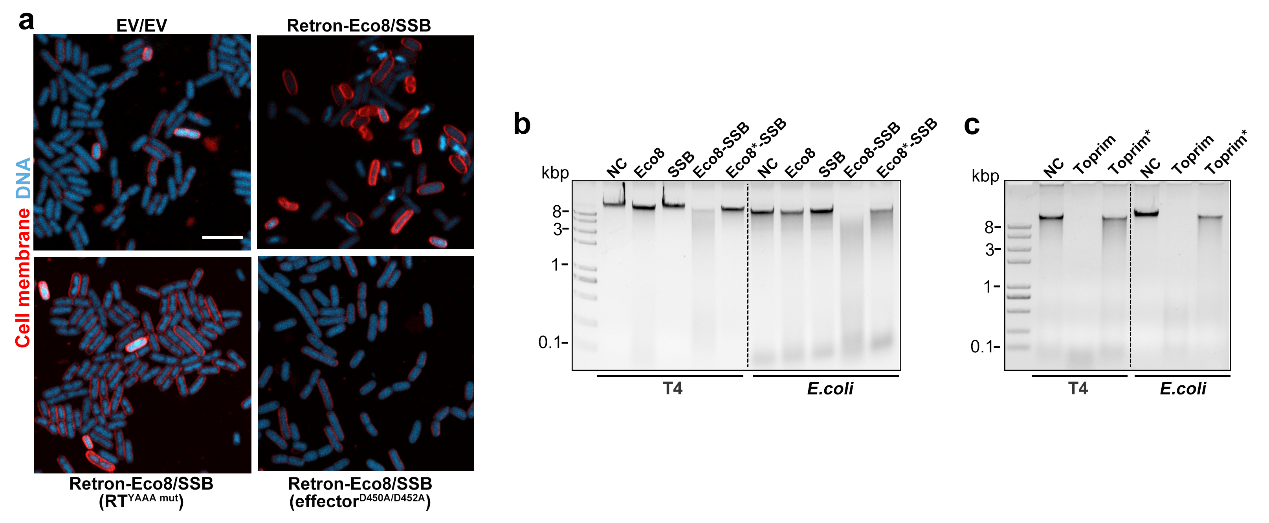
Fig 2. Phage SSB induces nuclease activation of Retron-Eco8 and mediates degradation of both invading phage DNA and host genomic DNA.
Functional experiments show that the oligomerization ability and DNA-binding ability of phage SSB are critical for activating Retron-Eco8. Disrupting the oligomeric state of SSB or impairing its DNA-binding ability prevents activation of Retron-Eco8. Notably, the SSB of host bacteria, although capable of binding single-stranded DNA, cannot activate the Retron-Eco8 system, demonstrating the high specificity of Retron-Eco8 system for recognizing phage SSB.
This study comprehensively elucidates the complete molecular mechanism of the Retron-Eco8 system from assembly, autoinhibition, phage SSB sensing, to nuclease activation and DNA degradation (Fig 3). These findings not only deepen our understanding of bacterial retron immune systems but also provide key structural and mechanistic guidance for developing precise genome-editing tools based on retron systems.
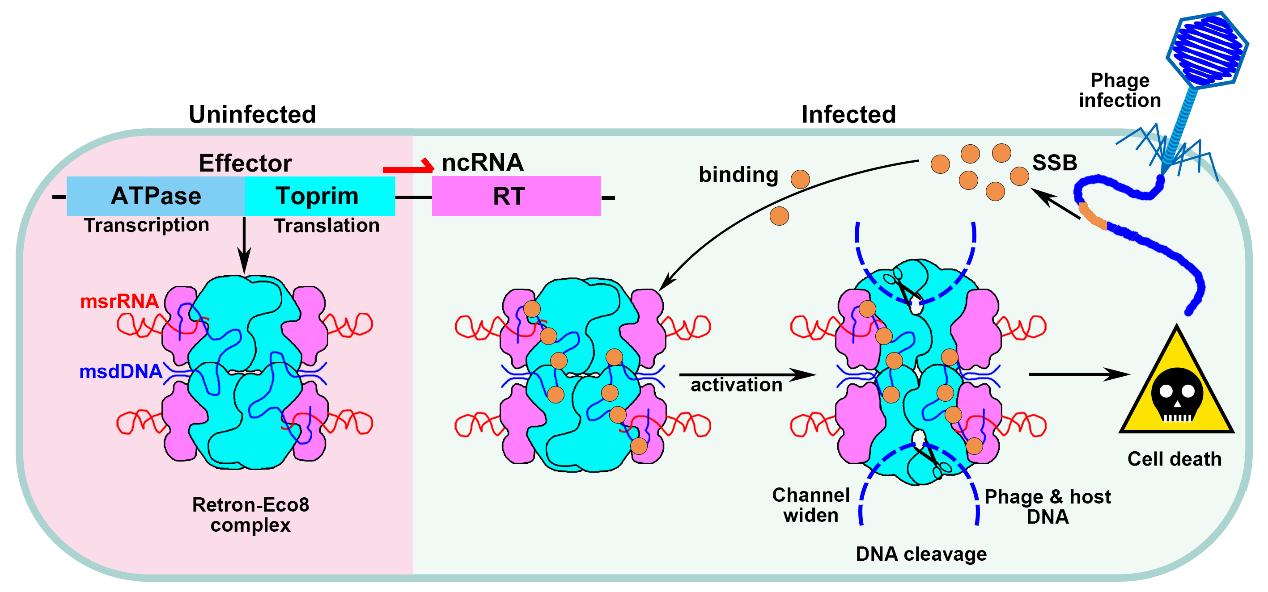
Fig 3. Proposed mechanistic model for phage SSB-induced activation of Retron-Eco8 nuclease in response to invading phages.
Dr. Chao-Guang JI, a postdoctoral fellow at Shenzhen People’s Hospital, and Zhuolin LI, a doctoral student, are the co-first authors of this paper. Associate Professor Ning JIA from the School of Medicine at SUSTech, Professor Xueyan LIU from the Shenzhen People’s Hospital, and research assistant Professor Jun‑Tao ZHANG from the School of Medicine at SUSTech, are the co‑corresponding authors. SUSTech is the first affiliation of the paper.
Paper Link: https://www.nature.com/articles/s41467-026-74106-9
Proofread ByNoah Crockett, Junxi KE
Photo ByYan QIU