Associate Professor Siteng FAN from the Department of Earth and Space Sciences at the Southern University of Science and Technology (SUSTech), together with collaborators, made important progress in understanding atmospheric circulation and material transport on Mars. The study reveals that the Martian Hadley circulation limits the mixing of materials across the cell’s interior and exterior on a planetary scale, and it also leads to long-range transport between the northern and southern polar regions. The findings were published online in the international journal Nature Geoscience under the title “Hadley circulation drives material isolation and pole-to-pole teleconnection on Mars.”
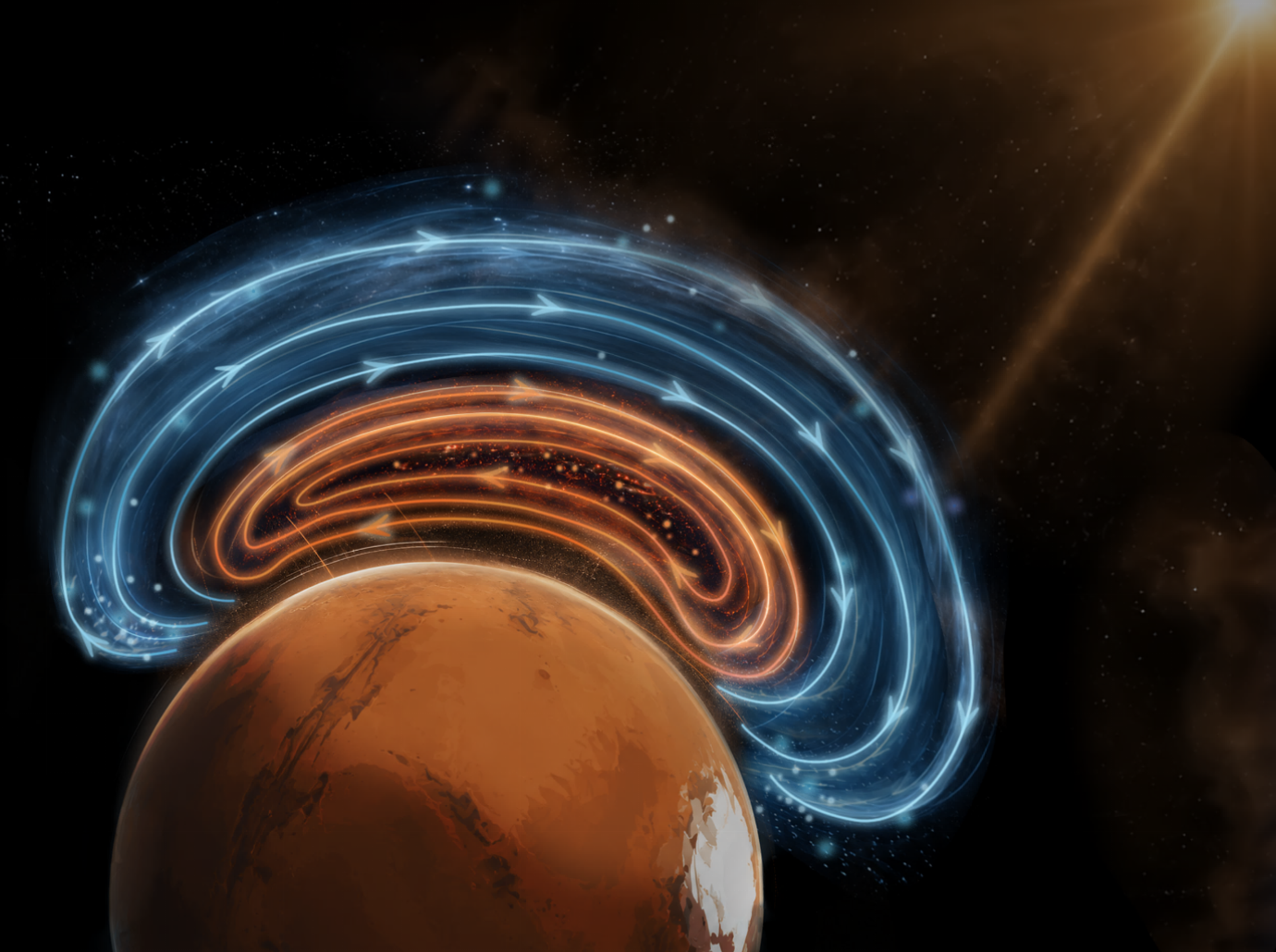
Mars is a natural laboratory for understanding atmospheric physics, climate change, planetary evolution, and habitability. Roughly four billion years ago, Mars had a thicker atmosphere and liquid water at its surface. Understanding how it evolved into the cold and arid world we see today can provide insights into climate stability and why neighboring terrestrial planets can follow different evolutionary paths.
Dust and water vapor are important materials on Mars because they strongly interact with climate, circulation, and the surface environment. Dust absorbs and scatters radiation, changing atmospheric temperatures and circulation, while water vapor links the atmosphere with polar ice caps and the planet’s long-term water inventory. Their transport is strongly influenced by Mars’ planetary-scale Hadley circulation, a large north-south overturning flow extending from the summer mid-latitudes to the winter mid-latitudes. Hadley circulations also occur on Earth and are often associated with large-scale mixing. However, pronounced planetary-scale inhomogeneities are observed in the atmosphere of Mars, where dust and water vapor seem to be separated by the single Hadley cell. Trace gases (e.g., CO) also exhibit different behaviors across the boundary of circulation, and some of them (e.g., H2O and Ar) have simultaneous seasonal changes in terms of concentrations at the two poles. It seems that the Martian atmosphere has planetary-scale transports following the mean flows, but a general mechanism is yet to be established.
To address these issues, we developed a Lagrangian particle-tracking technique to trace the trajectories of particles moving along with the flow of the Martian atmosphere, which is recreated based on hourly wind fields (maps of the speed and direction of winds) adapted from the reconstructed atmospheric data. In this analytical tool, a large number of passive tracers are released inside and outside the Hadley cell, and then moved forward in time to track the atmospheric transport pattern. The initial and final locations of these particles are used to trace their displacements, and the fractions crossing the circulation boundary are used to evaluate the dynamical barrier and to quantify the isolation efficiency. Sensitivity tests using different circulation boundaries are conducted to evaluate the result and confirm its robustness. In addition to Mars, the same procedure is applied to the atmospheres of Earth and Venus to achieve a planet-comparative view. Dimensional analysis including the timescales of the formation and dissipation of eddies is then conducted to achieve a universal picture that can explain the distinct patterns among these three planets.
The Lagrangian particle-tracking shows two outcomes. First, the Hadley circulation boundary has a dynamical barrier that only ~15% and ~20% of particles released inside and outside the cell, respectively, can cross during 30 Earth days (Figure 1. left). This phenomenon happens during 80% of a Martian year, when the single-cell configuration takes place. A weaker two-cell circulation happens during the remaining 20% of a year with a different isolation pattern.
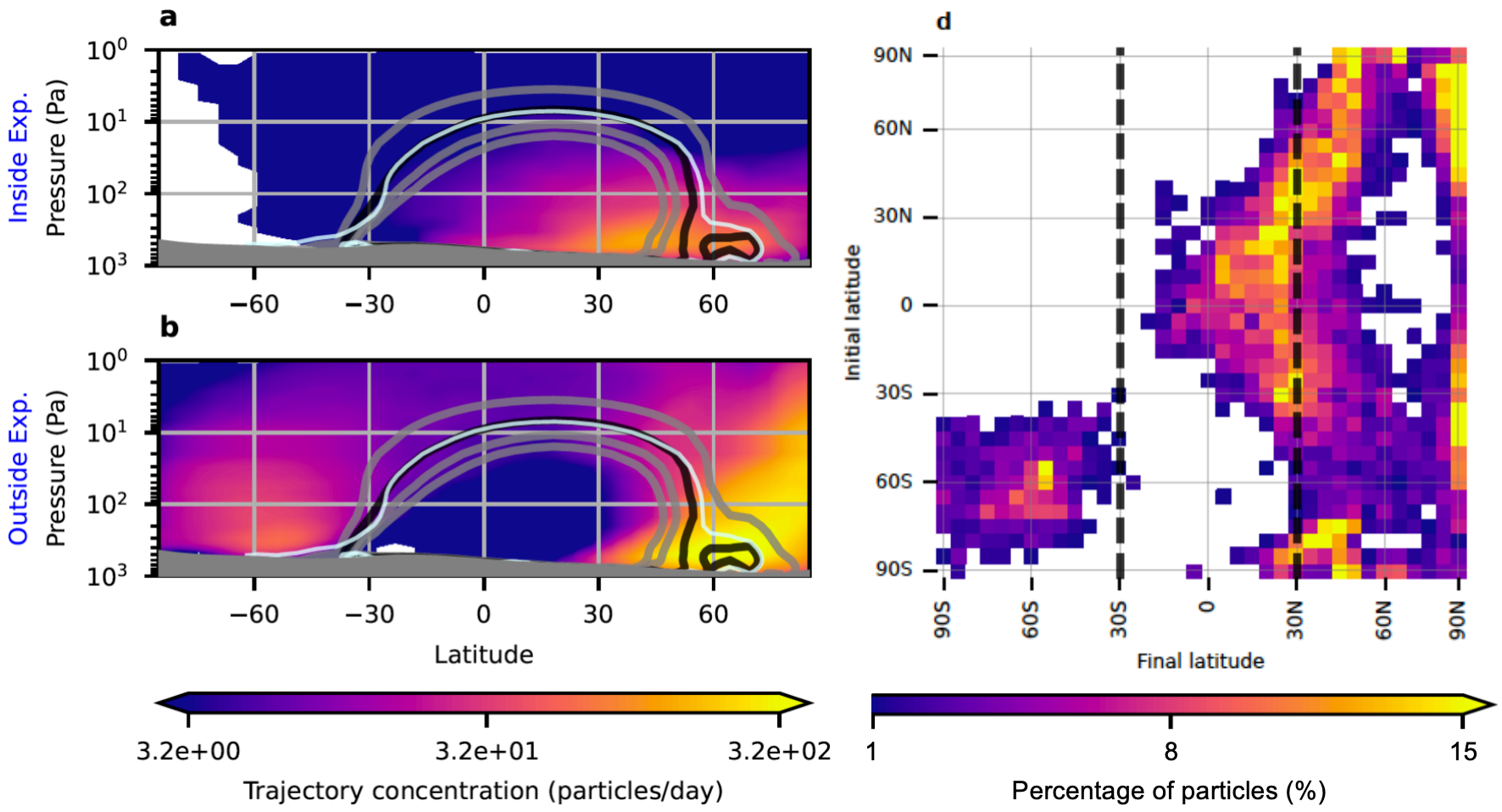
Figure 1. Distribution of atmospheric particle trajectories tracked for 30 Earth days inside and outside the circulation during northern winter on Mars (left), and the initial and final positions of particles throughout the atmosphere (right).
Second, a pole-to-pole teleconnection (a link between atmospheric phenomena that occur thousands of miles apart) is seen above the Hadley cell that transports particles from the summer to the winter high-latitude polar region within 10 Earth days (Figure 1. right). Dimensional analysis indicates that Mars’ rapid planetary rotation permits Earth-like eddy formation, but the quick temperature relaxation of its thin atmosphere efficiently dampens these eddies by balancing energy (Figure 2). Thus, transport on Mars generally follows the mean flows, a picture fundamentally different from Earth, where eddies dominate (Figure 3. left). Venus presents a similar mean flow-dominant feature, but its strong superrotating zonal winds confine the transport to narrow latitude bands (Figure 3. right).
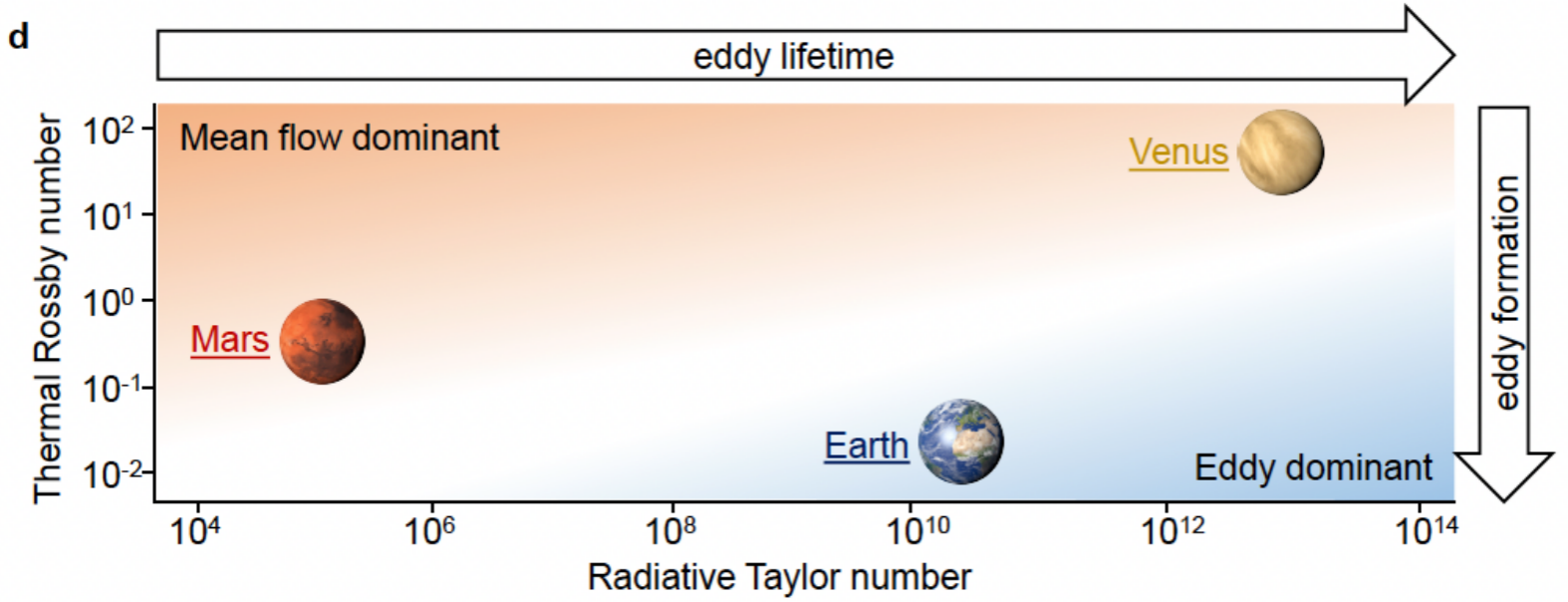
Figure 2. Parameter space corresponding to atmospheric material transport regimes on terrestrial planets.
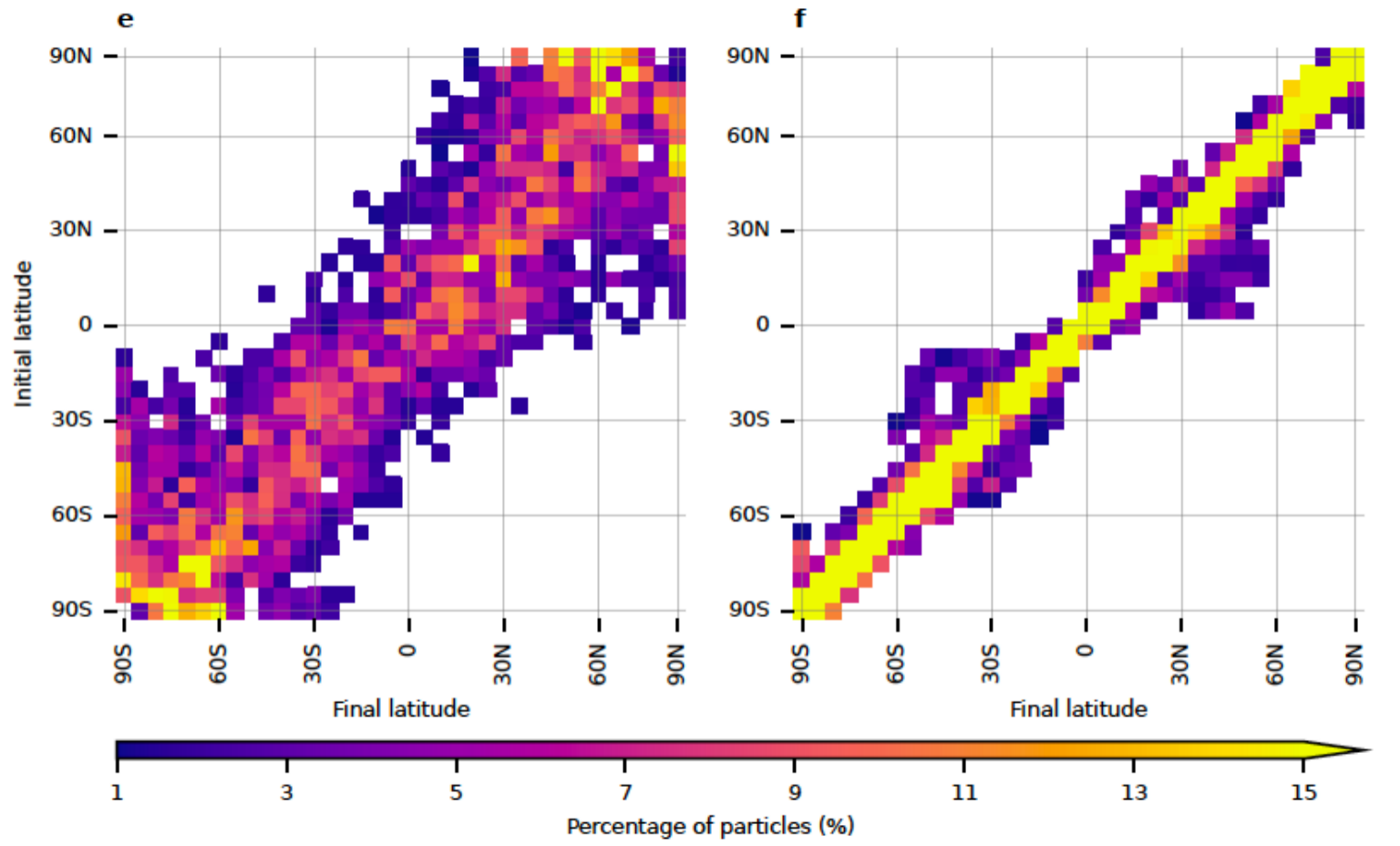
Figure 3. Initial and final positions of atmospheric particles tracked for 30 Earth days throughout the atmosphere during northern winter on Earth (left) and near noon at the prime meridian on Venus (right).
These findings explain several observations. The dynamical barrier that separates the dust and water might impede the formation of water ice on Mars, influencing atmospheric radiative balance and the water cycle. The high-altitude pole-to-pole transport corridor might result in the deposition of upper atmosphere photochemical products only in the winter polar region. Over longer periods, this transport could contribute to the redistribution of water and its isotopes (e.g., HDO) at high latitudes and influence the reservoirs due to hydrogen escape.
Associate Professor Siteng FAN from the Department of Earth and Space Sciences at SUSTech and postdoctoral researcher Chen-Shuo FAN from the same research group are the corresponding author and first author of the paper, respectively. The co-authors also include postdoctoral researchers Cong SUN and Lixiang GU from the same group, Assistant Professor Zhiang XIE from the College of Ocean and Earth Sciences at Xiamen University, and postdoctoral researcher Yangcheng LUO from the Laboratoire de Météorologie Dynamique (LMD) in France.
Paper Link: https://www.nature.com/articles/s41561-026-02090-2
Proofread ByNoah Crockett, Junxi KE
Photo By