The research group led by Associate Professor Longzhen CHENG from the School of Life Sciences at the Southern University of Science and Technology (SUSTech) published a research paper titled “A descending glycinergic circuit drives opioid-resistant mechanical pain via spinal GluN3A excitatory glycine receptors in mice” in Neuron. The study reveals, for the first time, a descending glycinergic pathway from the brainstem to the spinal cord. By activating a class of non-canonical excitatory glycine receptors (GluN3A-NMDA receptors) in the spinal cord, this pathway specifically drives opioid-resistant mechanical allodynia. This study not only challenges the traditional view that “spinal glycinergic signaling exclusively mediates inhibition,” but also provides a new target for developing non-opioid analgesics for refractory pain.

Chronic pain, especially mechanical allodynia, is a major clinical challenge. Patients may experience severe pain upon light touch or even friction of clothing, and this type of pain often shows resistance to opioids (such as morphine), severely impairing quality of life. The classic gate control theory of pain proposes that the spinal dorsal horn restricts light-touch signals from entering pain pathways through an endogenous “gate” mechanism. Clinically, it has long been observed that some patients with severe craniofacial pain, such as chronic migraine or trigeminal neuralgia, can develop widespread mechanical hypersensitivity in distal body regions, such as forearms, and respond poorly to opioid analgesics. This phenomenon suggests that craniofacial nociceptive signals may act through descending brainstem mechanisms to release the spinal dorsal horn from inhibition of light-touch signals, thereby leading to generalized pain sensitization. However, many things remain unclear at the neural circuit and molecular/cellular levels under pathological pain conditions; how this gate fails, why light-touch signals are aberrantly transmitted as pain signals, and why opioids such as morphine have limited inhibitory effects are among the core unresolved questions in the pain field.
To mimic this clinical phenomenon, the team generated a mouse model named “CFH.” They injected the noxious chemicals capsaicin or formalin into the cheek region of mice to induce craniofacial pain. Almost all injected mice developed robust bilateral hind paw mechanical allodynia; more importantly, this allodynia persisted after subcutaneous morphine administration, showing clear opioid resistance and successfully recapitulating the core clinical phenomenon of “craniofacial pain triggering distal opioid-resistant pain sensitization.” The researchers then focused on the rostral ventromedial medulla (RVM) in the brainstem, a region considered the “final relay station” for descending pain modulation from the brain to the spinal cord. They found that a population of neurons expressing glycine transporter 2 (GlyT2+) was significantly activated in the CFH model and directly projected to the spinal dorsal horn (SDH), suggesting that these neurons may constitute a key “dedicated line” connecting the brainstem and spinal cord.
To verify the causal role of this pathway, the team performed a series of functional manipulation experiments. When they specifically ablated or chemogenetically silenced GlyT2+ neurons projecting from the RVM to the SDH, the morphine-resistant mechanical allodynia in both hind paws of CFH model mice completely disappeared. Conversely, selectively activating this pathway in normal mice was sufficient to induce the same pain phenotype. Through bidirectional “loss-of-function” and “gain-of-function” validation, the team demonstrated that the RVM GlyT2+→SDH descending pathway is both necessary and sufficient for driving opioid-resistant mechanical pain. After clarifying the circuit structure, the team further found that the postsynaptic target of this descending pathway is not the conventional inhibitory glycine receptor, but a special NMDA receptor subtype, the GluN3A-NMDA receptor. This receptor does not respond to glutamate; it is selectively activated by glycine and mediates excitatory currents. In the spinal dorsal horn, almost all somatostatin-positive (SOM+) neurons-key excitatory neurons that transmit mechanical pain-express functional GluN3A-containing excitatory glycine receptors (GluN3A-eGlyRs). When glycine released from the RVM acts on these receptors, SOM+ neurons are directly excited, thereby “stepping on the accelerator” to open an otherwise tightly guarded morphine-resistant mechanical pain pathway. Mechanical allodynia mediated by this “glycine-GluN3A” axis can “escape” the analgesic effect of morphine.
By generating conditional knockout mice, the team further confirmed that specifically deleting the gene encoding GluN3A in dorsal horn SOM+ neurons, or knocking down GlyT2 expression in the RVM descending pathway, completely blocked mechanical allodynia in CFH model mice. These genetic data tightly link circuit function to specific molecular targets and establish the complete neural-molecular axis of “RVM GlyT2+ → SDH SOM+/GluN3A+” (Figure 1). This study not only redefines the functional role of glycine in the spinal cord-expanding from a classic “inhibitory messenger” to an “excitatory drive signal” under pathological conditions-but also provides a concrete neuroanatomical and molecular biological basis for understanding the comorbidity of craniofacial pain and distal pain sensitization. Designing specific blockers targeting GluN3A-NMDARs or interfering with the activity of this descending pathway is expected to provide new ideas for drug development and clinical treatment of refractory mechanical allodynia.
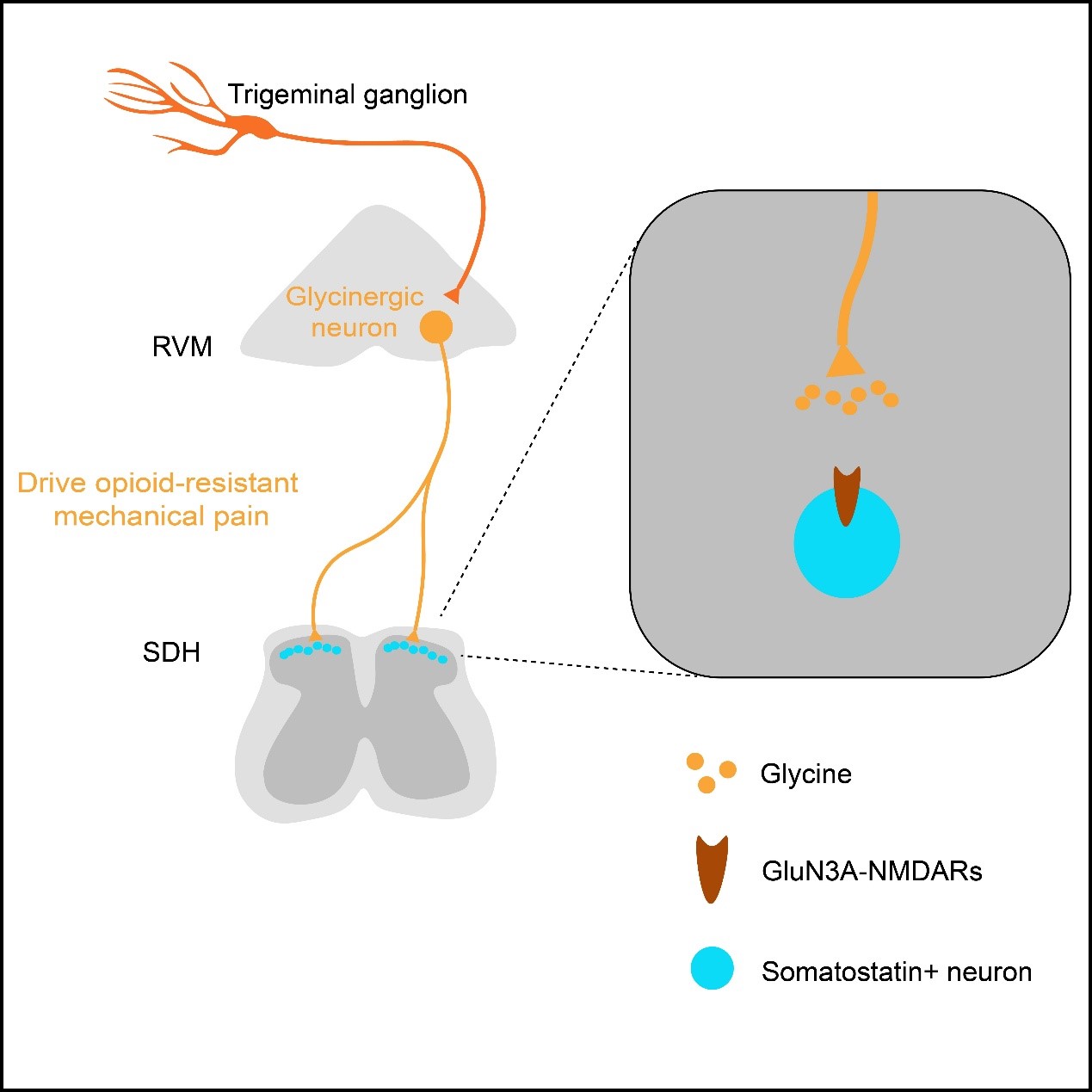
Figure 1. Descending glycinergic circuit drives opioid-resistant mechanical pain via spinal GluN3A excitatory glycine receptors
Research Assistant Professor Dong DONG, Postdoctoral Fellows Jiantao HUO and Guangjuan YIN, doctoral graduate Kaifang DUAN (graduated), and Master’s graduate Kaiyuan HU (graduated) from Longzhen CHENG’s team are co-first authors; Longzhen CHENG and Dong DONG are co-corresponding authors. SUSTech is the primary affiliation of the paper. Shujia ZHU from SUSTech and Changlin LI’s team at the Guangdong Institute of Intelligence Science and Technology are collaborators of this study.
Paper link: https://www.cell.com/neuron/abstract/S0896-6273(26)00612-4
Proofread ByNoah Crockett, Junxi KE
Photo By