On September 2, 2026, the laboratory of Professor Ning JIA at the Department of Biochemistry in the School of Medicine at the Southern University of Science and Technology (SUSTech) published a study in Cell Host & Microbe titled “Dual sensing activates antiviral reverse transcriptase for membrane targeting.” This study systematically dissects the complete immuno-pathway of the DRT2 defense system. The study revealed that bacteria use multiple infection signals to activate an unconventional reverse transcription process, transforming RNA that normally doesn’t code for proteins into genetic information capable of producing toxin proteins after phage infection. These toxins then damage the cell membrane, providing a new immune mechanism against phage infection. The research team further modified DRT2 into a molecular tool that can synthesize custom DNA on demand, offering a fresh approach for DNA synthesis technology.
Reverse transcriptases are essential polymerases that synthesize DNA from RNA templates. The DRT2 defense system, originating from Klebsiella pneumoniae and comprising an RT and a noncoding RNA (ncRNA), provides broad-spectrum protection against phages in E. coli (Figure 1A). Remarkably, DRT2 does not simply copy its RNA template; instead, it performs rolling-circle reverse transcription. The DRT2 RT forms a stable complex with its adjacent ncRNA (Figure 1B). Upon infection-triggered activation, DRT2 uses a segment of the ncRNA as a template and, through programmed template jumping, generates abundant head-to-tail tandem double-stranded ccDNA, which can reach thousands of base pairs and contain multiple repeat units (Figure 1C).
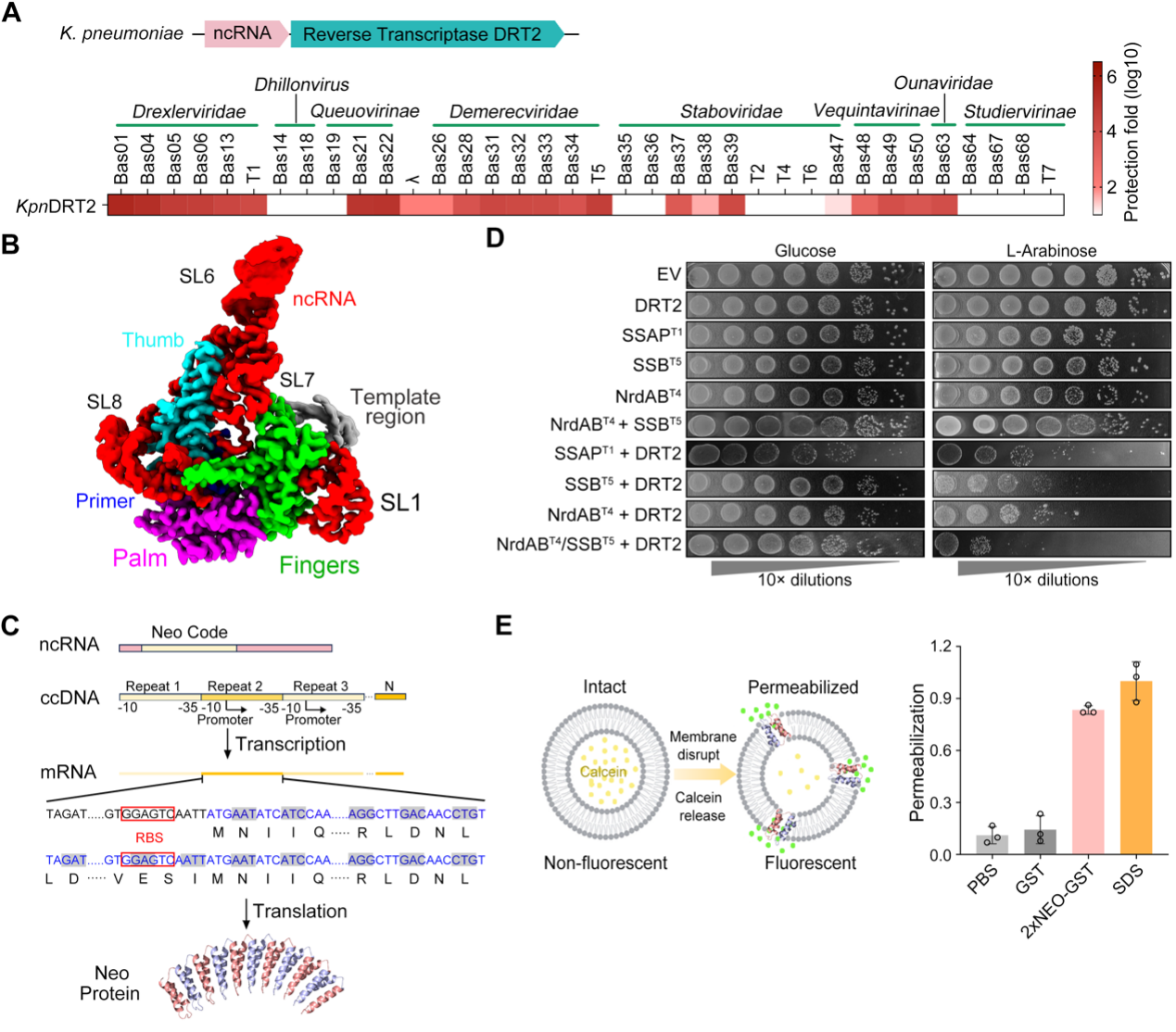
Figure 1. DRT2 immune system synthesizes toxic Neo protein to defend against multiple phage infections. (A) DRT2 anti-phage lineage; (B) Structure of the DRT2-ncRNA complex; (C) Schematic of Neo protein synthesis; (D) Phage SSAP, SSB, and NrdAB activate DRT2, leading to bacterial death; (E) Neo protein produced by DRT2 kills bacteria by disrupting cell membranes.
When these repeats are joined, they unexpectedly assemble a complete promoter and a never-ending open reading frame (neo) lacking a stop codon, meaning that fragmented information originally scattered in the ncRNA is recombined to form a new protein-coding gene (Figure 1C). This process overturns the classical central dogma (DNA→RNA→protein) and establishes a novel pathway:
Noncoding RNA → Rolling-circle reverse transcription → Repetitive double-stranded DNA → neo toxin gene → Neo protein
This unique gene-generation mechanism was also observed in previous studies from the ZHANG and Sternberg labs, which illuminated the unconventional generation of new protein-coding information by DRT2.
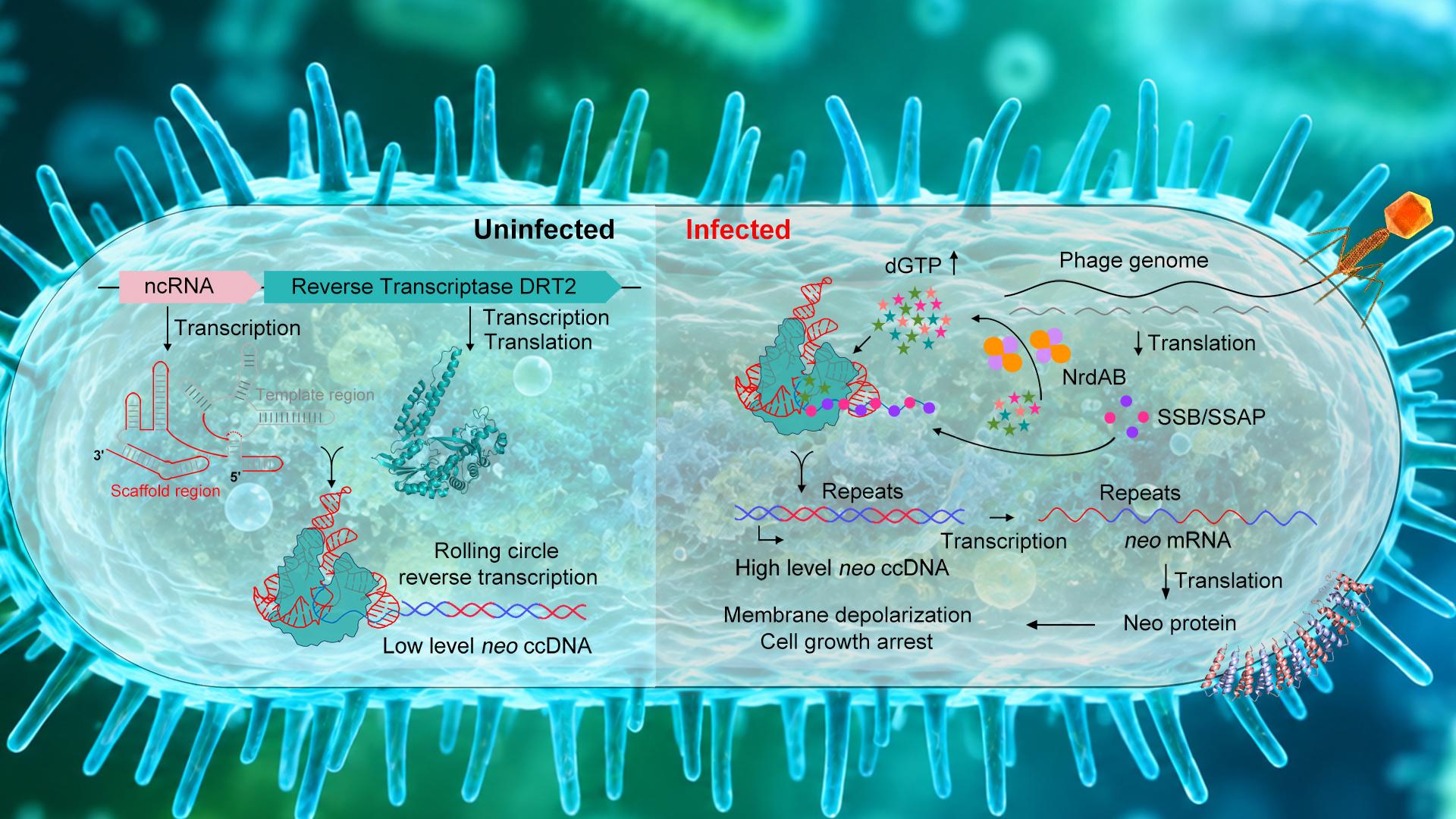
In uninfected cells, although the ncRNA and RT are constitutively expressed, only a small amount of concatemeric cDNA (ccDNA) is produced. Phage infection triggers rapid synthesis of double-stranded ccDNA, leading to massive accumulation, which enables the transcription and translation of the neo gene. Building on this, the current study further dissects how the DRT2 system recognizes phage invasion and how the newly formed Neo protein exerts its antiphage effects.
When phages infect bacteria, they leave multiple “molecular fingerprints.” The JIA Lab discovered that the DRT2 system does not rely on a single signal but simultaneously monitors two distinct infection hallmarks (Figure 1D).
The first pathway: phage-encoded single-stranded DNA-binding proteins (SSB/SSAP) directly bind to the DRT2 complex, stimulating its continuous DNA synthesis.
The second pathway: to accelerate their replication, phages use the NrdAB enzyme to greatly increase dNTP levels in the host cell. Elevated dGTP can directly bind to DRT2, releasing its autoinhibition. Cryo-EM structural analysis shows that after dGTP binds, the DRT2-ncRNA complex undergoes a conformational change and activates reverse transcription. These two pathways act independently but synergistically, ensuring DRT2 is fully activated only when a real phage threat is present, avoiding self-inflicted damage.
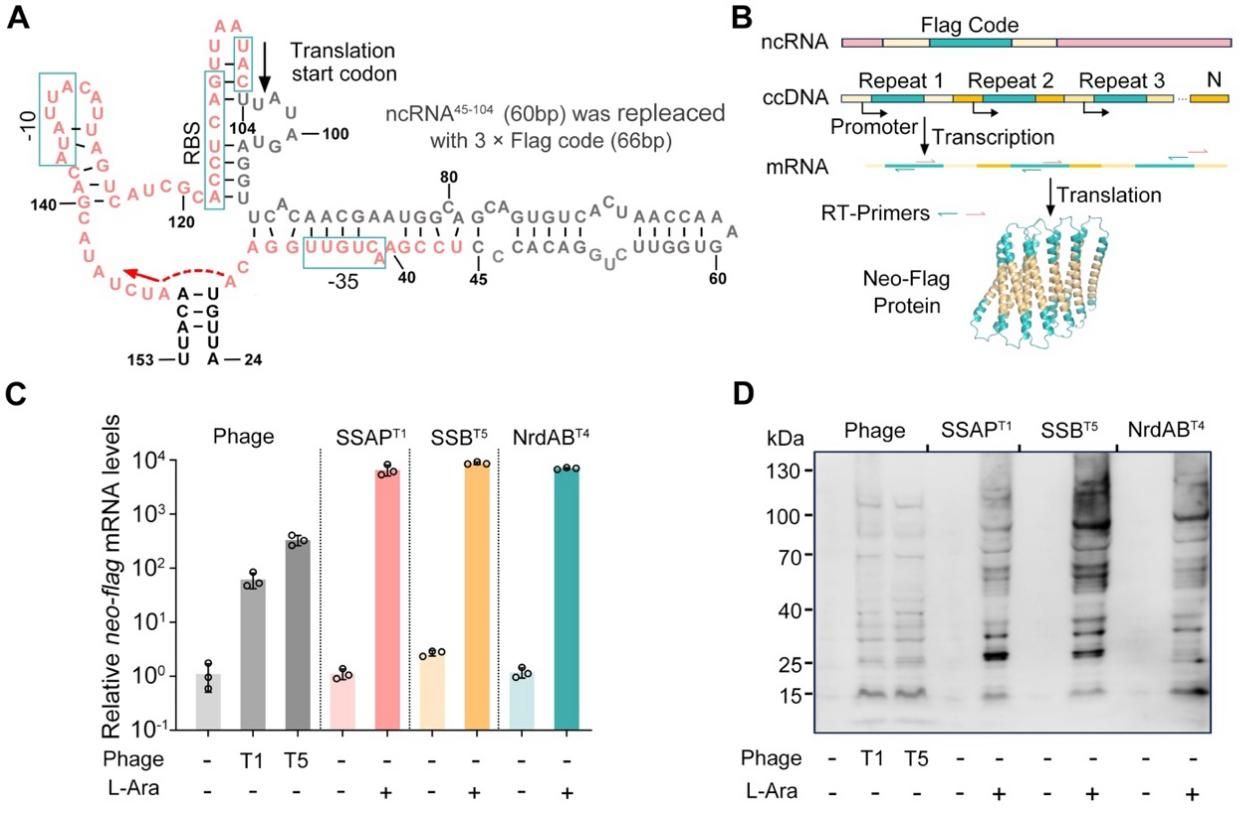
Figure 2. Reprogramming of the DRT2 system. (A) Schematic of DRT2 ncRNA engineering. (B) Schematic of reprogrammed protein production. (C) Transcriptional analysis of the reprogrammed protein. (D) Protein-level detection of the reprogrammed protein.
Compared to the previously characterized DRT9 system, DRT2 exhibits a more aggressive antiviral strategy. DRT9 senses elevated dATP levels during phage infection and produces long poly(A) single-stranded cDNA as a “decoy” to directly sequester phage SSB proteins. In contrast, DRT2 senses dual signals (dGTP and SSB/SSAP) and actively “writes” a novel toxin gene.
Together, these two studies unveil two fundamentally different ways in which defense-associated reverse transcriptases employ DNA for antiviral immunity, broadening our understanding of nucleic acid function and genetic information flow. Under specific physiological conditions, information embedded in noncoding RNA can be reorganized via reverse transcription to generate new protein-coding information that directly dictates cell fate.
Research Assistant Professor Dr. Yushan XIA and Doctoral students Hua QI and Xinyang WEI, from the Department of Biochemistry in the School of Medicine of SUSTech, are the co-first authors of this paper. Associate Professor Ning JIA is the corresponding author. SUSTech is the first and corresponding author institution.
Proofread ByNoah Crockett, Junxi KE
Photo ByYan QIU