The research team led by Associate Professor Weiqi YAO from the Department of Ocean Science and Engineering at the Southern University of Science and Technology (SUSTech) has made important progress in understanding fish productivity during the Paleocene-Eocene Thermal Maximum (PETM). The study provides a new perspective on the long-term response of marine productivity and ecosystems to sustained global warming. The study, entitled “Coupled increases in pelagic fish productivity and export productivity during the Paleocene-Eocene Thermal Maximum,” has been published in the international journal Nature Communications.
Marine productivity is an important component of the global carbon cycle and directly influences the survival of marine organisms, including fish, as well as fisheries resources. Modern observations indicate that global open-ocean productivity has generally declined over the past several decades. This decline is commonly attributed to enhanced ocean stratification, weakened upwelling, and reduced nutrient supply associated with global warming. The decline in marine productivity has therefore become an important signal of how global warming is affecting marine ecosystems. However, modern observations cover only a relatively short period, and whether these short-term declines reflect the ocean’s response over longer timescales remains poorly constrained by geological records.
Approximately 56 million years ago, the PETM was one of the most prominent episodes of rapid global warming in the Cenozoic. Large amounts of isotopically light carbon were rapidly injected into the ocean-atmosphere system, causing a substantial increase in global temperature that persisted for tens of thousands to more than 100,000 years. This ancient warm period therefore provides an opportunity to address a fundamental question: How would marine ecosystems respond to sustained warming over longer timescales?
To address this question, the research team focused on a distinctive type of fossil, ichthyoliths, to reconstruct changes in fish productivity during the PETM. Ichthyoliths are microscopic fossil remains of fish preserved in marine sediments, consisting mainly of small hard tissues such as fish teeth. Because fish continuously shed their teeth during growth and replacement, the resulting ichthyolith accumulation rate in marine sediments can be used to reconstruct the temporal evolution of past fish productivity.
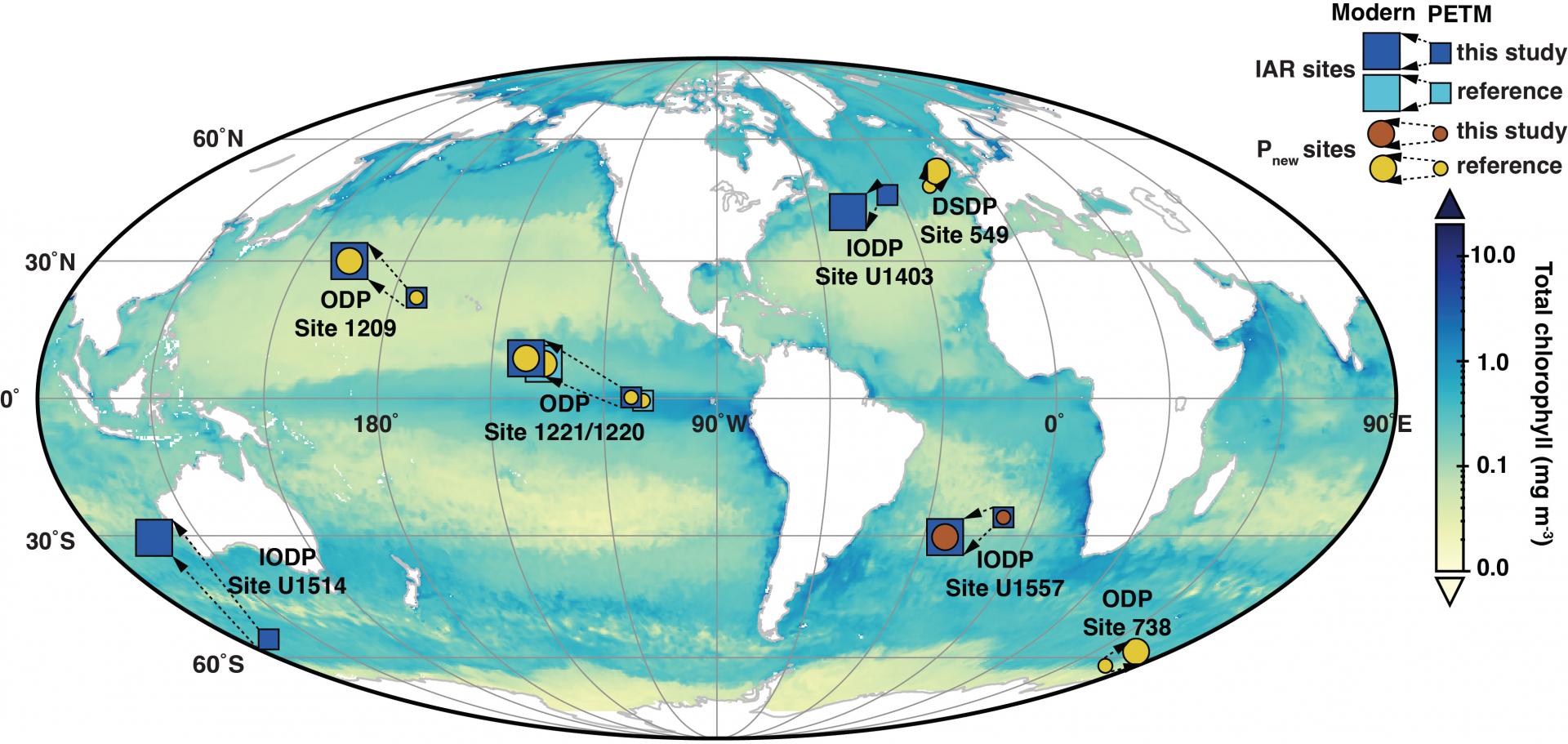
Figure 1. Locations of study sites
By analyzing marine sediment cores from multiple locations across the global ocean (Figure 1), the research team found that ichthyolith accumulation rates increased by up to an order of magnitude in several ocean regions during the PETM, with particularly pronounced responses in the Eastern Equatorial Pacific, North Pacific, and North Atlantic (Figure 2). At the same time, no substantial changes were observed in ichthyolith size or type, with no evidence of a large-scale transient excursion fauna, suggesting that the overall composition of fish communities remained relatively stable. These observations indicate that the increase in ichthyolith accumulation rates primarily reflects a substantial rise in pelagic fish productivity during the PETM.
Why did fish productivity increase?
One possible explanation is related to marine export productivity. Phytoplankton in the surface ocean fix carbon dioxide through photosynthesis, and part of the resulting organic carbon is exported into the deep ocean through particle sinking. This exported organic carbon provides an important source of energy for organisms at higher trophic levels. To examine the relationship between fish productivity and export productivity, the research team used marine barite accumulation rates to reconstruct changes in export productivity during the PETM.
The results show that export productivity and fish productivity both exhibited one or two pronounced peaks during the PETM at multiple ocean sites, with highly similar overall trends and spatial patterns. When the global datasets were combined, the two variables showed a significant positive correlation. These results suggest that enhanced carbon export during the PETM likely increased food availability for mid-trophic-level pelagic fish, thereby supporting the observed increase in fish productivity.
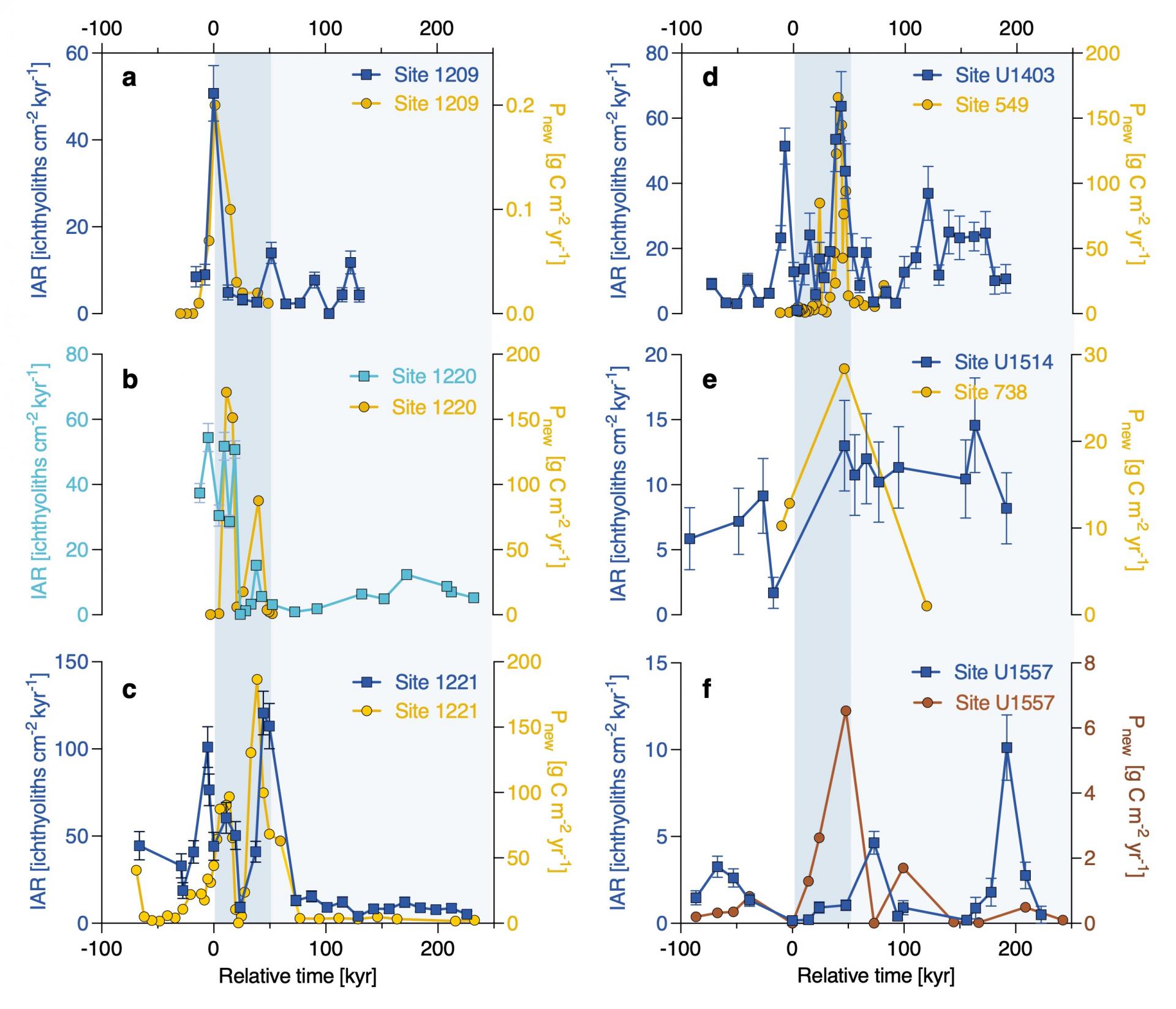
Figure 2. Comparison of ichthyolith accumulation rate (IAR) and export productivity (Pnew) during the PETM
Modern observations show that warming of the upper ocean generally strengthens stratification, making it more difficult for nutrient-rich deep waters to reach the surface. This is one of the major mechanisms proposed to explain declining productivity in some low-latitude regions under global warming.
Why did marine productivity increase during the PETM?
To further investigate the underlying mechanisms, the research team used the Earth system model cGENIE to simulate the effects of increased atmospheric pCO2, external phosphorus input from terrestrial weathering, and internal phosphorus recycling on export productivity (Figure 3). Under doubled atmospheric pCO2, when terrestrial phosphorus weathering increased to 1-1.9 times the baseline level, the global mean particulate organic carbon export flux increased from 0.7 to 1.2-1.6 mol m⁻2 yr⁻1. This increase is broadly consistent in magnitude with the approximately two- to threefold increase reconstructed from marine barite accumulation rates (Figure 3b, e). In contrast, enhanced phosphorus recycling did not produce an additional substantial increase in productivity because ocean stratification limited the upward transport of nutrients from deeper waters to the surface (Figure 3c, f). These simulations suggest that, over long timescales of sustained warming, enhanced external phosphorus input from intensified continental weathering can play an important role in maintaining or even increasing marine productivity.
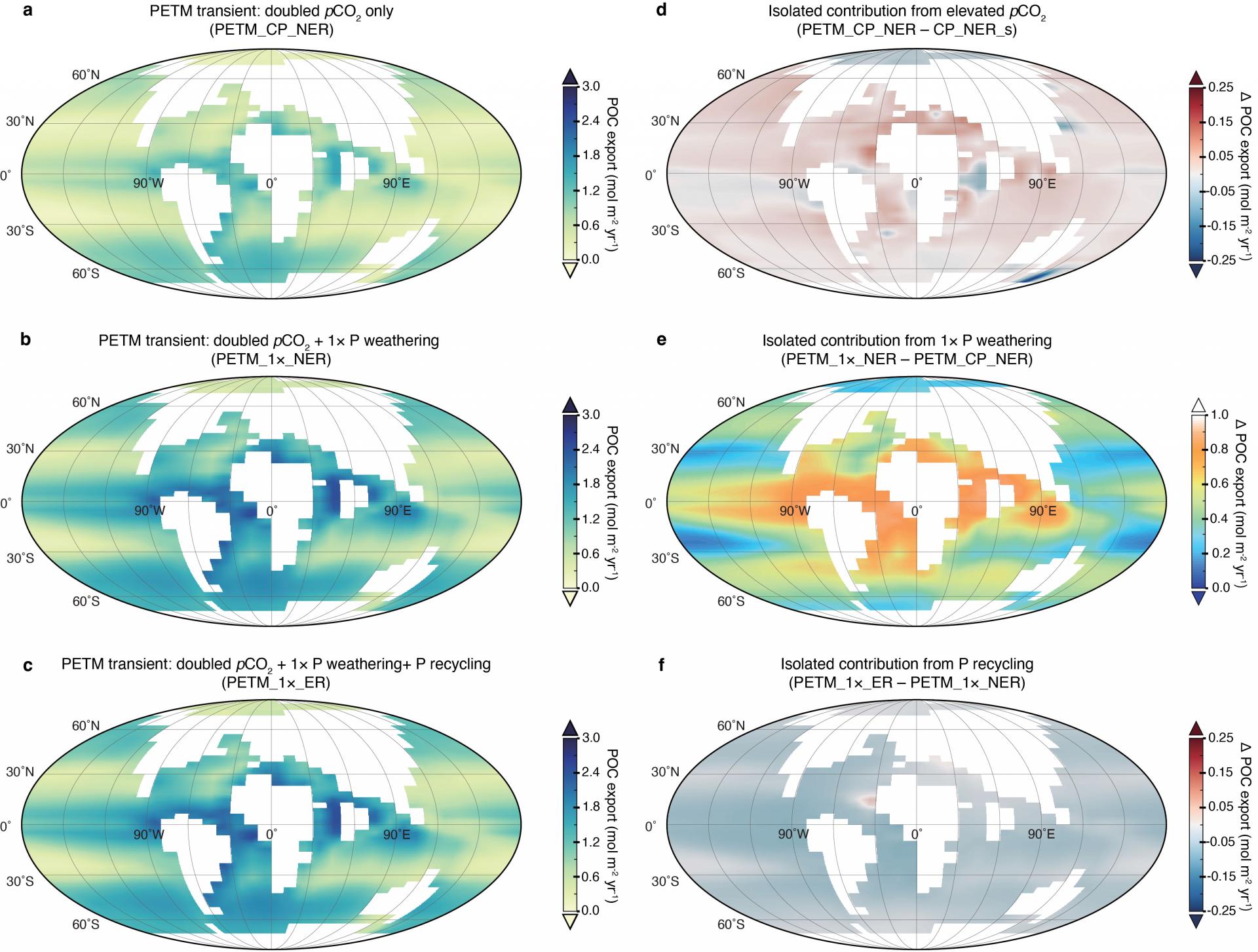
Figure 3. cGENIE simulations of changes in marine export productivity and their controlling mechanisms during the PETM
The findings do not tell us that “global warming makes more fish.” More importantly, they show that the response of marine productivity to global warming depends strongly on the timescale considered. Over short timescales of decades to centuries, rapid warming driven by human activities can quickly strengthen ocean stratification, while continental weathering and the redistribution of nutrients have not yet had sufficient time to respond. Marine productivity may therefore be suppressed. Over millennial and longer timescales, however, sustained global warming can intensify continental weathering and increase nutrient delivery to the ocean. These processes may gradually offset, or even exceed, the productivity limitation caused by enhanced ocean stratification, allowing marine productivity to recover and potentially increase. This suggests that the declining trend in marine productivity observed today does not necessarily represent the eventual state of the ocean over much longer timescales.
Xiuwen ZHOU, a Ph.D. student in the Department of Ocean Science and Engineering at SUSTech, is the first author of the paper. Associate Professor Weiqi YAO is the corresponding author, and SUSTech is the first affiliation. The research team includes Ruiling ZHANG, a Ph.D. student in the Department of Ocean Science and Engineering at SUSTech; Man-Yin Tsang, an Assistant Professor at the University of Saskatchewan, Canada; and Researcher Mingsong LI from Peking University.
Proofread ByNoah Crockett
Photo By