The research group of Associate Professor Junxue LI from the Department of Physics at Southern University of Science and Technology (SUSTech), the State Key Laboratory of Quantum Functional Materials, and the Quantum Science Center of Guangdong-Hong Kong-Macao Greater Bay Area has made progress in the study of antiferromagnetic spin transport. The related results were published in Nature Communications under the title “Observation of D’yakonov-Perel’-type magnon spin relaxation in uniaxial antiferromagnetic insulators.”
With the rapid development of information technology, how to achieve low-power, high-speed information transmission and processing has become an important research goal in the field of spintronics. Unlike traditional electronic devices that mainly rely on charge transport, spintronics uses electron spin/magnons to transmit information, which is expected to significantly reduce energy consumption during device operation. In magnetic insulators, spin information can be transmitted over long distances via magnons. Therefore, understanding magnon transport and spin relaxation mechanisms is crucial for the development of new low-power spintronic devices.
Compared to electronic spin relaxation mechanisms, the spin relaxation mechanisms of magnons have long lacked direct experimental verification. Theoretical studies indicate that in uniaxial antiferromagnets, two degenerate circularly polarized magnon modes can be analogous to electron spin; due to the effective spin-orbit coupling introduced by dipolar interactions, magnon spin may exhibit DP-type relaxation behavior similar to that in electronic systems. Yet, this mechanism has not been clearly experimentally verified.
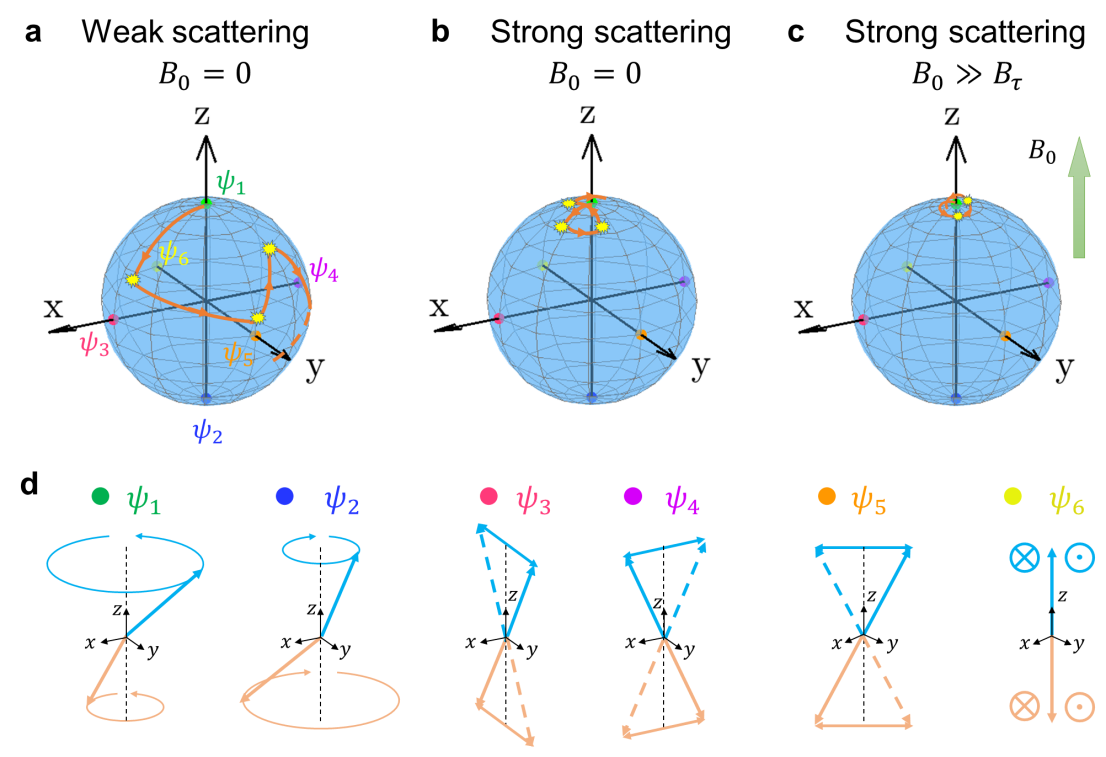
Figure 1. Schematic diagram of the DP-type magnon spin relaxation mechanism.
The research team chose two typical uniaxial collinear antiferromagnetic insulators, Cr₂O₃ and α-Fe₂O₃ (below 260 K), as study subjects, and systematically investigated magnon spin transport and relaxation behavior through nonlocal spin transport devices (Figure 2a).
The study found that before the spin-flop transition occurs, an external magnetic field can significantly enhance the nonlocal magnon spin signal (Figures 2f, 2d). This enhancement effect cannot be explained by conventional mechanisms such as the closure of the magnon gap, changes in domain wall scattering, local temperature variations, or magnon-phonon scattering. Since the magnetic field can effectively regulate the energy splitting of right-handed and left-handed magnons, it is expected that this anomalous phenomenon is related to the interaction between the two magnon modes.
The research team established a nonlocal transport model based on DP-type magnon spin relaxation. Using this model, it was found that when the external magnetic field is applied along the easy axis of the antiferromagnet, it can effectively suppress magnon spin relaxation, extend magnon spin lifetime, and enhance the nonlocal spin transport signal, showing high consistency between theory and experiment.
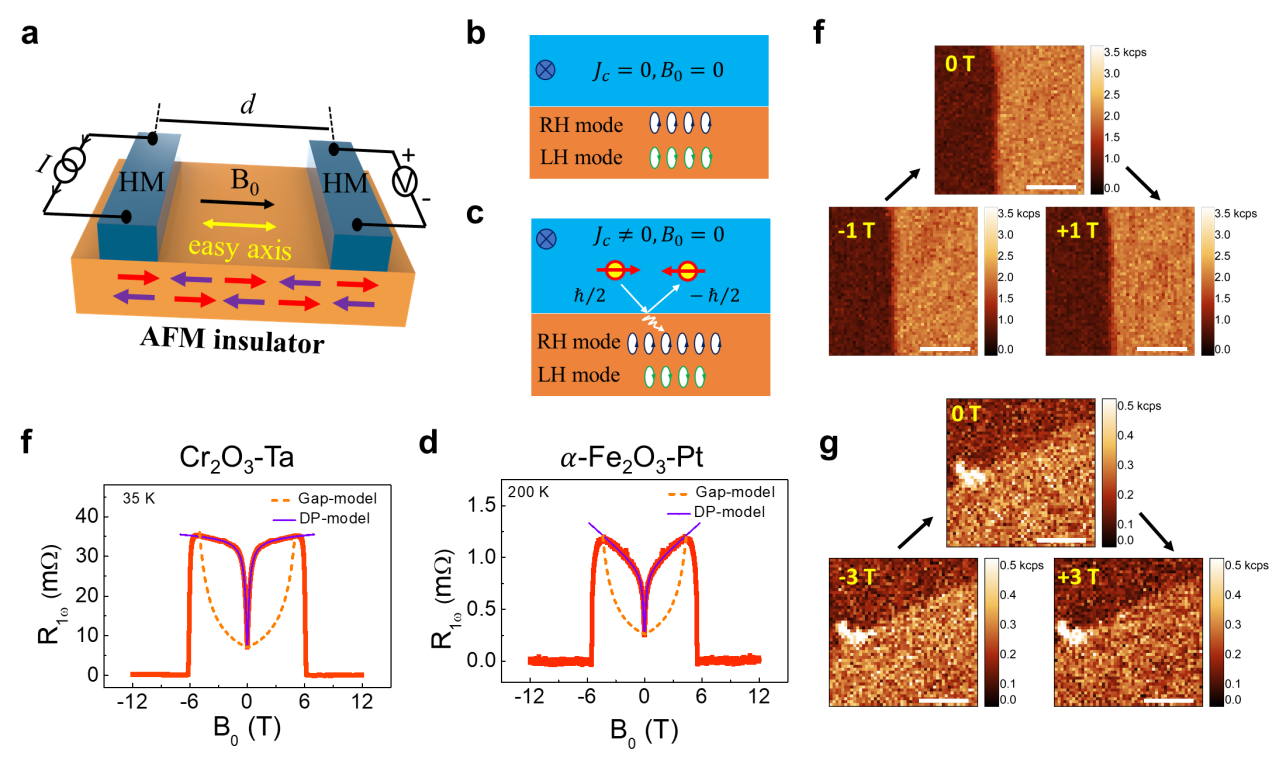
Figure 2. Long-distance magnon transport and antiferromagnetic domain imaging in uniaxial antiferromagnetic insulators.
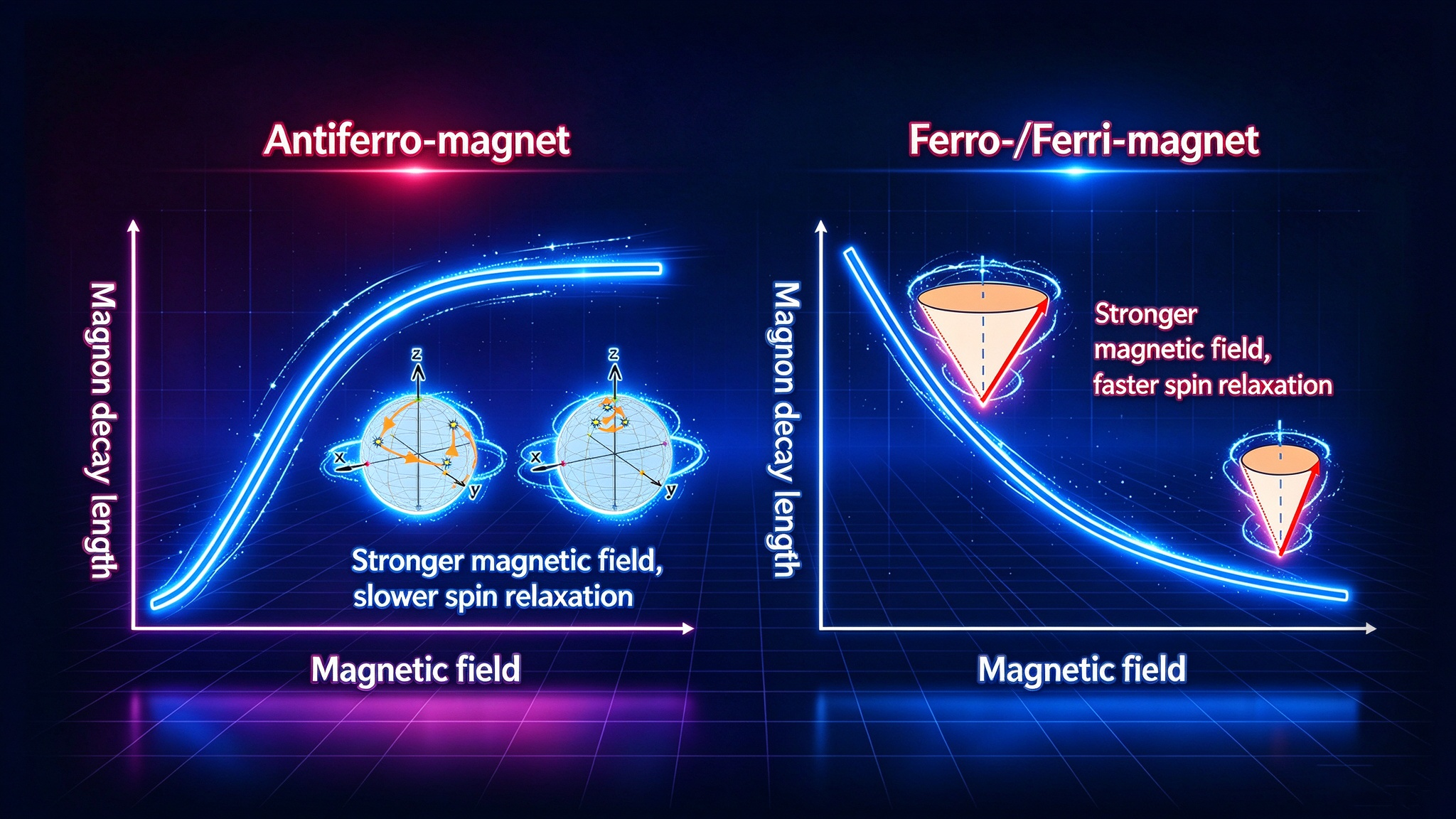
To verify the counterintuitive physical picture that the magnon spin relaxation length increases with increasing magnetic field, the research team fabricated nonlocal devices with different spacings and extracted the magnon spin diffusion lengths under various magnetic fields. As shown in Figures 3b and 3d, in Cr₂O₃ and α-Fe₂O₃, the magnon spin diffusion length increases with the external magnetic field and tends to saturate after a certain field strength. This is completely opposite to magnon relaxation phenomena in ferromagnets and ferrimagnets: in the latter, the magnon spin relaxation length decreases as the magnetic field increases. This result further demonstrates that an external magnetic field can suppress DP-type magnon spin relaxation, thereby enhancing magnon spin transport efficiency in antiferromagnets.
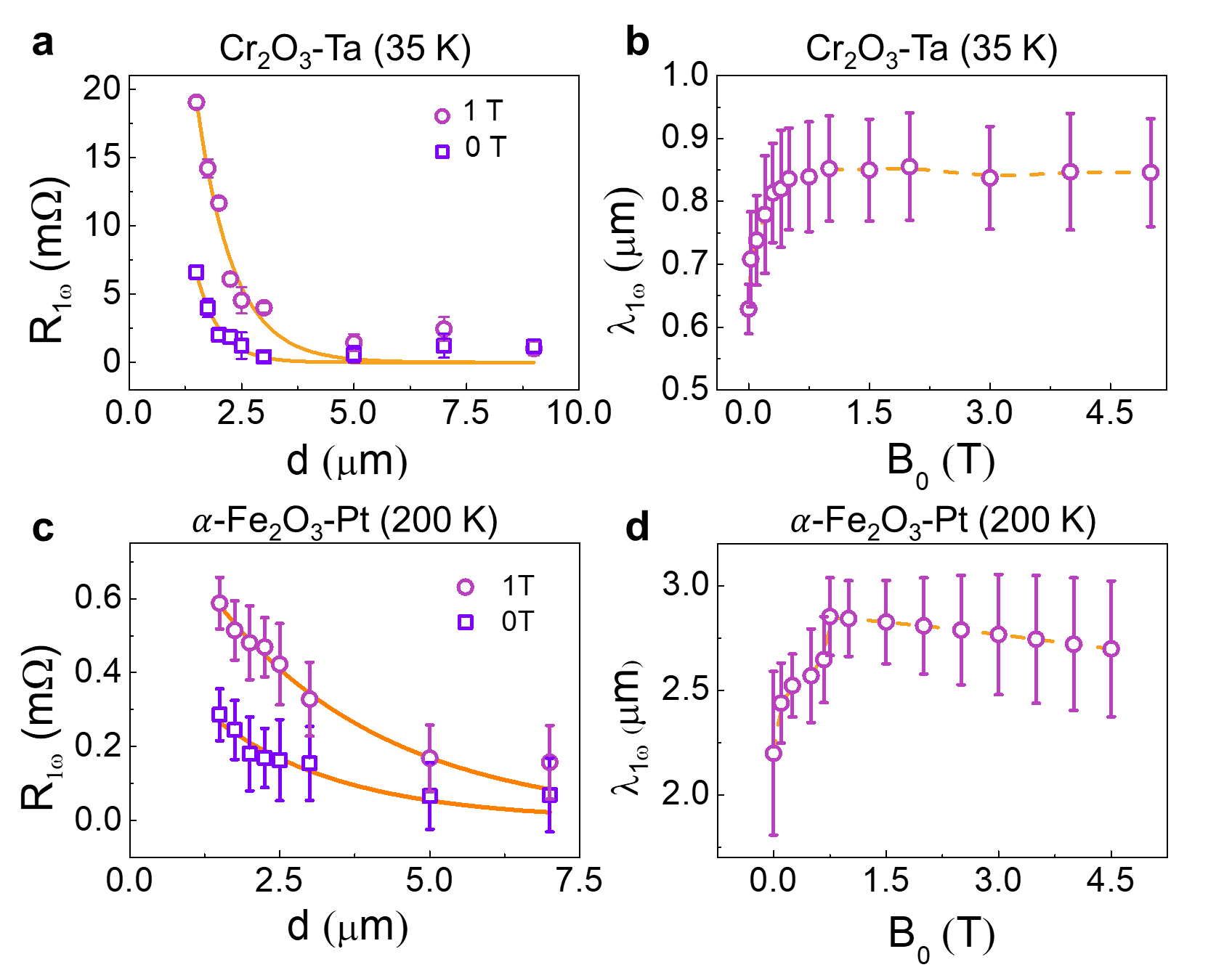
Figure 3. Magnon spin diffusion length as a function of magnetic Field.
The research team systematically studied the temperature dependence of the magnon spin diffusion length at zero field. The researchers found that the temperature evolution behavior in Cr₂O₃ and α-Fe₂O₃ can both be qualitatively explained by the DP-type magnon spin relaxation model. This indicates that magnon momentum relaxation, magnon energy gaps, and effective spin-orbit coupling together determine the magnon spin transport behavior in uniaxial collinear antiferromagnetic insulators.
This study experimentally reveals that DP-type magnon spin relaxation plays a dominant role in collinear antiferromagnetic insulators, providing a new physical picture for understanding magnon dynamics in antiferromagnets, and laying an important foundation for designing high-efficiency antiferromagnetic spintronic devices.
Assistant Researcher Qinwu GAO from the Quantum Science Center of Guangdong-Hong Kong-Macao Greater Bay Area and Dr. Andi CONG from the Department of Physics, Beijing Normal University, are co-first authors of the paper. Professor Ka SHEN from the Department of Physics, Beijing Normal University and Associate Professor Junxue LI from SUSTech are co-corresponding authors. This research was strongly supported by Professor Shiwei WU from Fudan University. SUSTech is the first affiliated institution of the paper.
Article Link: https://www.nature.com/articles/s41467-026-71298-y
Proofread ByNoah Crockett, Junxi KE
Photo ByYan QIU