The team led by Associate Professor Mingming ZHANG from the Department of Biomedical Engineering at the Southern University of Science and Technology (SUSTech) has achieved important progress in brain-computer interfaces (BCIs). The related work, “Aligning Temporal EEG Components: A Framework for Enhanced Motor Decoding,” has been published in Engineering, the flagship journal of the Chinese Academy of Engineering.
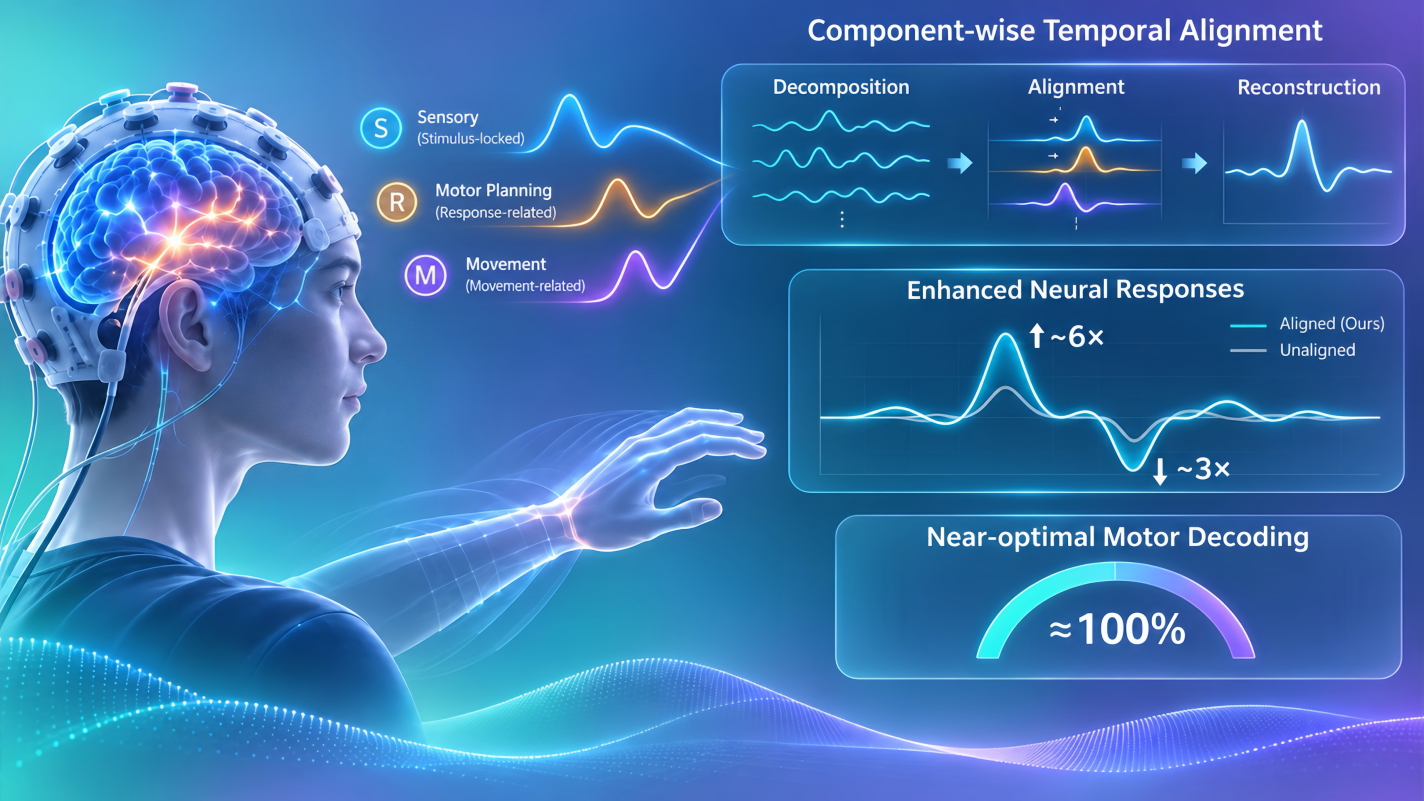
BCIs enable information exchange between the human brain and external devices by decoding neural activity, offering promising applications in motor function assistance and neurorehabilitation. Electroencephalogram (EEG)-based motor intention decoding is one of the key technologies underpinning non-invasive BCIs. Motor intention decoding has had limited performance due to temporal misalignment among distinct neural components in EEG signals and the blurring of neural response features. The team proposes a multi-component temporal alignment and reconstruction framework. It performs independent temporal calibration and signal reconstruction for various neural activity components, substantially improving the cross-trial temporal consistency of neural components and boosting motor decoding accuracy.
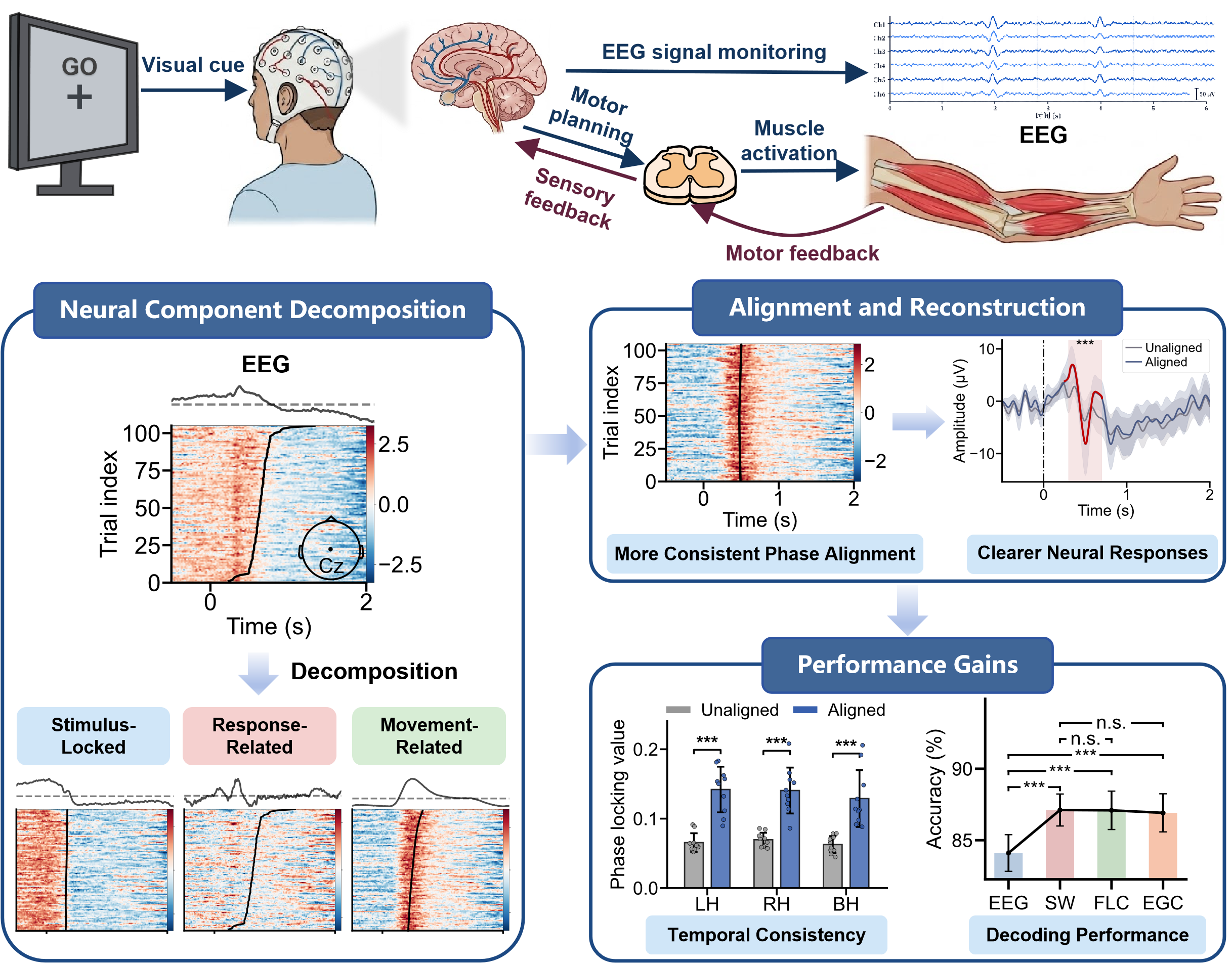 Figure 1. Multi-component neural activity temporal alignment and reconstruction framework
Temporal variability of movement-related neural activity is a critical factor affecting EEG signal analysis and decoding. Featuring non-invasiveness and ease of deployment, EEG has become an important technical modality for BCIs to recognize motor intentions and control external devices. Human movement, however, is a complex neural process comprising sensory processing, movement preparation, and movement execution. Neural activity at different stages exhibits distinct temporal characteristics, and the timing of neural responses fluctuates across trials. Conventional decoding methods generally extract and analyze signals within fixed time windows. Such methods struggle to accommodate temporal variations of different neural components, which may blur or miss key neural features and hinder further improvements in motor intention decoding performance.
Focusing on temporal alignment of neural components for motor decoding, the team explores new approaches for multi-component EEG information fusion. Using Residue Iteration Decomposition (RIDE), the researchers decompose movement-related EEG signals and conduct temporal calibration. On this basis, two complementary information fusion strategies are designed: full-length concatenation (FLC) and event-guided reconstruction (EGC), generating input signals for deep-learning-based motor intention decoding. Unlike traditional RIDE applications that mainly analyze neural response components, this work investigates how temporally calibrated multi-component information can facilitate motor intention decoding, establishing a complete processing pipeline from EEG component analysis to motor decoding.
Experiments confirm that component temporal alignment effectively strengthens movement-related neural response features. The experiments cover common movement patterns in daily life: unilateral left-hand movement, unilateral right-hand movement, and bimanual coordinated movement. Results show that after component-wise temporal calibration, the amplitudes of positive and negative event-related potential (ERP) peaks increase by approximately 6-fold and 3-fold, respectively, and the inter-trial phase-locking value (PLV) increases by approximately 107%. These findings demonstrate that temporal alignment mitigates feature blurring caused by the temporal variability of neural responses, improves cross-trial temporal consistency of neural activity, and provides clearer neural representations for motor intention decoding.
Further experiments verify that multi-component information integration can effectively improve motor decoding performance. The team systematically validates the framework using multiple deep learning models. Results indicate that after temporal alignment and information fusion, decoding accuracies for left-hand, right-hand, and bimanual tasks are all significantly higher than those obtained directly from raw EEG signals. For single-hand tasks, the proposed framework achieves comparable decoding performance to the optimized sliding time-window method. For the more challenging bimanual tasks, its decoding performance reaches roughly 97.6% of that of the optimized sliding window method, while reducing reliance on exhaustive time-window search, demonstrating its application potential for motor intention decoding.
This study offers a new technical pathway for improving motor intention decoding in non-invasive BCIs. It reveals the complementary roles of neural information across different movement stages and validates the efficacy of component temporal alignment and reconstruction for EEG motor decoding. It also lays a foundation for future exploration of this framework in other BCI tasks.
Associate Researcher Yi-Feng CHEN and Master’s student Mengjiao ZHANG from the Department of Biomedical Engineering at SUSTech, Associate Professor Mingjie DONG from Beijing University of Technology, and Dr. Zhenhong LI from the University of Manchester are co-first authors. Associate Professor Mingming ZHANG from the Department of Biomedical Engineering is the corresponding author. SUSTech is the first affiliation. Academician Jian S. DAI from SUSTech and Professor Changsong ZHOU from Hong Kong Baptist University provided key guidance and support.
Paper Link: https://doi.org/10.1016/j.eng.2026.10.015
Proofread ByNoah Crockett, Junxi KE
Photo By