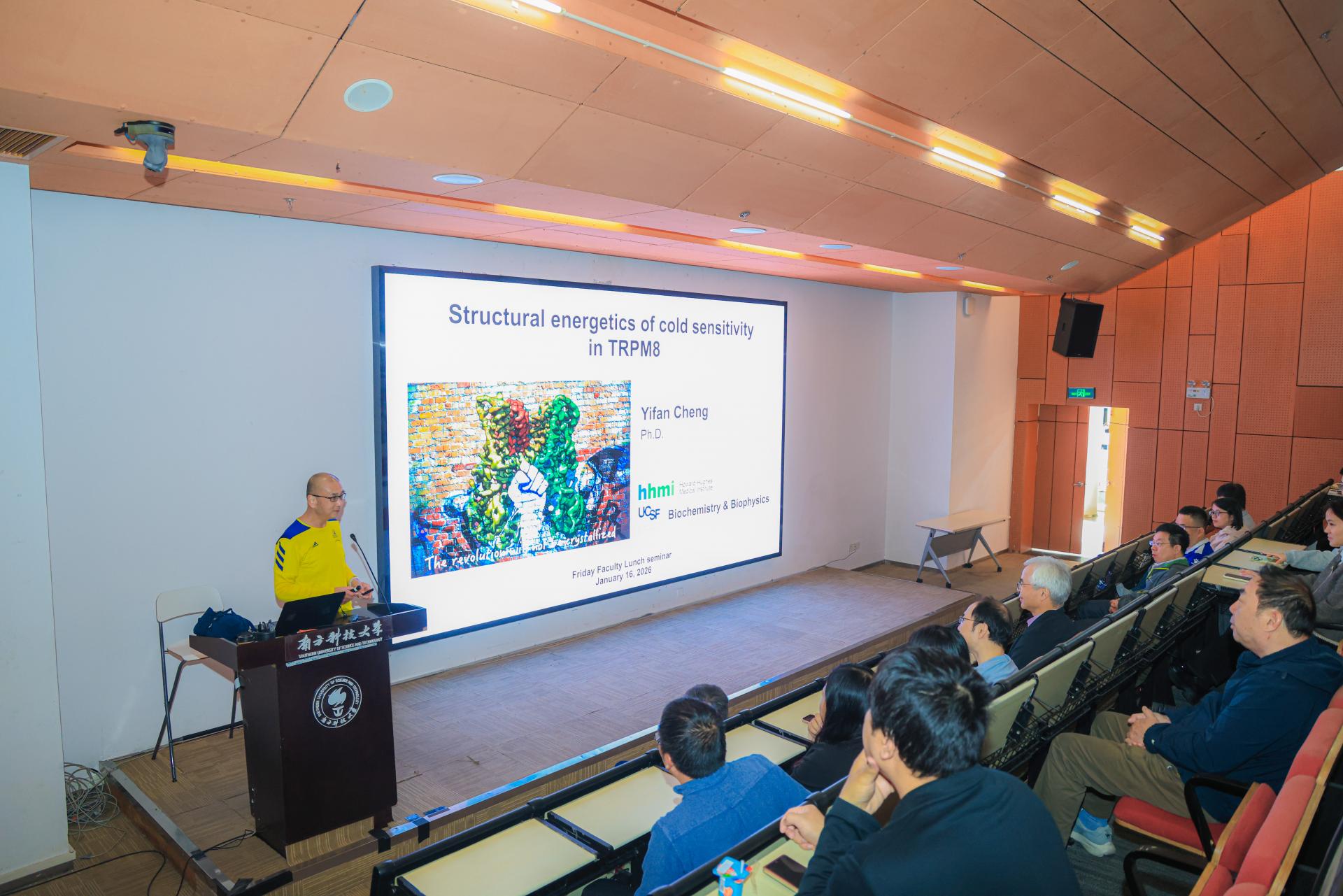
On March 16, Yifan CHENG was invited to the Southern University of Science and Technology (SUSTech) to deliver a guest lecture at the 427th session of the SUSTech Lecture Series. Yifan CHENG is a member of the American Academy of Arts and Sciences, a researcher at the Howard Hughes Medical Institute, and a professor of Biochemistry and Biophysics at the University of California San Francisco. His guest lecture was titled “Structural energetics of cold sensitivity in TRPM.” The event was hosted by Maofu LIAO, Chair Professor of the School of Life Sciences.
Academician Yifan CHENG focused on the issue of temperature sensing by TRP ion channels and highlighted the latest understanding of the cold-sensitive receptor TRPM8. TRPM8 is the cold receptor in mammals and also a menthol receptor; it is activated under low-temperature conditions and by chemical cold stimuli, playing a key role in the body’s temperature perception. Yifan CHENG pointed out that although the structures of several members of the TRP family have been resolved in recent years, and researchers have gained a relatively deep understanding of how ligands bind and regulate the channels, the question of “how temperature acts on the channel and drives its gating” remains one of the most fundamental and challenging scientific issues in the field. Unlike ligands that act on specific binding sites, temperature affects the thermal motion of nearly all atoms in a protein, so its mechanism cannot be directly explained solely by traditional static structures.
To address this problem, Yifan CHENG’s team combined cryo-electron microscopy structure determination with hydrogen-deuterium exchange mass spectrometry (HDX-MS) and other methods to study the cold-sensitive mechanism of TRPM8 from both structural and thermodynamic perspectives. The research suggests that TRPM8 may exist in a “semi-swapped” state that is different from the classical conformation, and the conversion between states is closely related to channel gating. This finding indicates that TRPM8’s function is closely linked to the dynamic balance between different conformations.
Academician Yifan CHENG introduced the differences between human TRPM8 and avian TRPM8. Although both have highly similar overall structures and can be activated by menthol, avian TRPM8 is not sensitive to low temperatures, whereas human TRPM8 shows clear cold activation properties. By comparing structure, dynamic behavior, and thermodynamic characteristics, the research team found that differences in local region stability may be the key reason for the difference in cold sensitivity. In particular, changes in conformational dynamics and stability in the pore region and TRP helix-related areas may be an important basis for cold-induced channel opening. He also introduced the team’s results in measuring conformational stability in different regions of TRPM8 using HDX-MS. The study showed that human and avian TRPM8 differ in the dynamic characteristics and stability of local structural elements, and these differences may be important factors determining their different cold sensitivities. Based on this, the team proposed that TRPM8’s response to low temperature is more likely due to changes in the energy landscape between different conformational states rather than the presence of a single special structure.
Academician Yifan CHENG pointed out that this work also provides methodological insights for structural biology research. For highly dynamic membrane proteins like TRPM8, merely pursuing a single high-resolution structure is insufficient to fully explain their functional mechanisms. Many key pieces of biological information lie exactly in the “low-resolution,” “hard-to-resolve,” or even “unseen” dynamic regions. In the future, structural biology needs to integrate more dynamics and thermodynamic analysis, moving from “static structures” to “dynamic energy landscapes,” to truly reveal the working mechanisms of complex biomacromolecules.
Proofread ByJunxi KE
Photo ByXuan WANG