The research team led by Assistant Professor Peng ZHAN from the Department of Ocean Science and Engineering at Southern University of Science and Technology (SUSTech) has made new progress in multi-scale ocean dynamics. Their study, titled “Submesoscale Vertical Heat Flux Amplifies a Cross-Scale Positive Feedback in the Western Arabian Sea,” has been published in Geophysical Research Letters.
Based on high-resolution numerical simulations, the study reveals a novel cross-scale coupled mechanism of upper-ocean heat transport under the summer monsoon in the western Arabian Sea, providing new physical insights into interactions across oceanic scales and the internal energy cycle of the ocean.
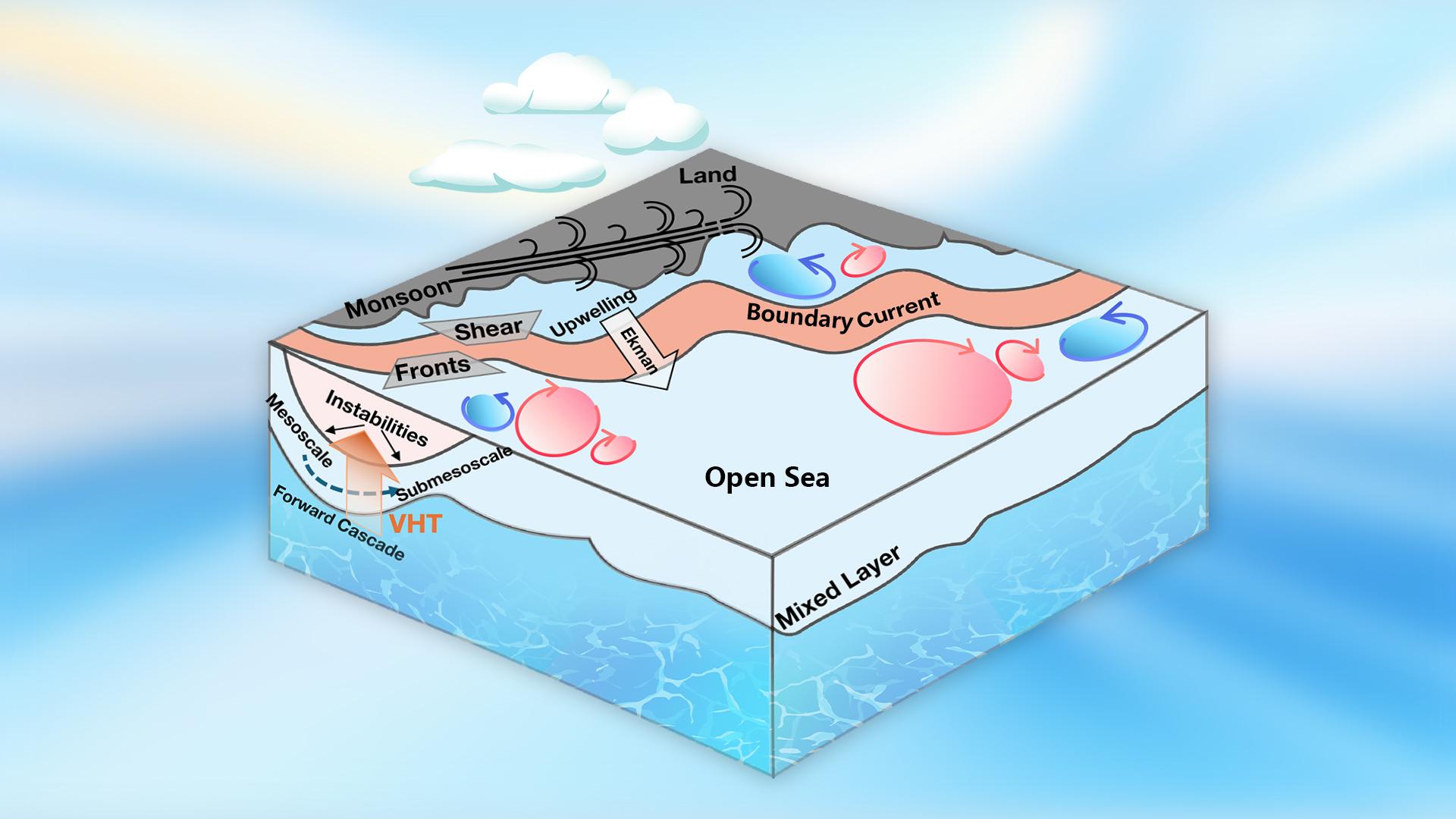
Figure 1. Schematic illustration of the positive feedback loop among baroclinic growth, forward energy cascade, and enhanced vertical heat transport under monsoon-driven upwelling and coastal cold-water replenishment.
Submesoscale ocean processes typically refer to rapid motions with spatial scales of ~0.1-10s km and temporal scales ranging from hours to days, often manifested as fronts, filaments, and associated strong vertical velocities. Compared with mesoscale eddies, these processes, although smaller in scale, are more efficient in transporting heat, salinity, and tracers. They are therefore regarded as a key bridge linking large-scale circulation, mesoscale eddies, and small-scale mixing, and play a critical role in regulating upper-ocean heat redistribution. This study focuses on submesoscale vertical heat flux, demonstrating that it not only affects sea surface temperature and air–sea heat exchange, but may also influence regional climate by modifying the upper-ocean thermal structure.
Submesoscale processes are generally considered to be more active in winter, particularly in the open ocean. However, this study shows that in the western Arabian Sea, submesoscale vertical heat flux peaks not in winter but during the summer monsoon. This finding challenges the conventional understanding of submesoscale seasonality and highlights strong regional specificity in upper-ocean heat transport mechanisms under the combined influence of monsoonal forcing and coastal upwelling. The results further indicate that summer coastal Ekman upwelling significantly enhances cross-shore buoyancy gradients and isopycnal tilting, thereby promoting upward heat transport driven jointly by mesoscale and submesoscale processes.
The research identifies a new cross-scale positive feedback mechanism: monsoon-driven coastal upwelling first establishes strong horizontal density gradients, triggering mesoscale baroclinic instability that releases available potential energy and generates upward mesoscale heat transport. Meanwhile, kinetic energy cascades forward from mesoscale to smaller scales, energizing submesoscale frontogenesis and mixed-layer instabilities, which in turn enhance upward submesoscale heat transport. The combined vertical heat flux from mesoscale and submesoscale processes further reinforces the original buoyancy gradients and instability background. Under conditions of coastal cold-water replenishment induced by upwelling, a closed positive feedback loop is established:
“baroclinic growth → forward energy cascade → enhanced vertical heat transport”
In this framework, vertical heat flux is no longer merely a consequence of ocean dynamics, but a key physical linkage connecting mesoscale-submesoscale interactions.
This discovery implies that the oceanic internal energy cycle is not simply a one-way pathway from background circulation to mesoscale eddies and then to small-scale dissipation. Instead, it may form a closed, coupled system involving the release of available potential energy, cross-scale kinetic energy transfer, and heat redistribution. From an ocean dynamics perspective, this work provides a new theoretical framework for understanding frontal maintenance, eddy evolution, and thermal structure adjustment in upwelling regions. More broadly, for air-sea interaction and climate studies, it suggests that motions across different oceanic scales are not independent but jointly shape sea surface temperature, air-sea heat exchange, and regional climate responses. The authors further note that this mechanism may not be unique to the Arabian Sea, but could apply to other regions characterized by strong upwelling, sharp fronts, and active eddies, thus holding important implications for improving the representation of upper-ocean heat transport in climate models.
SUSTech PhD student Chaoliang LI is the first author of the paper, and Peng ZHAN is the corresponding author. SUSTech is the primary affiliation.
Paper Link: https://agupubs.onlinelibrary.wiley.com/doi/10.1029/2025GL119482
Proofread ByNoah Crockett, Junxi KE
Photo ByYan QIU