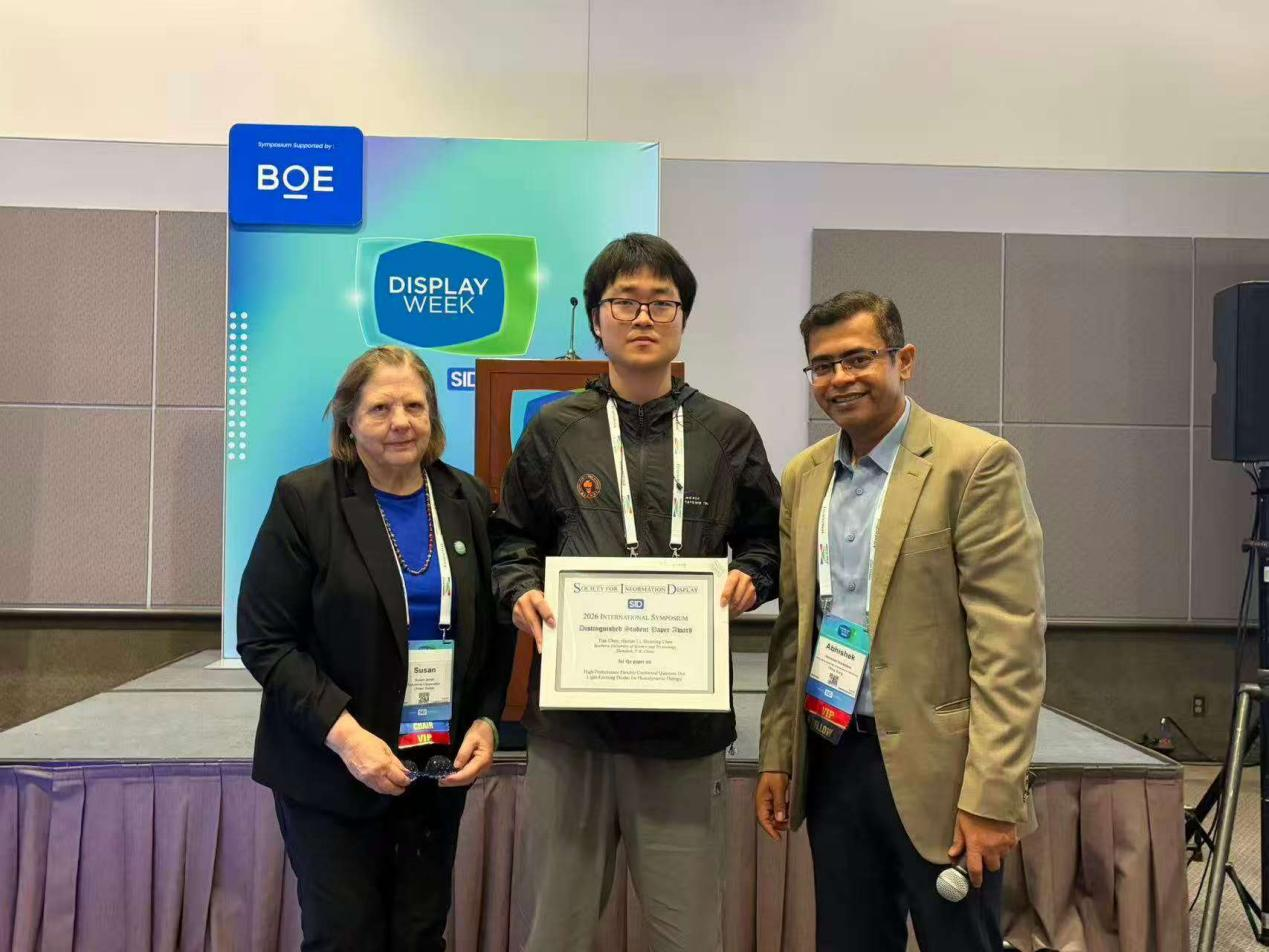
The Society for Information Display (SID) held Display Week 2026 in Los Angeles, USA. Tian CHEN, a 2023-entry undergraduate of Wolong Class majoring in Optoelectronic Information Science and Engineering at the Southern University of Science and Technology (SUSTech), won the “Distinguished Student Paper Award” at the conference for his reported paper and received a student travel grant from SID.
The Society for Information Display is a global professional academic organization composed of top scientists, engineers, enterprise researchers, and senior managers in the display industry, dedicated to promoting the development of display technology and industry. Display Week, organized by SID, is the largest and most influential global academic and industrial event in the field of display technology, covering multiple areas including basic research in display technology, device innovation, system integration, and cutting-edge applications, and showcasing the latest scientific research achievements and technological advancements across the global display industry chain. The conference attracts thousands of top scientists, engineers, industry experts, and representatives from well-known enterprises around the world to conduct in-depth exchanges and collaborations on the development trends of next-generation display technology. It is reported that the award rate for the “Distinguished Student Paper Award” at this conference is less than 5%.
The award-winning paper “High-Performance Flexible Conformal Quantum-Dot Light-Emitting Diodes for Photodynamic Therapy” has as its core achievement the development of high-performance top-emitting flexible quantum dot light-emitting diode (QLED) devices based on a PEN flexible substrate and a silver (Ag)/indium zinc oxide (IZO) composite transparent electrode, intended to meet the application needs of high-efficiency flexible light sources for photodynamic therapy (PDT). According to this scheme, through the synergistic optimization of the device’s optical, electrical, thermal, and mechanical properties, the device achieved an external quantum efficiency of 34.9%, a brightness exceeding 70,000 nits under 6V driving voltage, and a power density of 58 mW/cm², meeting the requirements of PDT applications for high brightness and high power output. To further enhance the safety and stability of the devices in practical medical scenarios, the research team introduced an efficient thermal management design, integrating a ultraconducting thermal patch (UCP) to reduce device operating temperature, alleviate thermal quenching effects, and extend operational lifetime; meanwhile, by combining advanced elastic packaging technology, the device’s stability under bending and complex deformation conditions was significantly improved. This device can achieve conformal adhesion to biological tissues, providing a new technical pathway for the development of wearable medical optoelectronic devices in the future.
The related research results have been published in the Journal of the Society for Information Display, with Tian CHEN and PhD student Haotao LI as co-first authors and Professor Shuming CHEN from the Department of Electronics and Electrical Engineering as the corresponding author.
Paper Link: http://dx.doi.org/10.1002/jsid.70069
Proofread ByShuming CHEN, Junxi KE
Photo ByDepartment of Electronics and Electrical Engineering