Chair Professor Ruijun TIAN and Associate Professor Lizhi TAO’s team from the Department of Chemistry of the College of Science at the Southern University of Science and Technology (SUSTech), together with Researcher Zhiyong LIU’s team from the Center for Excellence in Brain Science and Intelligence Technology of the Chinese Academy of Sciences, published a research paper titled “H2O2-Free Proximity Proteomics for Exploring Dynamic Protein Complexes in Living Systems” in Nature Chemical Biology. This work developed a proximity-labeling chemical proteomics technology aimed at studying dynamic protein complexes in live cells and in vivo animal systems. Notably, the work established a high-affinity small molecule probe obtained through chemical evolution and a highly selective proximity labeling chemical biology reaction system driven synergistically by in situ enzymatic radicals and oxygen.
The function of proteins in cells relies heavily on the rapid assembly and disassembly of dynamic protein complexes, and in many key signal transduction processes, the assembly of protein complexes occurs on a timescale of seconds. Although existing proximity labeling techniques have greatly advanced the study of organelle proteomes and protein interactions, they generally face bottlenecks such as slow labeling reactions, poor biocompatibility, serious oxidative damage, and limited tissue penetration. Therefore, how to capture dynamic protein complexes in their native in vivo environment quickly, accurately, and mildly has always been a technical challenge in the field of chemical proteomics.
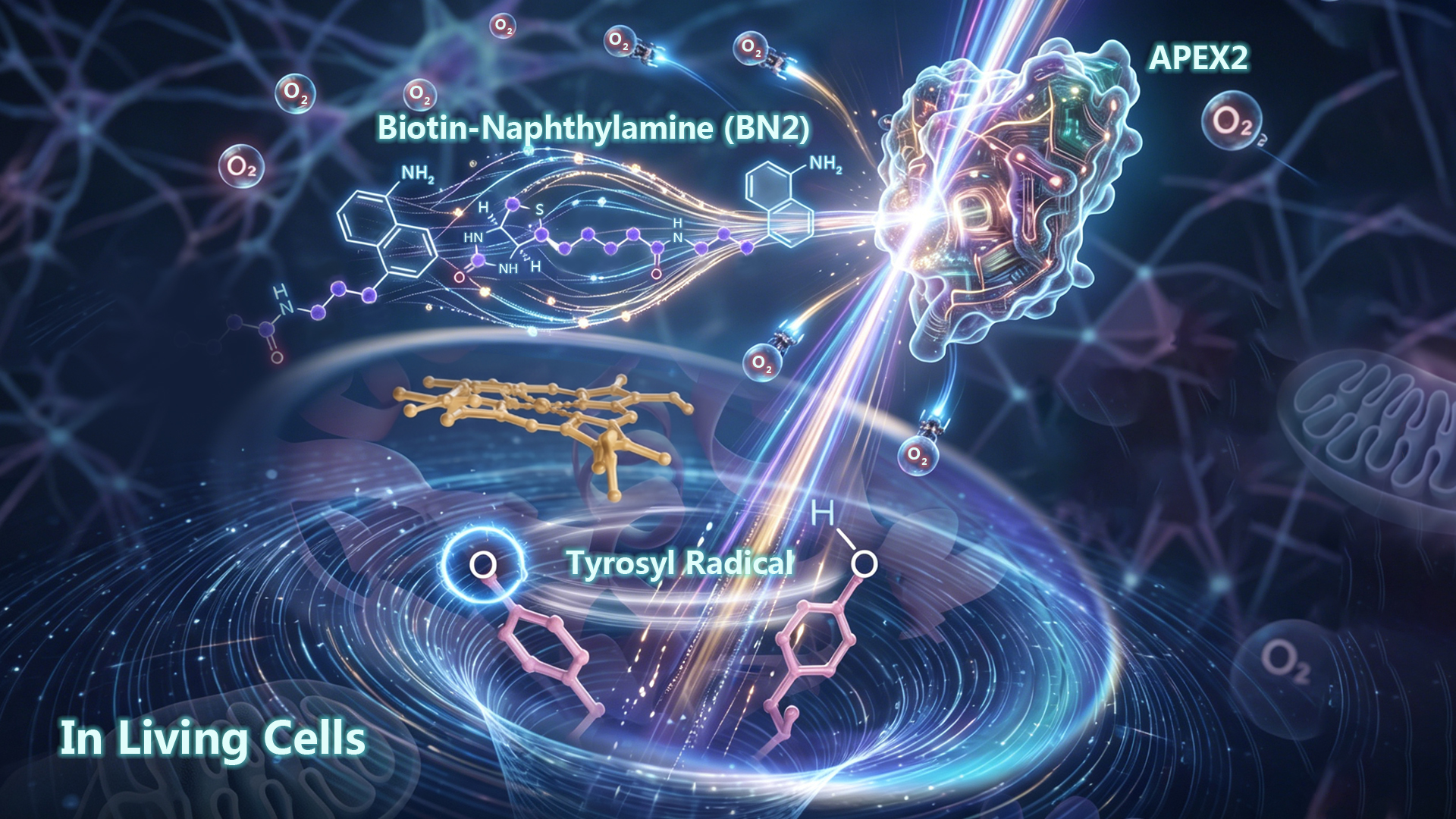
To address this issue, the research team started from the reaction mechanisms of the proximity labeling enzyme APX and its mutant APEX2, and developed the Radical- and Oxygen-driven proximity labeling (ROProx) system applicable to two modes: blue light responsiveness and low-level endogenous hydrogen peroxide responsiveness. The researchers designed and screened a chemical probe, biotin-naphthylamine BN2, which can synergize with high affinity to APEX2, and, combining experimental techniques such as electron paramagnetic resonance (EPR) spectroscopy, unexpectedly discovered the presence of tyrosyl radicals inside APX and APEX2. Based on the above unique chemical biology reaction mechanisms, ROProx possesses a dual-labeling mode: (1) under blue light illumination and the presence of oxygen at the second scale, ROProx can use this radical catalytic reaction mechanism to achieve highly selective and rapid proximity labeling of protein complexes within a range of approximately 10 nanometers; (2) ROProx can also respond to extremely low levels of endogenous hydrogen peroxide in cells, thereby bypassing the limitation of light penetration and achieving minute-level dynamic protein complex labeling in living animals. At the same time, the self-polymerization effect of the activated BN2 probe, along with site-specific proximity labeling at His42 on APEX2 and catalytic enzyme quenching, together form a dual “braking” mechanism that restricts the diffusion of active probe intermediates, ensuring that ROProx achieves high labeling selectivity within a 10-nanometer range.
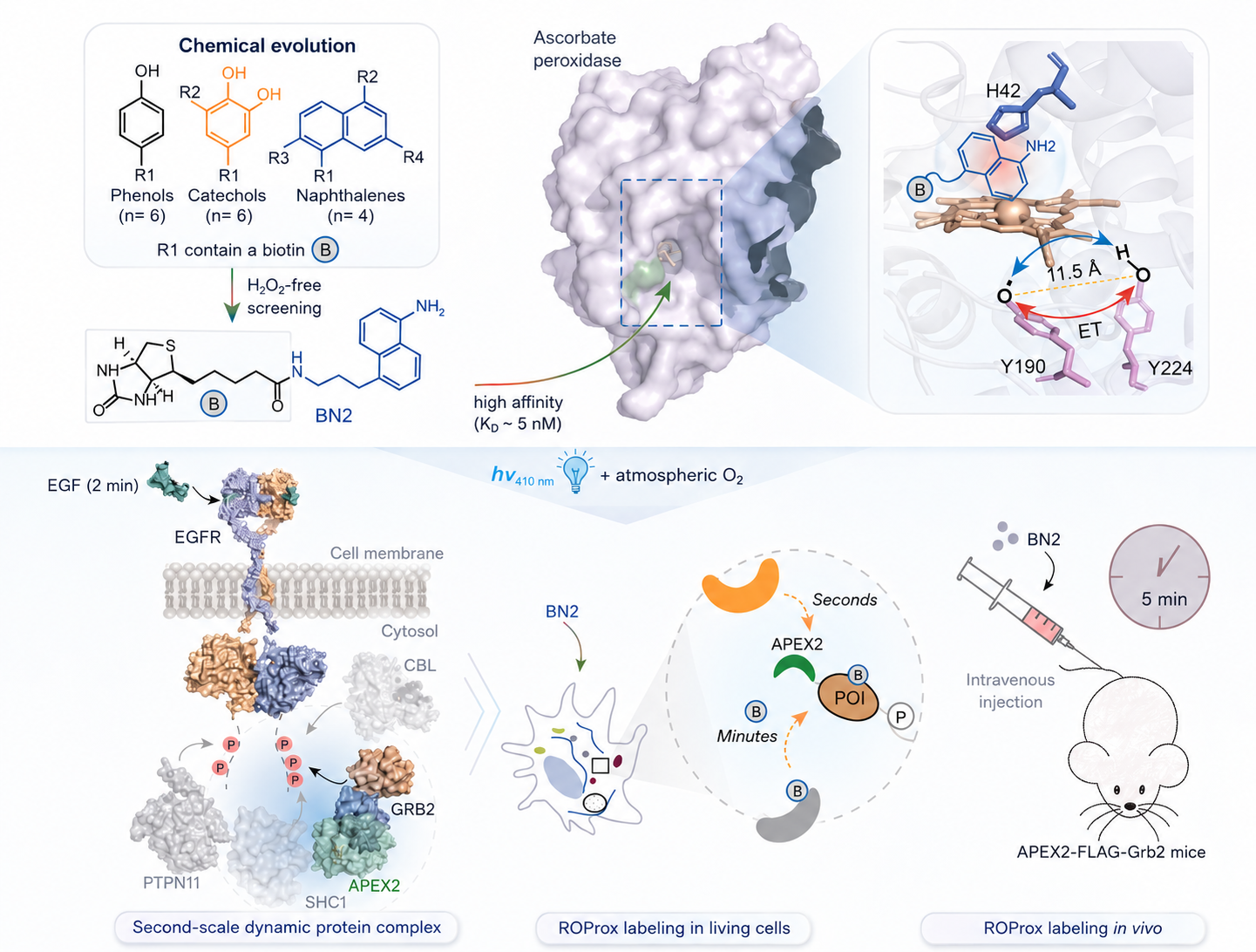
The research team further used a dynamic interactome system of the scaffold protein GRB2 mediated by the growth factor EGF to evaluate the proximity labeling performance of ROProx technology in live cells and transgenic in vivo animal systems. Compared to existing photoreactive enzyme-catalyzed proximity labeling techniques, ROProx technology can achieve highly selective labeling and proteomic analysis of protein complexes at the scale of seconds in live cells using mild blue light. More importantly, the BN2 probe can reach various organs within 5 minutes through tail vein injection and realize joint in situ proteomic characterization of dynamic protein complexes and related tyrosine phosphorylation signals at the minute level during processes such as liver regeneration. In summary, this study not only provides a new tool for analyzing dynamic protein interactomes in signaling networks in cancer and immune systems but also proposes a reaction system based on chemical evolution and in situ radical cooperative catalysis, opening new research directions for the design and development of future proximity labeling chemical biology reaction systems.
Chair Professor Ruijun TIAN from SUSTech is the corresponding author. Associate Professor Lizhi TAO from the Department of Chemistry of the College of Science at SUSTech, and Researcher Zhiyong LIU from the Center for Excellence in Brain Science and Intelligence Technology of the Chinese Academy of Sciences are co-corresponding authors of this paper. Research Assistant Professor Mi KE, Master’s student Fuchao LIANG from the Department of Chemistry, Ph.D. student Guangqin WANG from the Center for Excellence in Brain Science and Intelligence Technology, and Research Assistant An HE from SUSTech are co-first authors of this paper. The study was also actively supported by Associate Professor Zhe DONG and Associate Professor Jie WANG of the Department of Chemistry of the College of Science at SUSTech. SUSTech serves as the first author institution for this paper.
Article Link: https://doi.org/10.1038/s41589-026-02230-0
Proofread ByNoah Crockett, Junxi KE
Photo By