The research group led by Associate Professor Zhen GAO at Southern University of Science and Technology (SUSTech), in collaboration with the group led by Professor Peiheng ZHOU at the University of Electronic Science and Technology of China (UESTC), extended the study of Chiral Bound States in the Continuum (Chiral BICs) from conventional systems with broken spatial symmetry to systems with broken time-reversal symmetry. They experimentally observed Chiral BICs for the first time in self-biased magneto-optical photonic crystals without the need for an external magnetic field. The related findings were published in the Proceedings of the National Academy of Sciences (PNAS) under the title “Observation of Chiral Bound States in the Continuum in Self-Biased Magneto-Optical Photonic Crystals.”
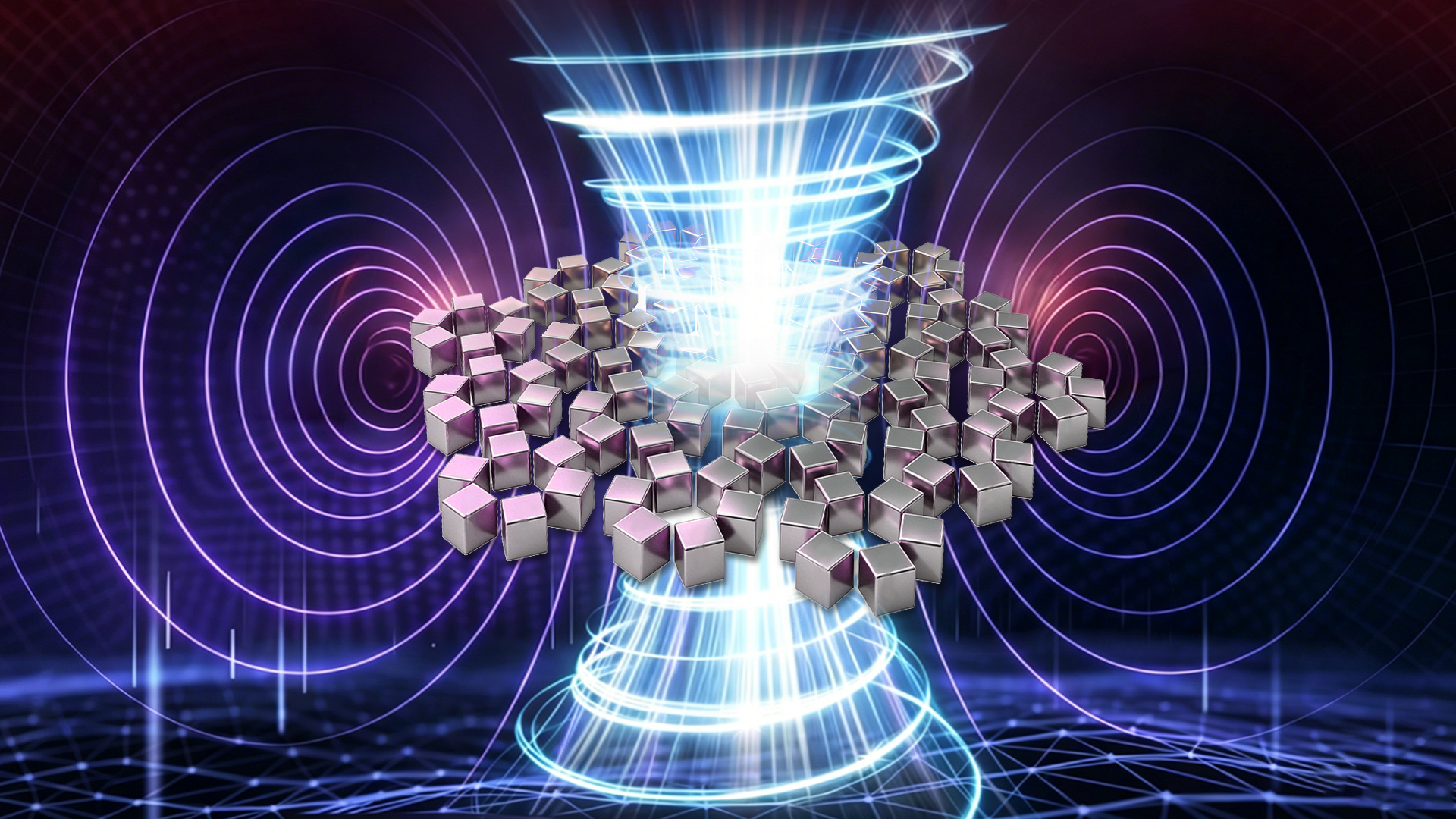
Bound states in the continuum (BICs) are a unique class of optical states that enable complete light localization within the radiation continuum while possessing theoretically infinite quality factors (Q factors). They provide an ideal platform for strong light confinement and optical field manipulation, holding great promise in areas such as lasers, nonlinear optics, and topological photonics. In recent years, the integration of chiral properties with BICs has led to the emergence of chiral BICs, which have become a key focus in chiral optics and topological photonics.
Conventional chiral BICs are typically realized by breaking structural symmetry in systems that preserve time-reversal symmetry (TRS). However, such approaches generally suffer from limited Q factors, high sensitivity to fabrication errors, and insufficient degrees of freedom for control. Recent theoretical studies have proposed that breaking TRS via the magneto-optical effect can split degenerate symmetry-protected BICs into a pair of chiral BICs with opposite handedness (Fig 1), offering a new route to overcome the limitations of conventional schemes.
Magnetically induced chiral BICs have so far remained at the theoretical stage, lacking experimental validation. Most proposals rely on externally applied magnetic fields, which hinder device integration and practical applications. Self-biased magneto-optical photonic crystals, leveraging the remnant magnetization of the material to break TRS, enable non-reciprocal and chiral control without the need for an external magnetic field, thus providing an ideal platform for the experimental realization of magnetically induced chiral BICs.
Achieving experimental observation, elucidating the formation mechanisms, and enabling performance control of chiral BICs in self-biased magneto-optical photonic crystals will not only fill the critical gap from theoretical prediction to experimental demonstration in this field, but also play a crucial foundation for the development of robust, tunable, and on-chip integrated chiral photonic devices.
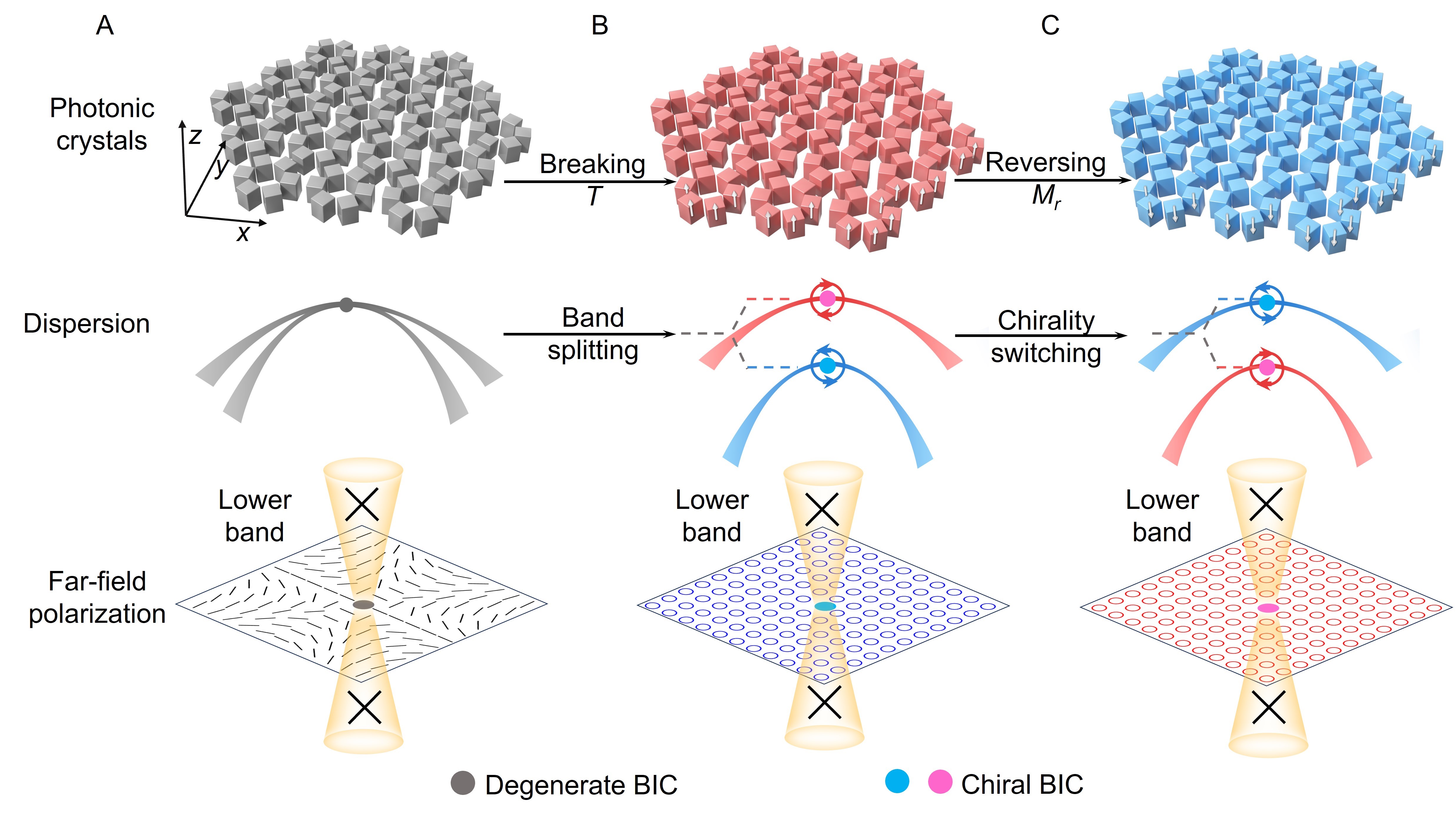
Fig 1. Physical mechanism of the magnetically induced chiral BICs with TRS breaking. (A) A 2D MO PhC (upper panel) with C6v and TRS hosts a pair of doubly degenerate symmetry-protected BICs (grey dot in the middle panel) at the Γ point. The far-field linear polarization of the lower band (lower panel) exhibits an integer topological charge around the Γ point, verifying the existence of a pair of degenerate symmetry-protected BICs. (B) When breaking TRS by a non-zero remnant magnetization along the +z direction (Mr > 0, white arrows in the upper panel), the doubly degenerate BICs split into a pair of chiral BICs (red and blue dots in the middle panel) with opposite chirality. The far-field polarization near the Γ point evolves from linear to nearly circular (bottom panel). (C) The chirality of chiral BICs and their surrounding far-field polarization can be switched by reversing the magnetization direction (white arrows) without modifying the PhC structures.
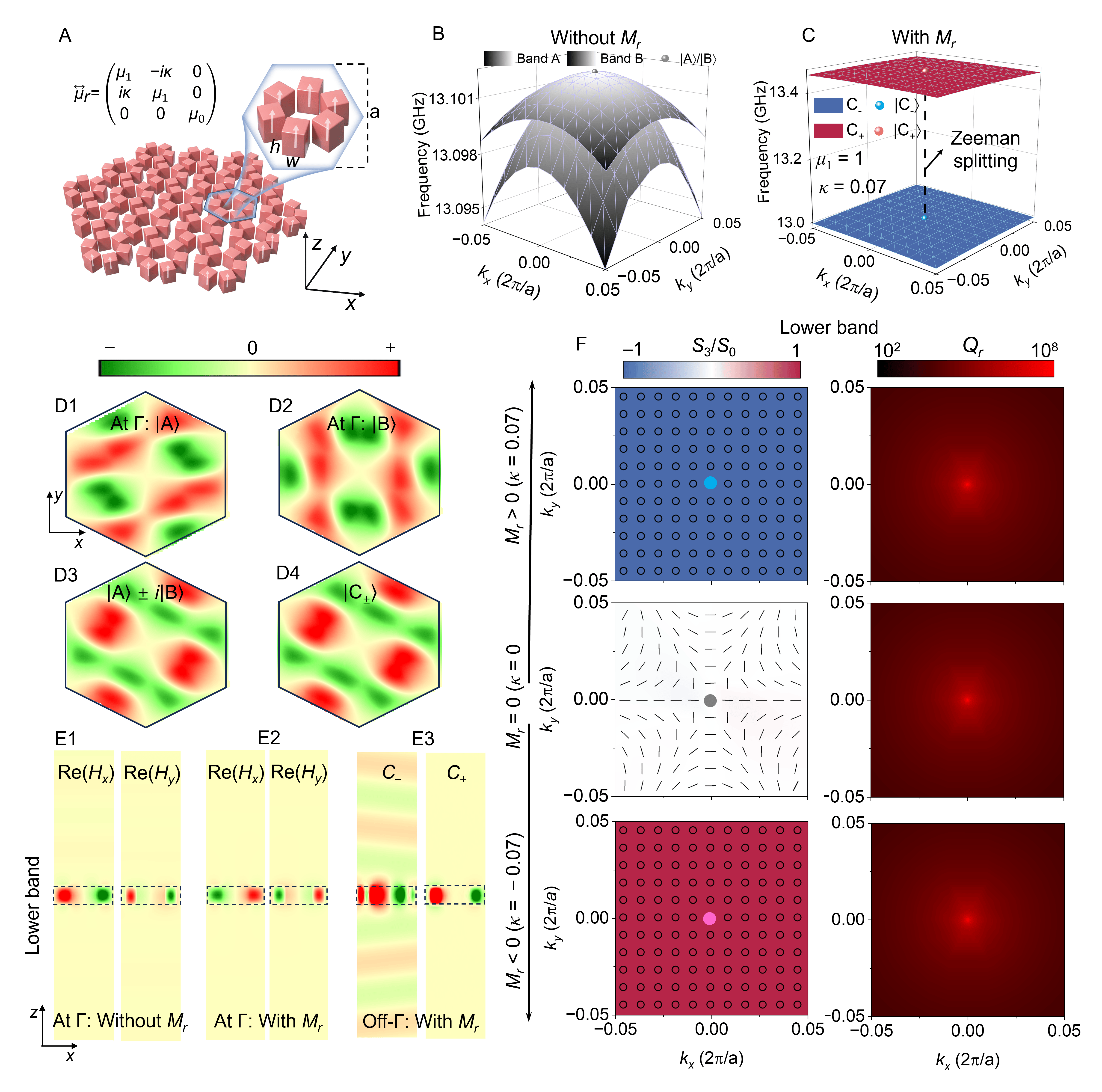
Fig 2. Numerical simulation of the chiral BICs in self-biased MO PhCs. (A) Geometrical parameters and permeability of the self-biased MO PhC. The inset shows the unit cell, with the white arrows indicating the direction of remnant magnetization Mr. (B) Simulated band structure for Mr = 0, where two eigenmodes degenerate at the Γ point (grey dot). (C) Simulated band structure for Mr ≠ 0, the two degenerate eigenmodes at the Γ point split into a pair of chiral BICs (red and blue dots). (D) Eigenmode profiles of the two degenerate modes |A⟩ (D1) and |B⟩ (D2) at the Γ point under Mr = 0. The superposed field distribution |A⟩ ± i|B⟩ in (D3) corresponds to the chiral eigenmode profiles |C±⟩ obtained for Mr > 0 in (D4). (E1-E2) Side views of the magnetic field distributions (Hx and Hy) for the BIC eigenmodes at the Γ points of the lower band under Mr = 0 (E1) and Mr > 0 (E2). (E3) Side views of the circularly polarized components (C±) of the leaky modes at the off-Γ point, exhibiting chiral selectivity under Mr > 0. (F) The first column shows the far-field polarization distributions near the Γ point of the lower band under Mr = 0 (middle row), Mr > 0 (top row), and Mr < 0 (bottom row), respectively. The background color denotes the normalized third Stokes parameter (S3/S0), characterizing the ellipticity and chirality of the modes. The second column presents the Qr factor, showing divergent values at the Γ point for both degenerate (middle panel) and chiral BICs (upper and lower panels).
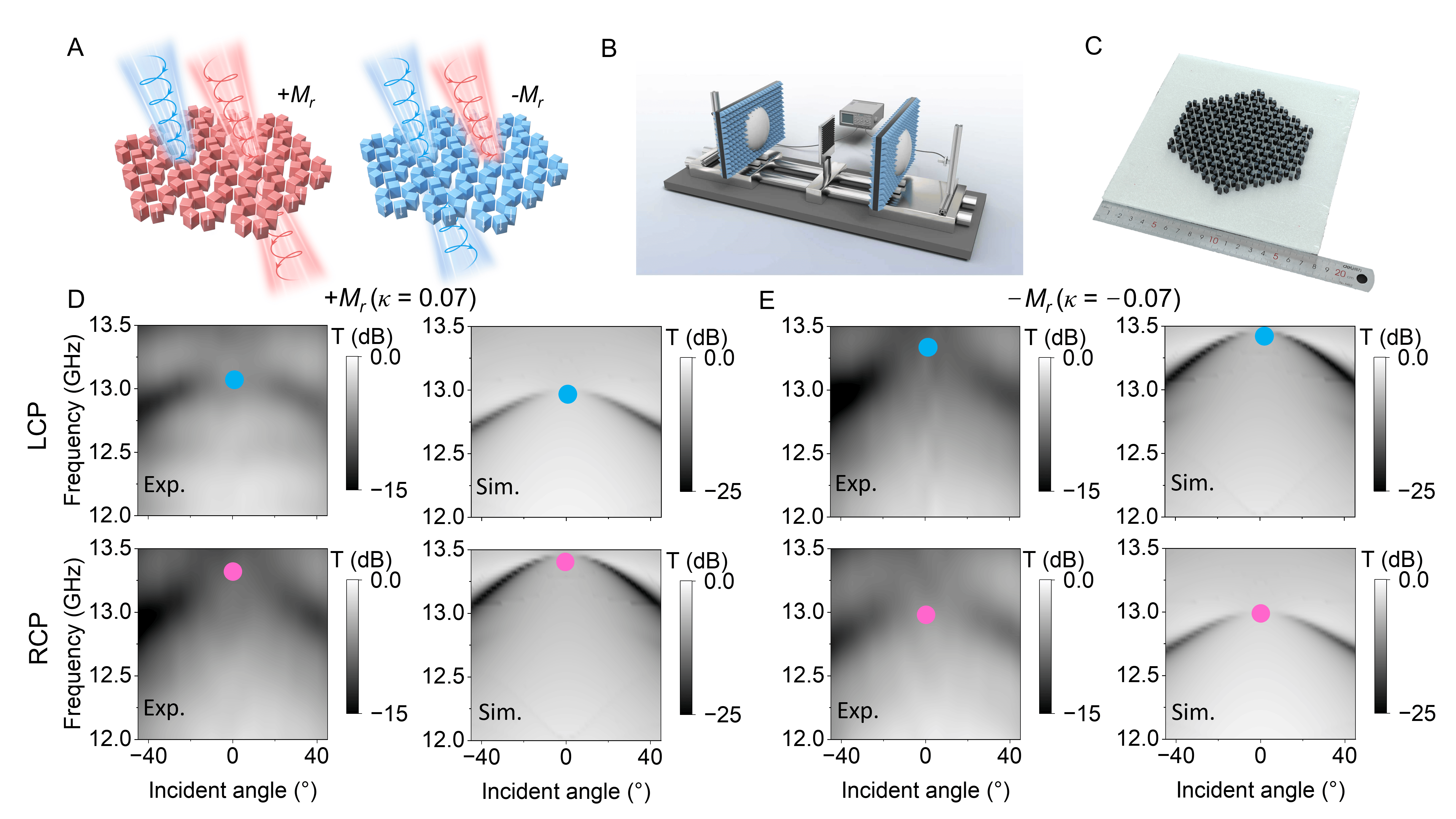
Fig 3. Experimental demonstration of chiral BICs in self-biased MO PhCs. (A) Schematic of the MO PhC with Mr > 0 (left panel) and Mr < 0 (right panel) under oblique LCP and RCP excitations. (B) Schematic of the experimental setup, which consists of a vector network analyzer, an experimental sample, and a pair of circularly polarized lens antennas. (C) Photograph of the fabricated self-biased MO PhC sample. (D) Measured (left column) and simulated (right column) transmission spectra for Mr > 0 under oblique LCP (upper panel) and RCP (lower panel) incidences. Red and blue dots at the Γ point indicate the chiral BICs at the upper and lower bands, respectively. (E) Measured (left column) and simulated (right column) transmission spectra under oblique LCP (upper panel) and RCP (lower panel) incidences for Mr < 0, exhibiting reversed chiral selectivity.
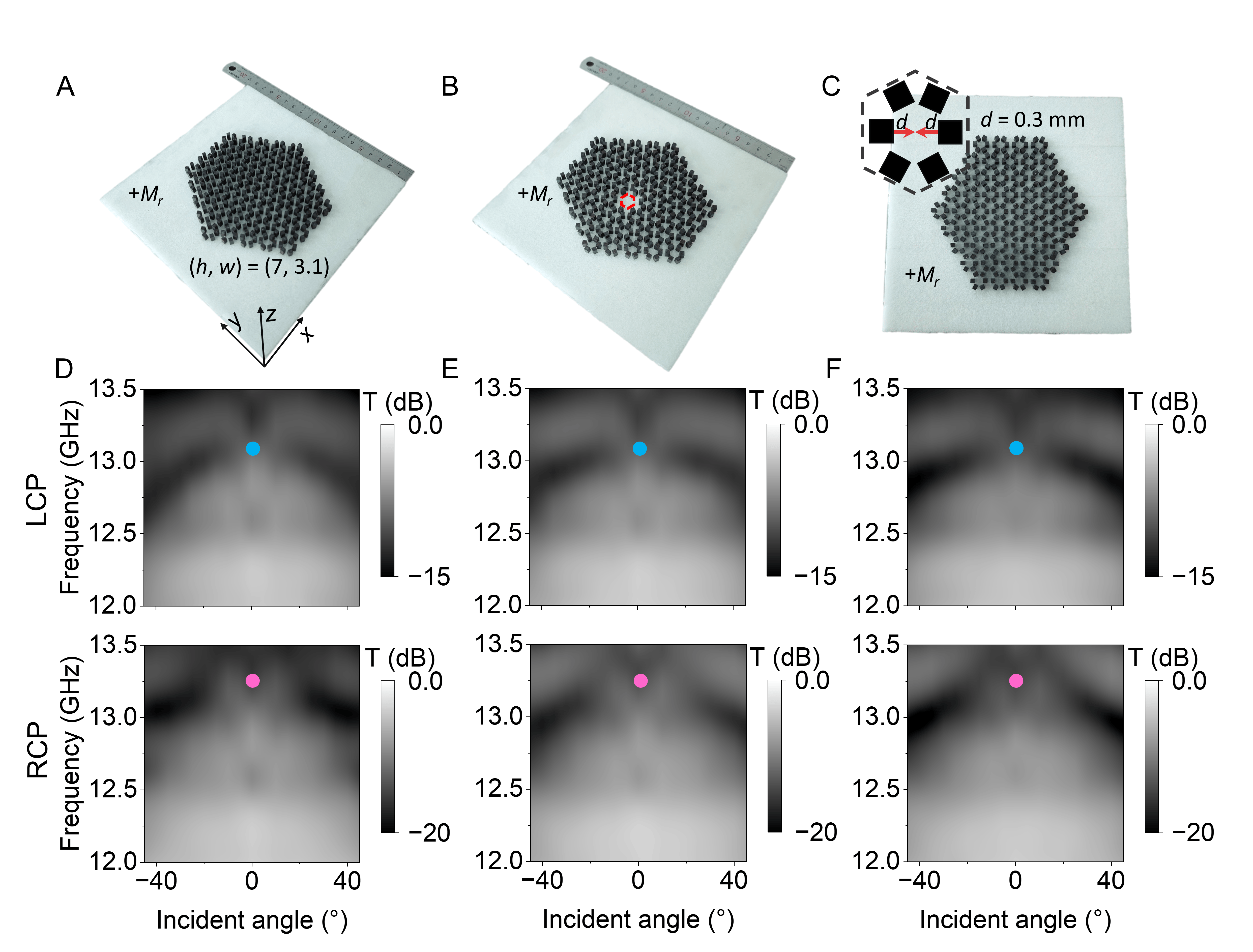
Fig 4. Robustness of the chiral BICs. (A-C) Schematics of the MO PhC samples with different imperfections: (a) fabrication deviations with (h’,w’) = (h+1 mm, w-0.3 mm); (B) a defect induced by removing an entire unit cell (highlighted by the red dashed frame); (C) a perturbation that breaks the C6v symmetry with a relative displacement d along the x direction (indicated by red arrows in the inset). (D-F) Measured transmission spectra as a function of incident angle under LCP incidences (upper panels, blue dots) and RCP (lower panels, red dots), corresponding to the structures in (A)-(C), respectively.
This study experimentally realizes, for the first time, magnetically induced chiral BICs in self-biased magneto-optical photonic crystals. It reveals the splitting mechanism of degenerate BICs into modes with opposite handedness under time-reversal symmetry breaking, and validates the existence of chiral bands, reversible control of chirality, and good robustness against structural imperfections. The findings provide important experimental evidence for understanding new physical mechanisms in non-Hermitian and chiral light-field control, and hold significant implications for the development of circularly polarized lasers, chiral sensing, non-reciprocal photonic devices, and topological photonics. Extending this mechanism from the microwave regime to the terahertz and optical bands could open up new technological pathways toward high-performance, tunable, and robust chiral photonic devices, and further advance the development of integrated photonics and quantum information technologies.
Dr. Maohua GONG, a postdoctoral fellow at SUSTech, is the first author of the paper, and Dr. Qiutong ZHEN from UESTC is the co-first author. Professors Peiheng ZHOU of UESTC, Zhen GAO and Dr. Yan MENG of SUSTech are the co-corresponding authors. Additionally, Associate Professor Peng HU from Chongqing University of Technology, Dr. Yujie TANG from UESTC, and Dr. Qingan TU from SUSTech made significant contributions to this work. SUSTech is the first affiliated institution.
Paper Link: https://www.pnas.org/doi/10.1073/pnas.2536341123
Proofread ByNoah Crockett, Junxi KE
Photo By