Associate Professor Chengzhi HU’s team from the Department of Mechanical and Energy Engineering at the Southern University of Science and Technology (SUSTech) proposed a Wireless Electromagnetic Tracking System (WEMTS) for hardware-constrained medical devices such as capsule robots. The related research, titled “Wireless Electromagnetic Tracking Using Ultra-Low Frequency Fields for Hardware-constrained Medical Devices,” was published in IEEE/ASME Transactions on Mechatronics.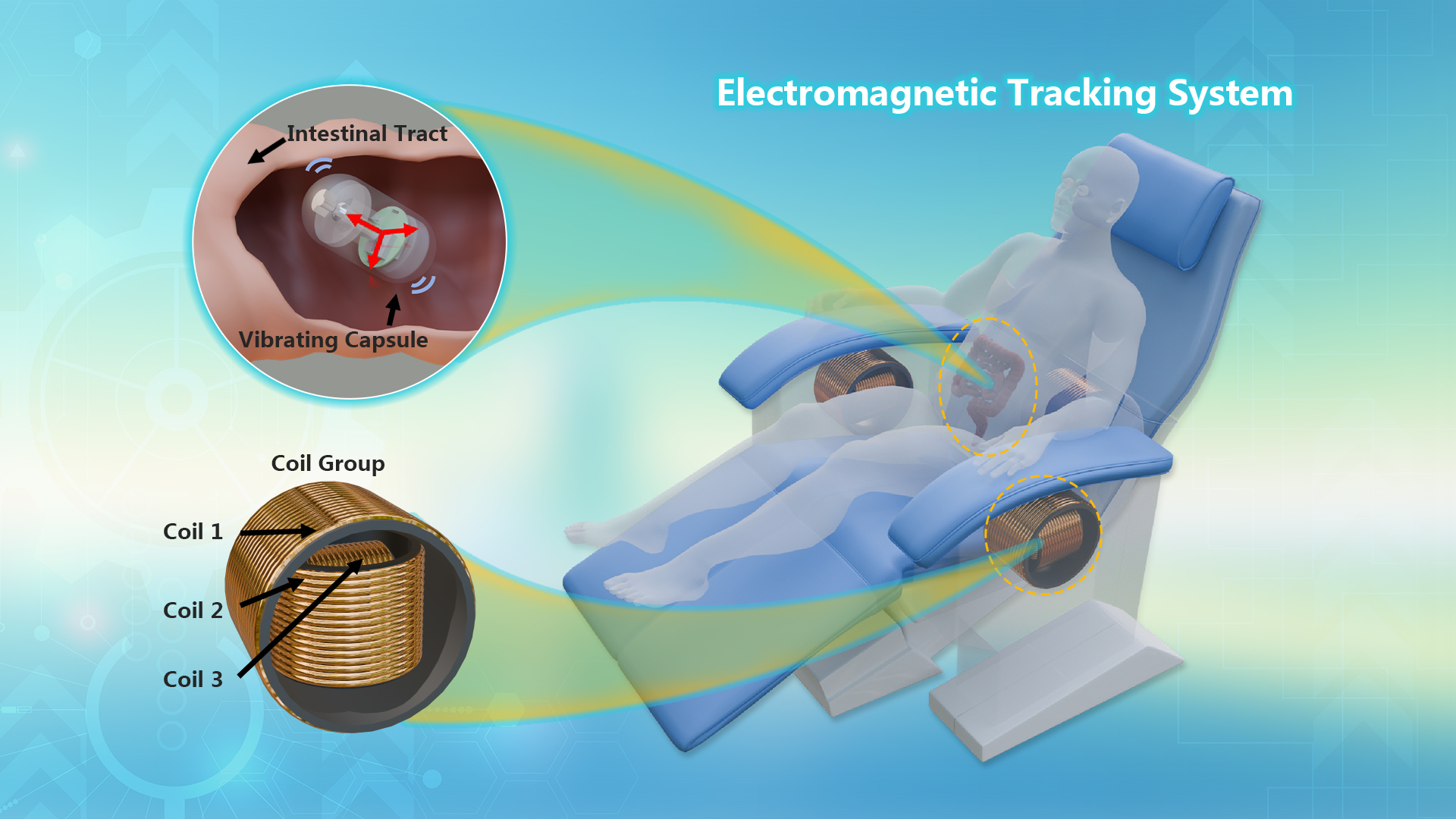
Fig 1. Design and working principle of the ultra-low-frequency wireless electromagnetic tracking system
Miniaturized medical devices, including capsule endoscopes, implantable sensors, and continuum robots, have shown great potential in gastrointestinal examination, targeted drug delivery, biopsy sampling, and interventional therapy due to their capability for non-invasive or minimally invasive in vivo operation. These devices are typically constrained by limited internal space and wireless communication bandwidth. Achieving stable and accurate in vivo position and orientation tracking without significantly increasing device size or power consumption remains a key challenge in this field.
The research team developed a wireless electromagnetic tracking system based on ultra-low-frequency magnetic fields. Unlike conventional electromagnetic localization methods that operate at relatively higher frequencies, the proposed system works within an ultra-low-frequency range of 2 Hz to 10 Hz. This design reduces the requirements for sampling rate, communication bandwidth, and signal processing capability, making it more suitable for integration into small, low-power medical devices such as capsule robots. Meanwhile, ultra-low-frequency magnetic fields can also help reduce interference from eddy currents and other environmental factors, providing a new technical pathway for stable tracking in complex in vivo environments.
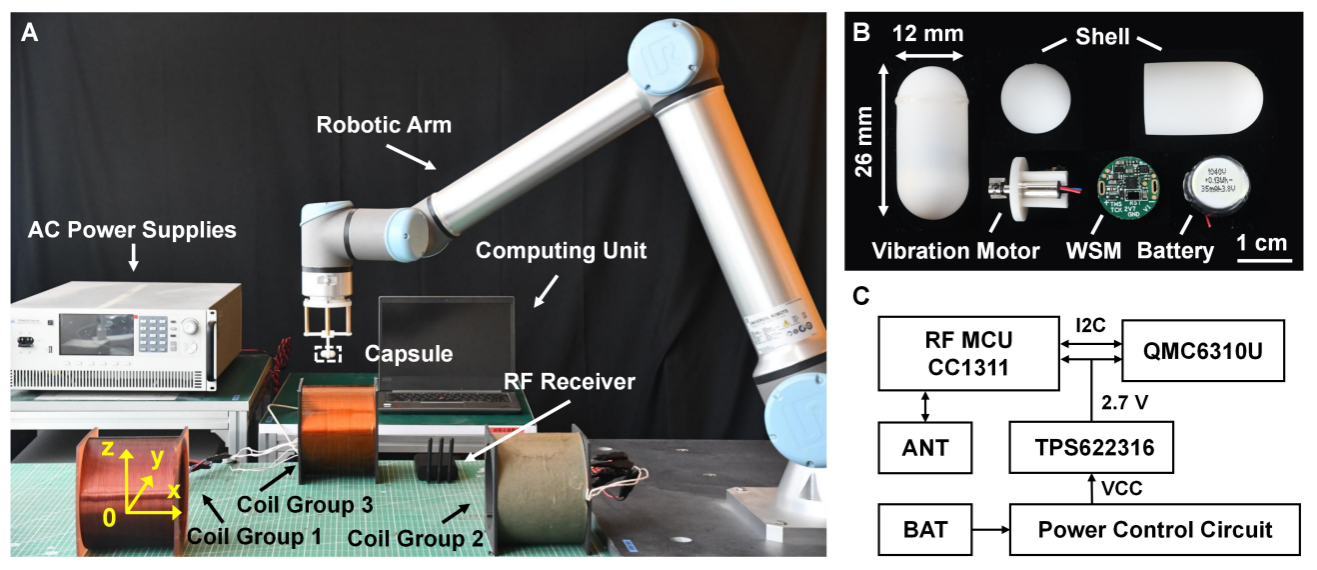
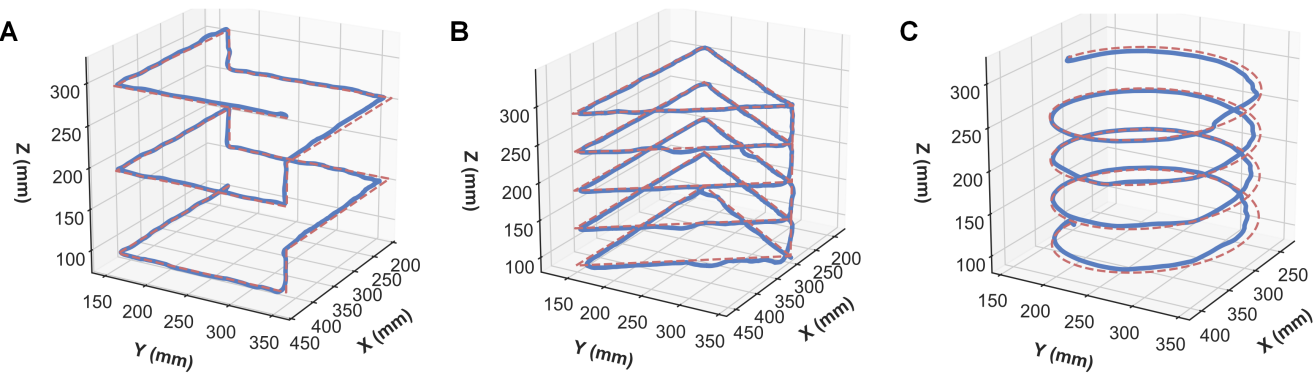
Fig 2. WEMTS hardware platform and trajectory tracking results
The system mainly consists of three external groups of orthogonal electromagnetic coils and a wireless sensing module embedded inside the capsule. The external coils generate controllable spatial magnetic fields, while the capsule integrates a three-axis magnetic sensor and an RF transmission module to collect and transmit magnetic field information in real time. The system then uses digital lock-in amplification to extract the amplitudes of magnetic signals at different frequencies. Combined with a magnetic field model, a multilateration algorithm, and a sequential pose estimation method, the system achieves six-degrees-of-freedom estimation of the capsule’s position and orientation.
Experimental results show that, within a workspace of 400 mm × 200 mm × 300 mm, WEMTS achieved a static positioning accuracy of 3.09 ± 0.99 mm and a static orientation estimation accuracy of 2.21 ± 0.62°. In dynamic tracking experiments, the system achieved a position error of 3.23 ± 1.05 mm and an orientation error of 2.67 ± 0.89° at a motion speed of 5 mm/s, demonstrating its stable tracking capability in continuous motion scenarios.
This study provides a low-frequency, low-power, and high-accuracy solution for wireless localization of hardware-constrained medical devices. In the future, this technology is expected to further support capsule endoscopy, active capsule robots, implantable medical devices, and in vivo microrobots, providing technical support for precise navigation, closed-loop control, and functional integration of in vivo diagnostic and therapeutic devices.
The first author of the paper is Ding HUANG, a Master’s student in the Department of Mechanical and Energy Engineering, and the co-first author is Yi ZHANG, a doctoral student in the Department of Mechanical and Energy Engineering. The corresponding authors are Professor Chaoyang SHI from Tianjin University and Associate Professor Chengzhi HU from SUSTech. SUSTech is the first affiliated institution.
Paper Link: https://doi.org/10.1109/TMECH.2026.3694425
Proofread ByNoah Crockett, Junxi KE
Photo ByYan QIU